



An Optimization Method for Metro Passenger Flow Control by Tracing Congestion Sources
-
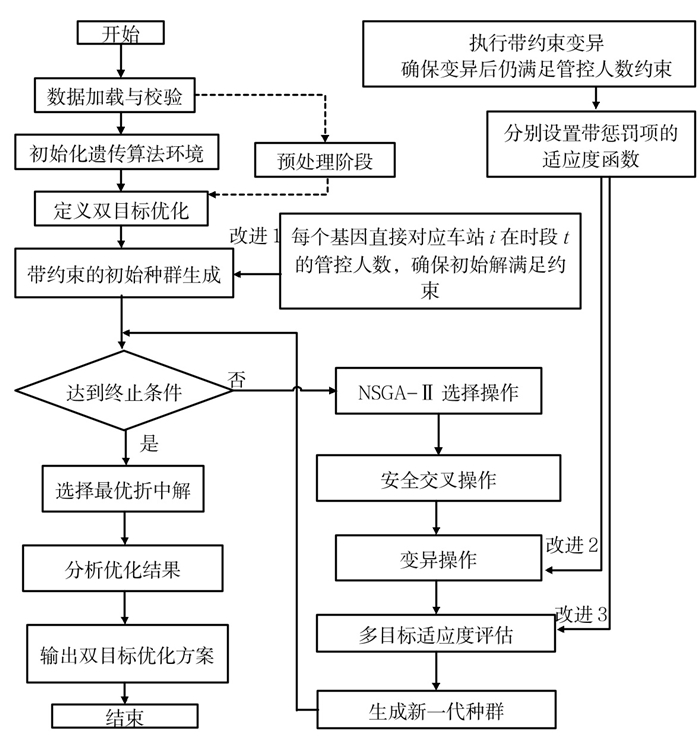
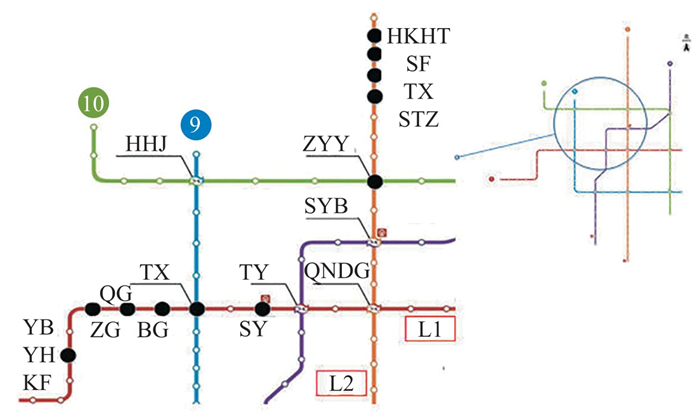
摘要: 现有单站管控措施难以从源头疏解线网级拥堵,导致管控效果受限,为解决高峰时段地铁线网因客流拥堵引发的车站滞留及安全隐患问题,研究了基于拥堵客流溯源的多站协同客流管控方法。该方法通过三重维度精准定位客流拥堵的源头车站:①筛选持续高进站客流量的站点,从源头减少流入线网的客流压力;②锁定换乘过程中出现明显拥堵的站点,通过客流溯源确定主要源头车站;③对瓶颈区间的客流进行溯源,追踪拥堵客流的初始源头车站,通过构建多维度客流溯源模型确定客流管控车站,实现从源头到换乘环节的全链条管控。基于上述管控逻辑,构建以乘客进站滞留人数、平均满载率和最大站台聚集人数最小为目标的多站协同客流管控优化模型,模型通过进站量动态调节实现源头控流与换乘疏解联动,并将区间通过能力、站台容量、满载率等作为约束条件。为求解该模型,设计改进的非支配排序遗传算法(non-dominated sorting genetic algorithm Ⅱ,NSGA-Ⅱ),通过约束感知的遗传算子设计、多目标适应度与约束惩罚融合及问题适配的种群初始化约束,提升算法的求解精度与效率。为验证模型有效性,对某城市地铁线网的5条线路共111个车站进行案例研究,结果表明:实施客流管控后,1号线与2号线的满载率标准差分别降低了1.50%和2.69%,线网客流分布更趋均匀;高风险时空单元数量减少了5.88%,关键换乘站点站台滞留人数降低了31.4%,极端聚集风险同步得到有效抑制,客流瓶颈区间的满载率峰值降低了4.6%~6.9%,区间拥堵压力得到缓解。该方法可降低高峰时段关键车站拥堵风险,提升地铁线网整体运行效率。Abstract: Single-station control measures cannot alleviate network-level congestion from the source. This study investigates a multi-station collaborative control method to address peak-hour congestion and safety hazards through tracing passenger flow sources in metro networks. This method identifies source stations of congestion through three dimensions. First, the stations with persistently high inbound volumes are selected to reduce the pressure entering the network. Second, the stations with significant transfer congestion are located, and their main source stations are determined via tracing passenger flow. Third, the bottleneck sections are traced to identify the initial source stations. A multi-dimensional source tracing model is constructed to determine which stations are require to control. Based on this logic, an optimization model is developed. This model minimizes three objectives: the number of stranded passengers, the average load factor, and the maximum platform occupancy. It links source control with transfer relief through dynamic adjustment of inbound volumes. The constraint conditions include interval capacity, platform capacity, and load factor. An improved non-dominated sorting genetic algorithm (NSGA-Ⅱ) is designed to solve the model. The algorithm incorporates constraint-aware genetic operators, a fusion of multi-objective fitness with constraint penalties, and problem-specific population initialization to enhance solution accuracy and efficiency. A case study is conducted on 111 stations across five lines of an urban metro network. After implementing the pro-posed control, the standard deviation of load factors decreases by 1.50% on Line 1 and by 2.69% on Line 2. This indicates a more balanced network passenger distribution. The number of high-risk spatiotemporal units decreases by 5.88%. The stranded passengers at key transfer stations decrease by 31.4%, effectively suppressing extreme crowding risks. The peak load factors in bottleneck sections decline by 4.6% to 6.9%, alleviating the congestion in these intervals. This method reduces the congestion risks at key stations during peak hours. It also improves the overall operational efficiency of metro networks.
-

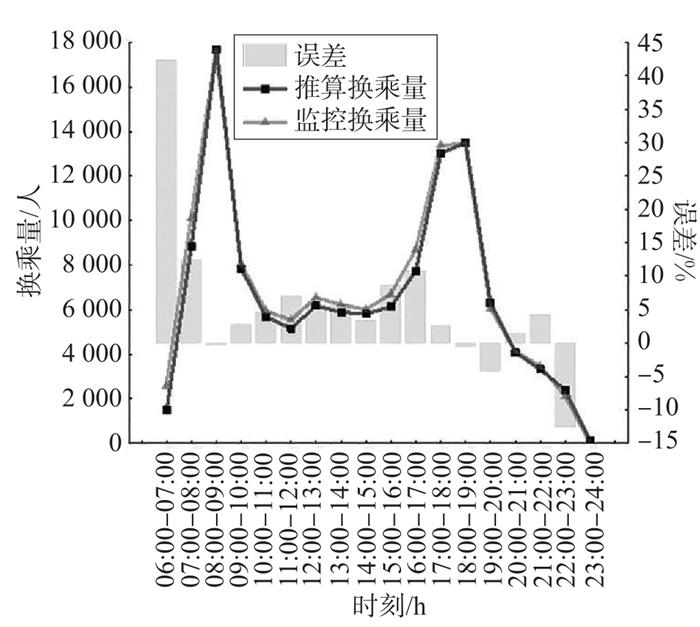
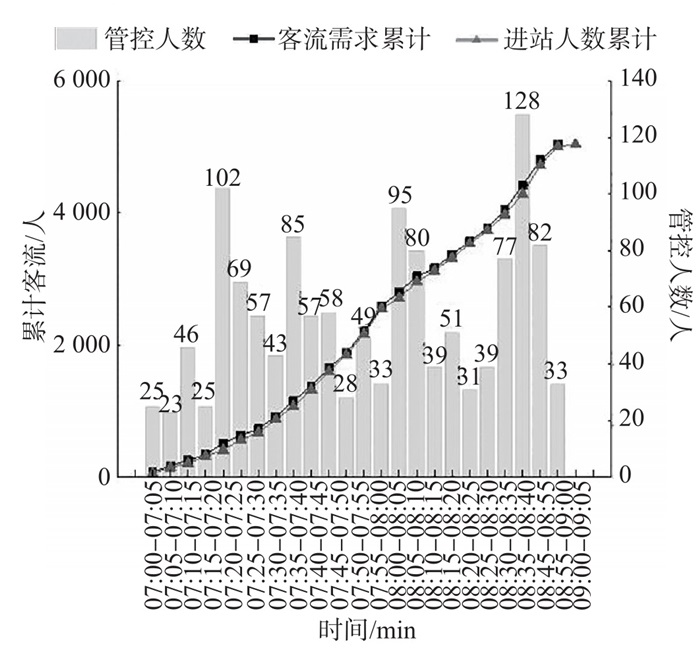
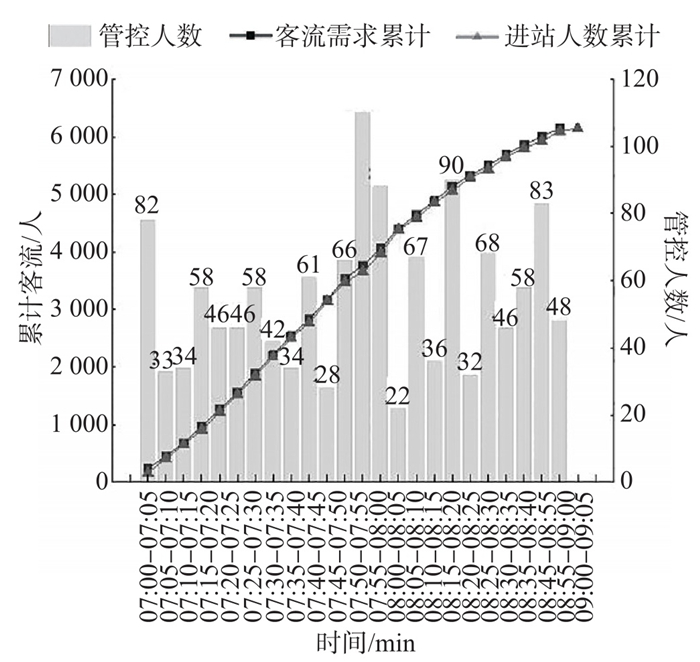
图 2 QNDJ站推算和监控换乘量对比
Figure 2. Comparison of transfer volume calculated and monitored at QNDJ Station

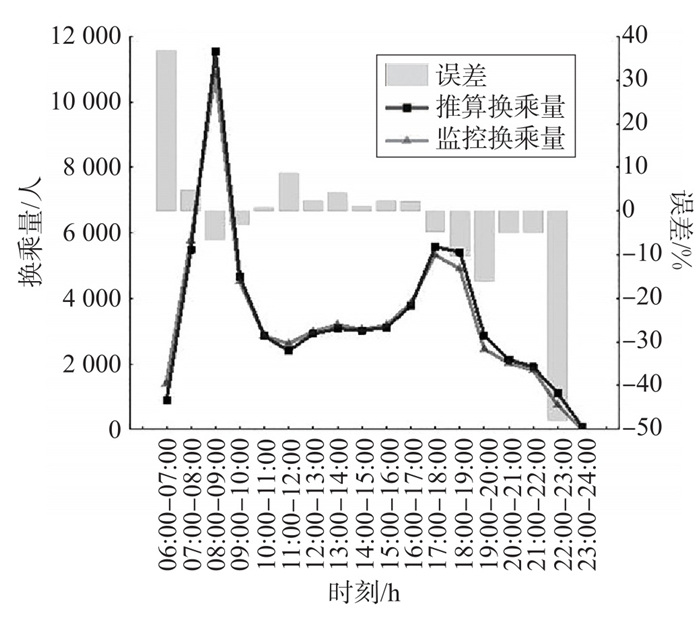
图 3 QNDJ站L1换L2推算和监控换乘量对比
Figure 3. Comparison of transfer volume calculation and monitoring for L1 to L2 at QNDJ Station

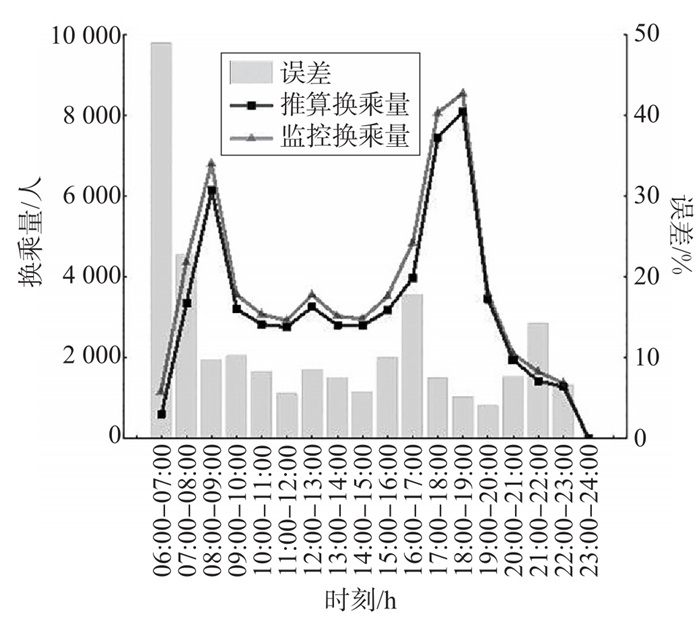
图 4 QNDJ站L2换L1推算和监控换乘量对比
Figure 4. Comparison of transfer volume calculation and monitoring for L2 to L1 at QNDJ Station

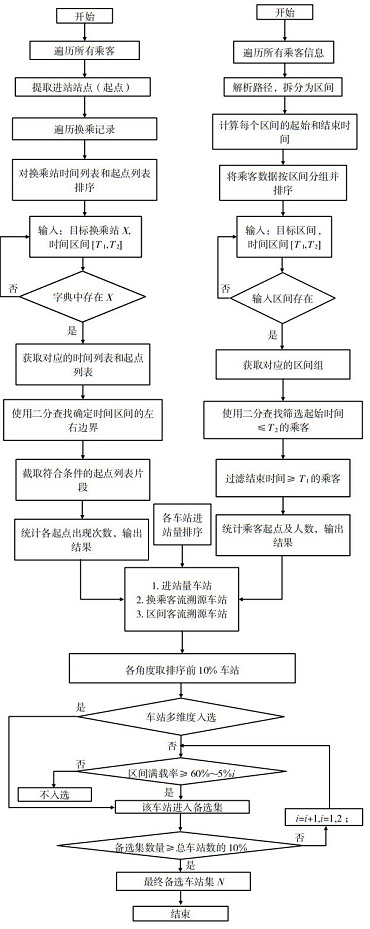
图 5 协同管控备选车站确定流程
Figure 5. Determination process of alternative stations for collaborative control
表 1 参数及变量
Table 1. Parameters and variables
参数及变量 含义 单位 rs, t 车站s在时段t的进站限流人数 人 Ms, t 车站s在时段t的初始进站人数 人 Ds, t 车站s在时段t的进站滞留人数 人 Ls, t 车站s在时段t的站台人数 人 Gs, t 车站s在时段t的站台滞留人数 人 ls, t 车站s在时段t的上车人数 人 gs, t 车站s在时段t的在车人数 人 fs, t 车站s在时段t的到站在车人数 人 ρs, t 列车在车站s与车站s+1区间在时段t的满载率 % S 备选管控车站集 n 限流车站数量 个 m 车站总数量 个 c 列车额定载客量 人 ρmax 列车最大满载率 % βmax 限流率上限 % Csmax 车站s安全容量 人 s 车站编号s依次为1~m t 时间段t依次为1~24  下载: 导出CSV
表 2 参数设置
Table 2. Parameter settings
参数 取值 车站总数/个 111 管控车站数/个 11 时段数/个 24 列车容量/人 1 440 μ/% 60 λ/% 10 θ/% 90 种群大小/个 100 交叉概率 0.7 变异概率 0.3 迭代次数/次 100
下载: 导出CSV
表 3 进站量降序车站集合
Table 3. Gather at the stations in descending order of the number of arrivals
起点站 进站人数 HKHT 6 125 SF 5 936 YX 5 404 STZ 5 395 SY 5 006 LM 4 968 PH 4 895 BG 4 826 DTH 4 747 ZG 4 733 TX 4 622 YP 4 494 YH 4 015
下载: 导出CSV
表 4 换乘站客流溯源车站集合
Table 4. Gather at the transfer station for passenger flow tracing
起点站 进站的换乘人数 HKHT 4 687 SF 4 634 DTH 4 391 JLH 4 182 YX 4 051 PH 4 050 DXH 4 020 LM 3 879 BG 3 849 ZG 3 823 STZ 3 767 SY 3 483 TX 3 302
下载: 导出CSV
表 5 瓶颈区间溯源车站集合
Table 5. Gather at the source tracing station of the bottleneck section
起点站 瓶颈客流人数 HKHT 5 066 SF 4 820 STZ 4 632 YX 4 532 PH 4 075 BG 3 776 SY 3 592 ZG 3 539 TX 3 129 QG 3 073 LN 3 060 YH 2 678 ZYY 2 038
下载: 导出CSV
表 6 满载率标准差优化前后对比
Table 6. Comparison of standard deviation of full load rate before and after optimization
线路 优化前 优化后 变化率/% L1 0.266 0.262 1.50 L2 0.260 0.253 2.69
下载: 导出CSV
表 7 风险时空单元数量优化前后对比
Table 7. Comparison of the number of risk spatiotemporal units before and after optimization
区间满载率/% 风险等级 风险时空单元数量 优化前/个 优化后/个 变化率/% > 90 高风险区间 17 16 5.88 > 80~90 一般风险区间 45 40 11.11 > 60~80 低风险区间 245 237 3.27 ≤60 无风险 2357 2371 -0.59
下载: 导出CSV
表 8 SY站至TY站区间满载率优化前后对比
Table 8. Comparison of the full load rate between SY railway station and TY station before and after optimization
时间/min SY站-TY站区间满载率/% 变化率 优化前 优化后 07:45—07:50 90.27 87.28 3.32 07:50—07:55 100.89 99.04 1.85 07:55—08:00 85.21 84.55 0.75 08:00—08:05 96.44 94.56 1.94 08:05—08:10 101.23 98.43 1.78 08:10—08:15 80.23 77.15 3.84 08:15—08:20 85.68 79.91 6.77 08:20—08:25 88.49 84.4 4.63
下载: 导出CSV
表 9 站台滞留人数变化
Table 9. Changes in the number of stranded people
风险车站 指标 站台滞留人数/人 变化率/% 优化前 优化后 SY站 总滞留人数 455 312 31.4 最大站台聚集人数 98 72 27.6 QNDJ站 总滞留人数 524 425 18.9 最大站台聚集人数 112 88 21.4 TY站 总滞留人数 327 304 7.1 最大站台聚集人数 75 72 4.0
下载: 导出CSV
-
[1] 杨振珑, 黄文成, 法慧妍, 等. 基于Kolmogorov熵权的城市轨道交通网络节点重要度识别算法[J]. 交通运输工程与信息学报, 2024, 22(1): 139-149.YANG Z L, HUANG W C, FA H Y, et al. Node importance recognition algorithm for urban rail transit networks based on Kolmogorov entropy weight[J]. Journal of Transportation Engineering and Information, 2024, 22(1): 139-149. (in Chinese) [2] 陈锦渠, 吴雨遥, 殷勇, 等. 城市轨道交通站点可达性研究[J]. 交通运输工程与信息学报, 2020, 18(4): 38-45.CHEN J Q, WU Y Y, YIN Y, et al. Analysis of urban rail transit station's accessibility[J]. Journal of Transportation Engineering and Information, 2020, 18(4): 38-45. (in Chinese) [3] 肖霁川, 邢颖. 基于熵权TOPSIS模型的地铁车站运营脆弱性评价方法[J]. 交通运输工程与信息学报, 2020, 18(2): 163-169.XIAO J C, XING Y. Vulnerability evaluation method for metro station operation based on entropy weight TOPSIS model[J]. Journal of Transportation Engineering and Information, 2020, 18(2): 163-169. (in Chinese) [4] 陈春娇. 基于智慧地铁的车站客流压力分级管控策略[J]. 城市轨道交通研究, 2021, 24(1): 52-55.CHEN C J. Research on station passenger flow pressure classification management and control strategy based on smart metro[J]. Urban Mass Transit, 2021, 24(1): 52-55. (in Chinese) [5] WANG Y G, QIN Y, GUO J Y, et al. Multiposition joint control in transfer station considering the nonlinear characteristics of passenger flow[J]. Journal of Transportation Engineering, Part A: Systems, 2021, 147(10): 04021068. doi: 10.1061/JTEPBS.0000564 [6] 申梦君, 董宁宁, 李铁柱, 等. 基于遗传算法的高峰时段车站协同限流方法[J]. 交通信息与安全, 2024, 42(1): 131-141. doi: 10.3963/j.jssn.1674-4861.2024.01.015SHEN M J, DONG N N, LI T Z, et al. A method for coordinated passenger flow control at stations during peak period based on genetic algorithms[J]. Journal of Transport Information and Safety, 2024, 42(1): 131-141. (in Chinese) doi: 10.3963/j.jssn.1674-4861.2024.01.015 [7] 石俊刚, 杨静, 杨立兴. 以安全为导向的地铁高峰时段多车站客流协同控制模型[J]. 交通运输系统工程与信息, 2019, 19 (1): 125-131.SHI J G, YANG J, YANG L X. Safety-oriented cooperative passenger flow control model in peak hours for a metro line[J]. Journal of Transportation Systems Engineering and Information Technology, 2019, 19(1): 125-131. (in Chinese) [8] 陈治亚, 甘金荣, 王小军. 考虑安全的城市轨道交通三级客流控制模型[J]. 中南大学学报(自然科学版), 2020, 51(5): 1441-1450.CHEN Z Y, GAN J R, WANG X J. Three-level passenger flow control model for urban rail transit in consideration of safety[J]. Journal of Central South University (Science and Technology), 2020, 51(5): 1441-1450. (in Chinese) [9] MENG F, YANG L J, SHI J C, et al. Collaborative passenger flow control for oversaturated metro lines: a stochastic optimization method[J]. Transportmetrica A: Transport Science, 2022, 18(3): 619-658. doi: 10.1080/23249935.2021.1886195 [10] YUAN F, SUN H, KANG L J, et al. Passenger flow control strategies for urban rail transit networks[J]. Applied Mathematical Modelling, 2020, 82: 168-188. doi: 10.1016/j.apm.2020.01.041 [11] HUAN N, HESS S H, YAO E J. Understanding the effects of travel demand management on metro commuters' behavioural loyalty: a hybrid choice modelling approach[J]. Transportation, 2022, 49(2): 343-372. doi: 10.1007/s11116-021-10179-3 [12] HU H X, LI J T, WU S. Simulation evaluation of a current limiting scheme in an urban rail transit network[J]. Sustainability, 2022, 15(1): 375. doi: 10.3390/su15010375 [13] LIANG J P, ZANG G Z, LIU H T, et al. Reducing passenger waiting time in oversaturated metro lines with passenger flow control policy[J]. Omega-International Journal of Management Science, 2023, 117: 102845. [14] 韩庆龙, 姚向明, 刘楠. 城市轨道交通线网客流管控系统设计及实现[J]. 铁路计算机应用, 2024, 33(5): 80-83.HAN Q L, YAO X M, LIU N. Passenger flow management control system for urban rail transit network[J]. Railway Computer Application, 2024, 33(5): 80-83. (in Chinese) [15] 刘建委, 张少文, 陈朝晖, 等. 城市轨道交通场景化运营管控研究[J]. 现代城市轨道交通, 2023(10): 92-96.LIU J W, ZHANG S W, CHEN Z H, et al. Study on scenario-based operation control of urban rail transit[J]. Modern Urban Transit, 2023(10): 92-96. (in Chinese) [16] 皮雁南, 郭建媛, 马骁, 等. 城市轨道交通换乘车站多方式客流控制模型[J]. 都市快轨交通, 2020, 33(3): 72-76, 84.PI Y N, GUO J Y, MA X, et al. Multi-mode passenger flow control model for urban rail transit transfer station[J]. Urban Rapid Rail Transit, 2020, 33(3): 72-76, 84. (in Chinese) [17] 杨陶源, 赵鹏, 姚向明, 等. 轨道交通延误条件下列车跳站与客流控制协同优化模型[J]. 交通运输系统工程与信息, 2021, 21(2): 105-110, 132.YANG T Y, ZHAO P, YAO X M, et al. Coordinated optimization model of rail transit delayed train stop-skip pattern and passenger flow control[J]. Journal of Transportation Systems Engineering and Information Technology, 2021, 21(2): 105-110, 132. (in Chinese) [18] 肖中圣, 许奇, 冯旭杰, 等. 基于可控性的城市轨道交通客流控制车站识别方法[J]. 交通运输系统工程与信息, 2021, 21 (3): 150-155, 162.XIAO Z S, XU Q, FENG X J, et al. Urban rail transit passenger volume control station identification method based on exact controllability[J]. Journal of Transportation Systems Engineering and Information Technology, 2021, 21(3): 150-155, 162. (in Chinese) [19] 鲁工圆, 雷元争, 张宏翔. 基于多智能体仿真的城市轨道交通限流策略[J]. 同济大学学报(自然科学版), 2022, 50(8): 1189-1197.LU G Y, LEI Y Z, ZHANG H X. Passenger flow control strategy of urban rail transit based on multi-agent simulation[J]. Journal of Tongji University (Natural Science), 2022, 50(8): 1189-1197. (in Chinese) [20] 豆飞, 姚向明, 张文强, 等. 大规模城市轨道交通网常态限流方案编制[J]. 北京工业大学学报, 2019, 45(10): 988-997.DOU F, YAO X M, ZHANG W Q, et al. Regular inflow control plan construction in large urban rail transit networks[J]. Journal of Beijing University of Technology, 2019, 45(10): 988-997. (in Chinese) [21] 茧敏, 王卓, 陈哲轩, 等. 基于时空路径推算的城轨网络客流分配方法[J]. 西南交通大学学报, 2023, 58(5): 1117-1125.JIAN M, WANG Z, CHEN Z X, et al. Passenger flow assignment method for urban rail transit networks based on inference of spatiotemporal path[J]. Journal of Southwest Jiaotong University, 2023, 58(5): 1117-1125. (in Chinese) -

 点击查看大图
计量
- 文章访问数: 40
- HTML全文浏览量: 20
- PDF下载量: 1
- 被引次数: 0