



Ship-Shore Collaborative Remote Control System Architecture for Inland Autonomous Ships
-
摘要: 传统船舶控制系统架构已难以适配船岸协同升级与远程控制功能部署的现实需求,缺乏统一的系统框架将直接制约船岸协同作业效能的有效发挥。为保障船岸协同场景下船舶远程控制协同系统的适配性与一致性,研究适配内河智能船舶的远程驾驶类型与系统架构。通过文献综述与智能船舶相关规范的对比分析,提出内河智能船舶远程驾驶的4种基本控制模式,包括直接执行车舵指令的远程遥控模式、具备远程指令安全性判断功能的远程控制Ⅰ型、可生成自主航行决策并实现人机指令融合的远程控制Ⅱ型,以及完全自主航行场景下的监督式远程控制Ⅲ型;结合各模式对现有规范及内河航行环境的适应性分析,针对性搭建面向内河场景的“船岸云”协同远程驾驶系统架构,厘清船岸云端系统功能划分以及信息流向;针对提出的框架设计船岸协同场景下的6种远程驾驶信息服务类型,同时适配5类远程驾驶人机交互模式,明确岸基与云端数据链路融入船舶控制系统的实现路径;通过多组仿真实验,对比分析不同船岸通信延迟条件下各远程控制模式的控制性能差异。结果表明:在仿真环境下,700~1 000 ms延迟条件下,远程控制Ⅱ型可显著提升船舶远程驾驶对通信延迟的鲁棒性;400~600 ms延迟条件下,远程控制Ⅰ型的控制表现最优;更低延迟条件下,远程遥控模式亦能实现良好的控制效果。该研究提出的控制模式与系统架构为内河智能船舶远程驾驶的工程应用提供了基础框架支撑,其人机交互设计与通信延迟适配建议为船岸协同控制效能优化提供了重要参考。Abstract: The traditional ship control system architecture can hardly meet the practical demands for Ship-Shore Coordination upgrading and Remote Control function deployment, and the lack of a unified framework directly restricts the efficiency of ship-shore collaborative operations. To ensure the adaptability and consistency of the ship remote control system in this scenario, this paper proposes Modes of Remote Navigation and a Remote Control Architecture suitable for inland waterway Autonomous Ships. Based on literature review and comparative analysis of relevant specifications, four basic remote navigation modes are proposed: remote teleoperation (directly executing rudder and propulsion commands), Remote Control Mode Ⅰ (remote command safety judgment), Remote Control Mode Ⅱ (autonomous navigation decision-making and Human-Machine Interaction command fusion), and Supervisory Remote Control Mode Ⅲ (fully autonomous navigation supervision). A'Ship-Shore-Cloud'collaborative architecture for inland waterway scenarios is constructed, clarifying system functional division and information flow. Six remote navigation information services and five human-machine interaction modes are designed, with the implementation path of integrating shore-based/cloud data links into the ship control system defined. Finally, simulation experiments compare control performance under different ship-shore communication delays. Results show that Remote Control Mode Ⅱ enhances robustness in high-delay environments, Mode Ⅰ performs optimally in medium-delay conditions, and remote teleoperation achieves satisfactory effects in low-delay scenarios. The proposed modes and architecture provide core technical support for the engineering application of inland autonomous ship remote navigation, while the interaction design and delay adaptation suggestions offer important references for optimizing ship-shore coordination efficiency.
-

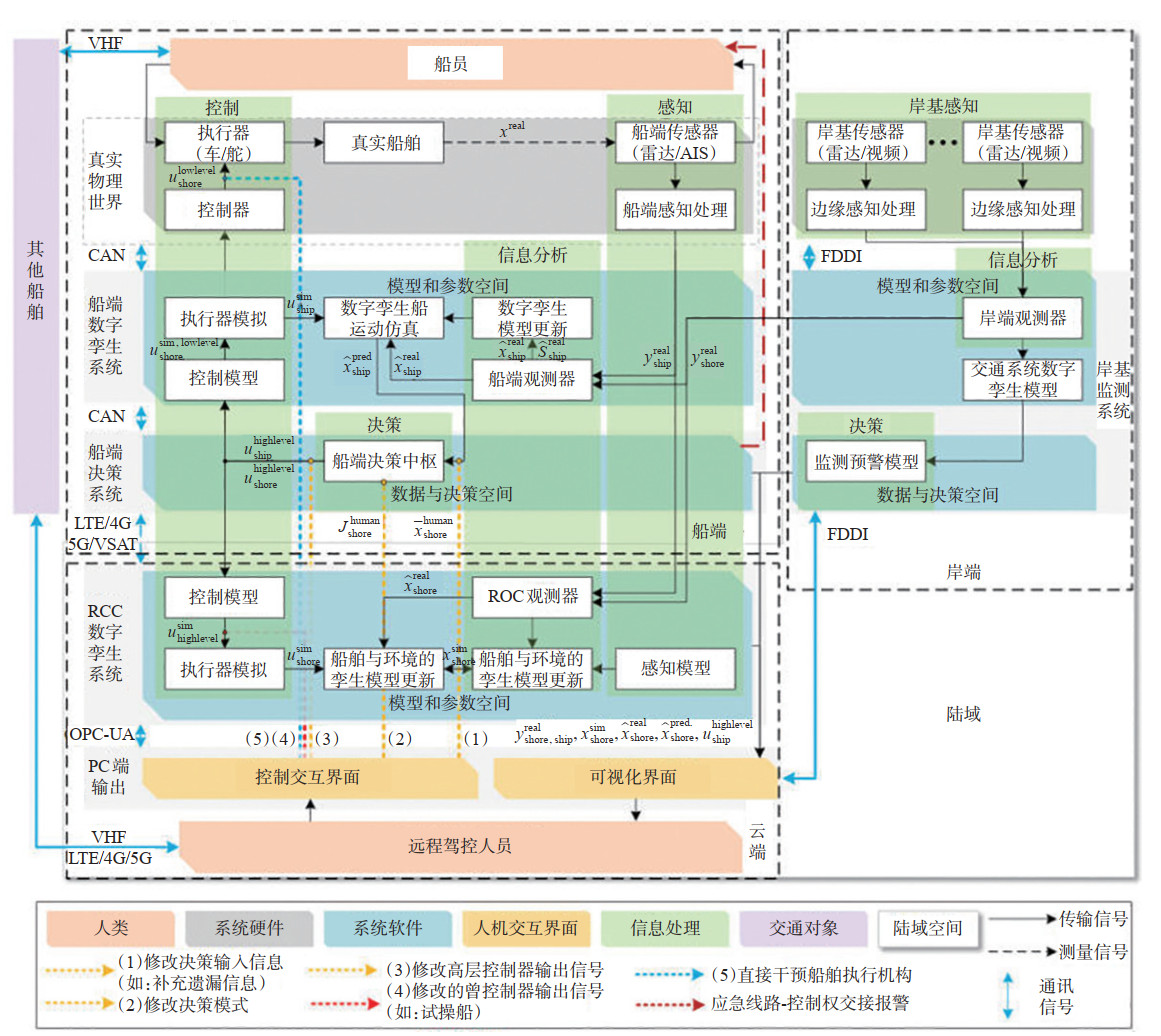
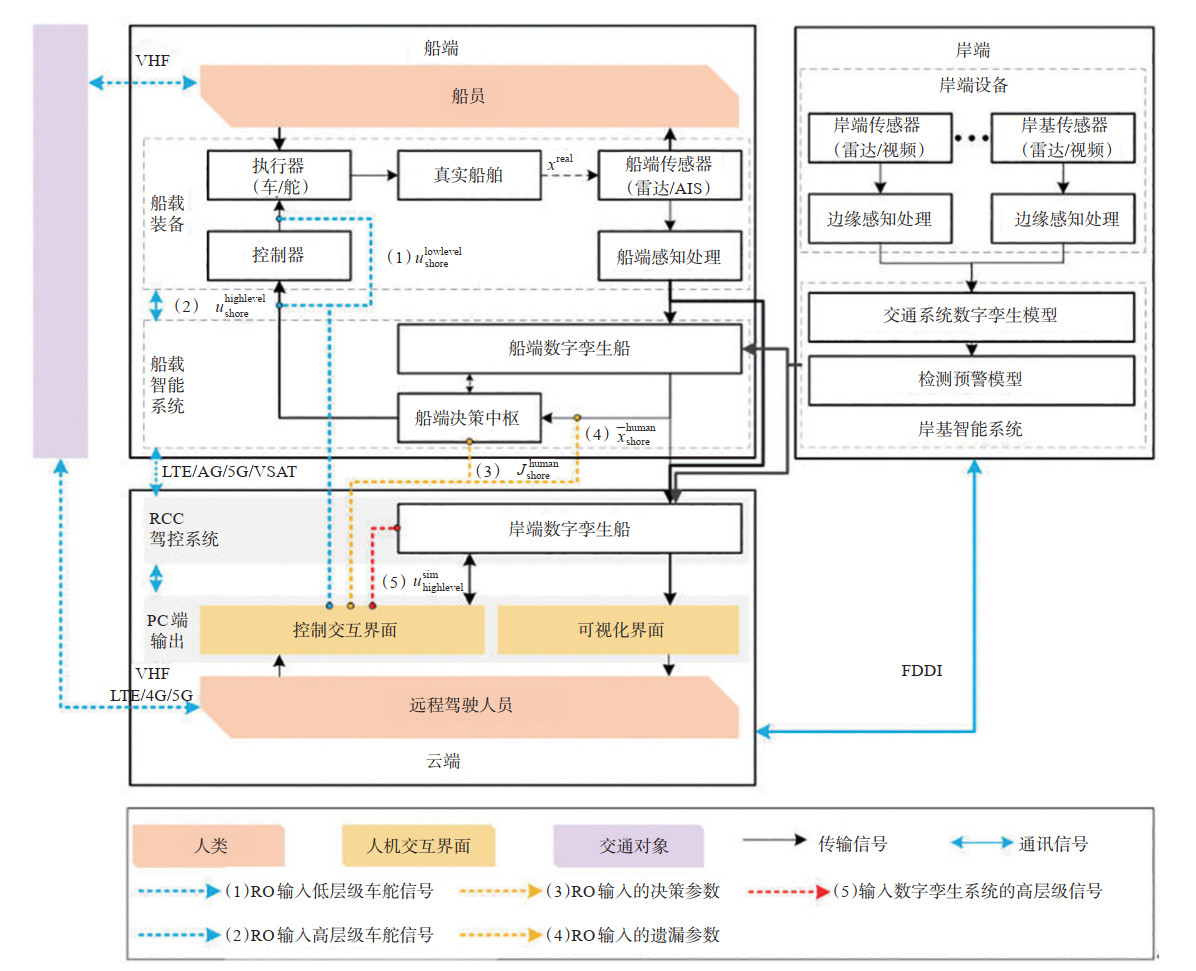
图 2 内河船岸协同式远程控制系统架构
Figure 2. Control architecture for inland"Ship-Shore"cooperative remote control ships

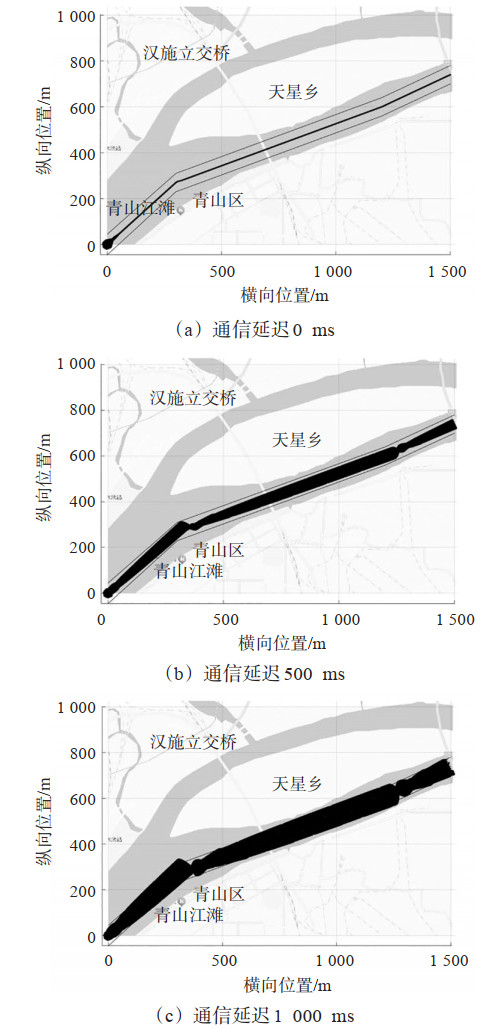
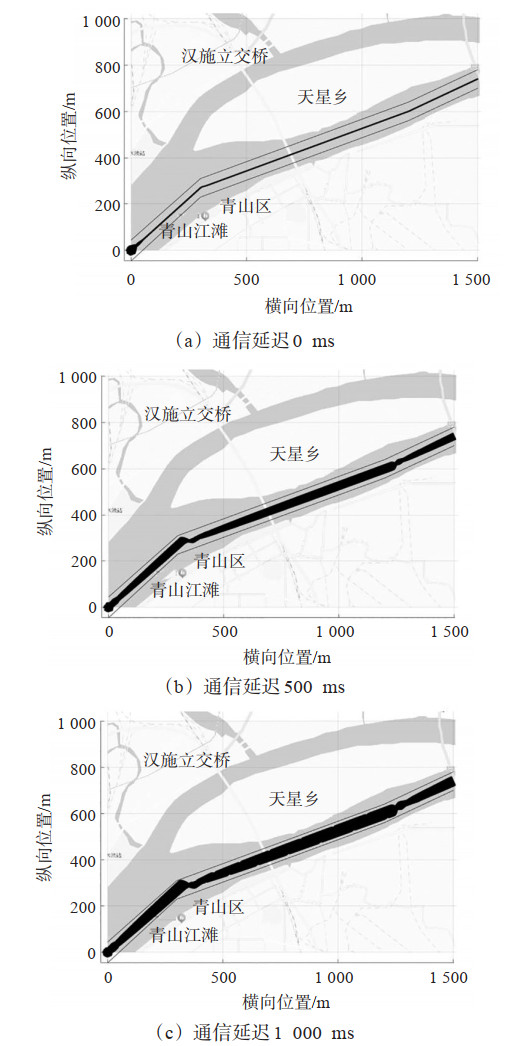
图 5 远程遥控模式在各通信延迟下的轨迹图
Figure 5. Trajectory diagram of remote control mode under communication delay

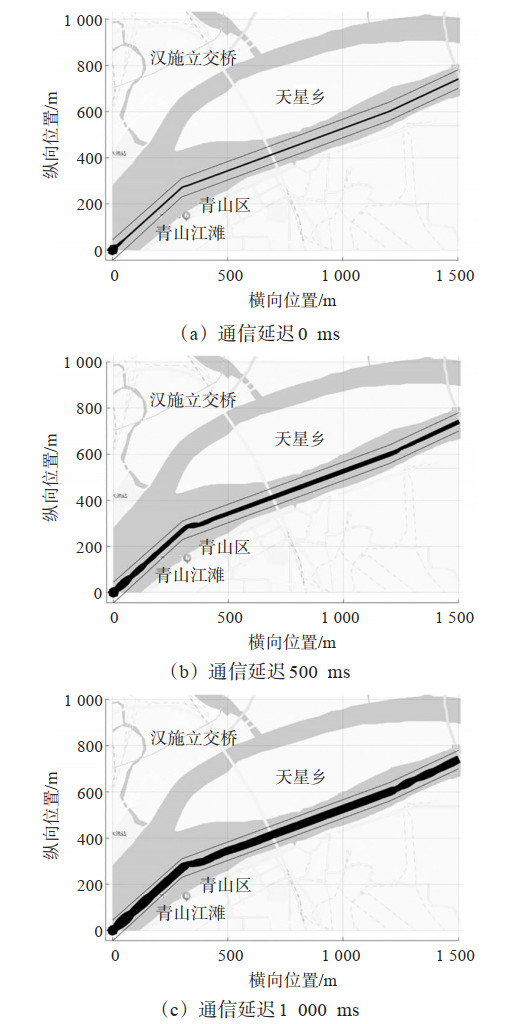
图 6 远程控制Ⅰ型在各通信延迟下的轨迹图
Figure 6. Trajectory diagram of remote control mode Ⅰ under communication delay

图 7 远程控制Ⅱ型在各通信延迟下的轨迹图
Figure 7. Trajectory diagram of remote control mode Ⅱ under communication delay

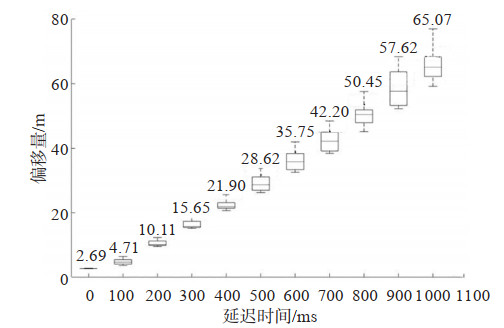
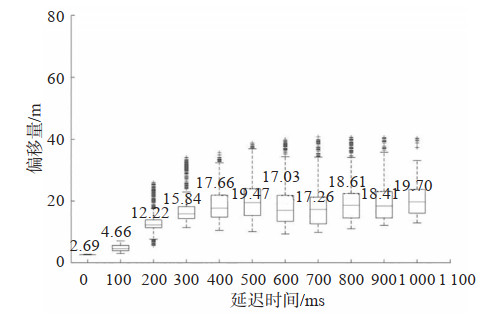
图 9 远程控制Ⅰ型的最大偏移量箱型图
Figure 9. Maximum offset box type diagram for remote control mode Ⅰ

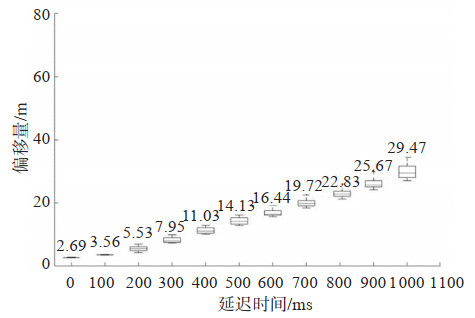
图 10 远程控制Ⅱ型的最大偏移量箱型图
Figure 10. Maximum offset box type diagram for remote control mode Ⅱ

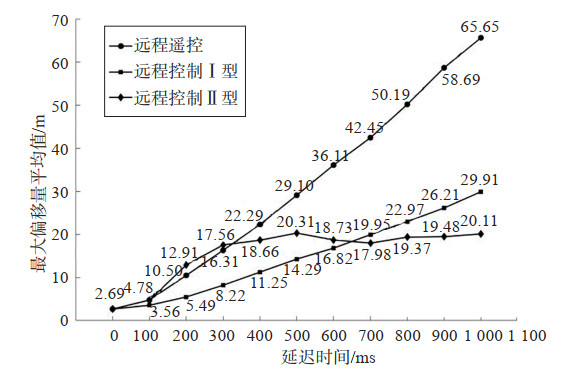
图 11 不同控制模式的最大偏移量均值图
Figure 11. Mean value of maximum offset diagram for different control modes
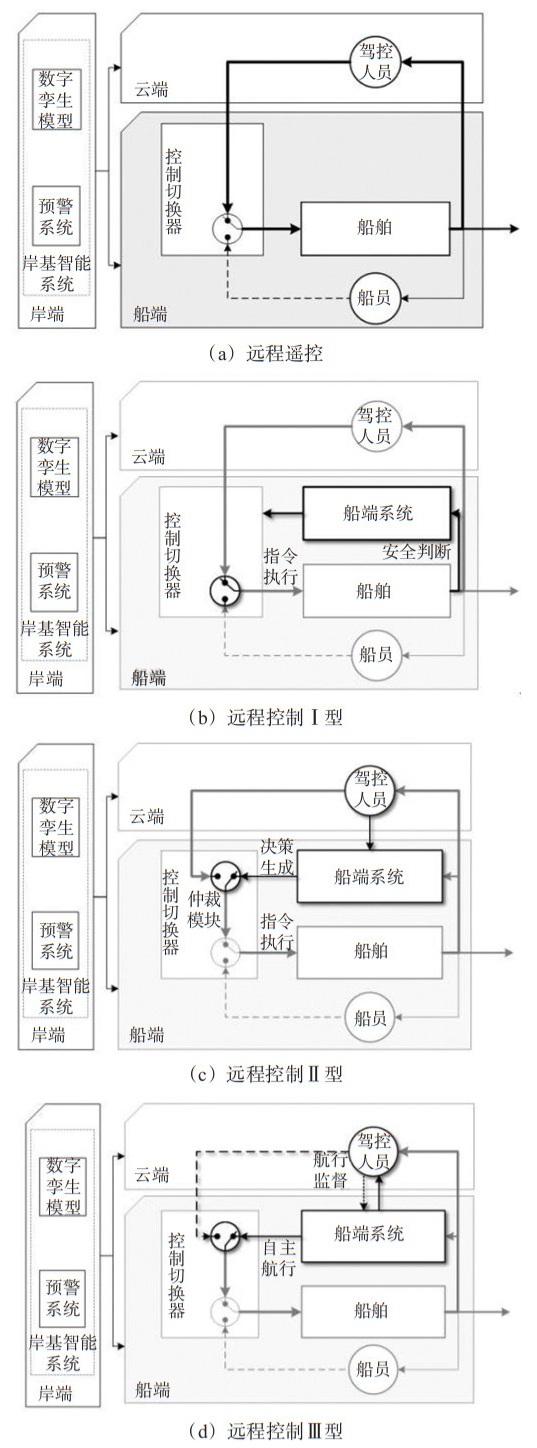
表 1 4类远程驾驶控制模式
Table 1. Four modes of remote control ships
名称 功能模块 模式内涵 模式特点 远程遥控 指令执行 远程驾控人员远程发布车舵指令; 船端系统直接执行车舵指令 船端无智能航行系统 远程控制Ⅰ型 安全判断、指令执行 船端系统具备判断模块确定远程驾控人员远程实时发布的车舵指令是否安全; 接收判断模块的判断结果, 如果安全则执行 船端有智能航行系统 远程控制Ⅱ型 决策生成、仲裁模块、指令执行 船端系统能够根据远程驾控人员远程实时发布的车舵指令、跟踪指令等决策信息生成智能航行系统的车舵控制指令; 接收人、机两端的控制指令并判断双方控制指令的安全性, 根据系统设置的仲裁规则输出人机融合决策; 接收仲裁模块的人机融合决策并执行 船端有智能航行系统 远程控制Ⅲ型 航行监督、自主航行 远程驾控人员不参与具体控制惭作, 远程监督受控船舶执行航行任务, 只在必要情况下向受控船舶发送车舵指令、跟踪信号等决策信息; 船端系统能够实现一般情况下的自主航行, 驾控人员直接的远程控制成为备选 船端有智能航行系统  下载: 导出CSV
表 2 部分随机初始状态
Table 2. Some of the random initial state
初始横坐标/m 初始纵坐标/m 初始航向/(°) -5.18 11.18 1.04 -14.49 8.79 0.58 6.90 -0.80 0.78 2.82 0.99 0.60
下载: 导出CSV
-
[1] 严新平, 柳晨光. 智能航运系统的发展现状与趋势[J]. 智能系统学报, 2016, 11(6): 807-817.YAN X P, LIU C G. Review and prospect for intelligent waterway transportation system[J]. CAAI Transactions on Intelligent Systems, 2016, 11(6): 807-817. (in Chinese). [2] 中国船级社. 智能船舶规范(2025): R012-2025[S]. 北京: 中国船级社, 2025.China Classification Society, Rules for intelligent ships: R012-2025[S]. 2025. Beijing: CCS, 2025. (in Chinese) [3] KUFOALORD K M, JOHANSEN T A, BREKKE E F, et al. Autonomous maritime collision avoidance: field verification of autonomous surface vehicle behavior in challenging scenarios[J]. Journal of Field Robotics, 2020, 37: 387-403. doi: 10.1002/rob.21919 [4] International Maritime Organization. IMO takes first steps to address autonomous ships[EB/OL]. (2018-05-25). [2025-06-30]. http://www.imo.org/en/mediacentre/pressbriefings/pages/08-msc-99-mass-scoping.aspx [5] 郑南宁. 人工智能新时代[J]. 智能科学与技术学报, 2019, 1 (1): 1-3.ZHENG N N. The new era of artificial intelligence[J]. Chinese Journal of Intelligent Science and Technology, 2019, 1 (1): 1-3. (in Chinese) [6] 李永杰, 张瑞, 魏慕恒, 等. 船舶自主航行关键技术研究现状与展望[J]. 中国舰船研究, 2021, 16(1): 32-44.LI Y J, ZHANG R, WEI M H, et al. State-of-the-art research and prospects of key technologies for ship autonomous navigation[J]. Chinese Journal of Ship Research, 2021, 16(1): 32-44. (in Chinese) [7] WENNERSBERG L A L, NORDAHL H, RøDSETH Ø J, et al. A framework for description of autonomous ship systems and operations[J]. IOP Conference Series: Materials Science and Engineering, 2020, 929(1): 012004. doi: 10.1088/1757-899X/929/1/012004 [8] Ministry of Tranport. Statistical bulletin on the development of the transport industry [EB/OL]. (2025-04-12). [2025-06--30]. https://xxgk.mot.gov.cn/2020/jigou/zhghs/202506/t2025-25-0610_4170228.html .[9] GAO X J, DAI W, YU L, et al. Study on factors contributing to severity of ship collision accidents in the Yangtze river estuary[J]. Transportation Safety and Environment, 2024, 6(4): 14-32. [10] 邵泽远, 尹勇, 吕红光, 等. 面向智能船艇航行场景的小目标高精度跟踪器[J]. 交通信息与安全, 2025, 43(4): 75-85.SHAO Z Y, YⅠN Y, LYU H G, et al. A high-precision tracker for small objects in intelligent vessel navigation scenarios[J]. Journal of Transport Information and Safety, 2025, 43 (4): 75-85. (in Chinese) [11] 王远渊, 刘佳仑, 马枫, 等. 智能船舶远程驾驶控制技术研究现状与趋势[J]. 中国舰船研究, 2021, 16(1): 18-31.WANG Y Y, LIU J L, MA F, et al. Review and prospect of remote control intelligent ships[J]. Chinese Journal of Ship Research, 2021, 16(1): 18-31. (in Chinese) [12] YOU X, MA F, LU S, et al. An integrated platform for the development of autonomous and remote-control ships[C]. 19th International Conference on Computer and IT Applications in the Maritime Industries, Pontignano, Italy 2020. [13] 马枫, 陈晨, 刘佳仑, 等. 船岸协同支持下的内河船舶远程驾控系统关键技术研究[J]. 中国舰船研究, 2022, 17(5): 125-133.MA F, CHEN C, LIU J L, et al. Key technologies of ship remote control system in inland waterways under ship-shore cooperation conditions[J]. Chinese Journal of Ship Research, 2022, 17(5): 125-133. (in Chinese) [14] LI W, CHEN W, GUO Y, et al. Risk performance analysis on navigation of MASS via a hybrid framework of STPA and HMM: evidence from the human-machine co-driving mode[J]. Journal of Marine Science and Engineering, 2024, 12: 7. [15] EIDE E, BREIVIK M, BREKKE E F, et al. The autonomous urban passenger ferry milliAmpere2: design and testing[J]. Journal of Offshore Mechanics and Arctic Engineering, 2025, 147(3): 031409. doi: 10.1115/1.4067370 [16] ERⅠK V, OLE A A, CHENG T T, et al. Human factor influences on supervisory control of remotely operated and autonomous vessels[J]. Ocean Engineering, 2024, 299: 117257. doi: 10.1016/j.oceaneng.2024.117257 [17] WANG Z, YANG S, XIANG X, et al. Cloud-based remote control framework for unmanned surface vehicles[J]. IF-AC-Papers OnLine, 2020, 53(2): 14564-14569. doi: 10.1016/j.ifacol.2020.12.1462 [18] 李晨, 严新平, 刘佳仑, 等. 船舶远程驾驶控制系统设计与应用[J]. 交通运输工程学报, 2024, 24(5): 333-347.LI C, YAN X P, LIU J L, et al. Design and application of a remote driving control system for ships[J]. Journal of Transportation Engineering, 2024, 24(5): 333-347. (in Chinese) [19] 牟学东, 吴建华, 马勇, 等. 万州三桥建设对海事雷达的影响[J]. 中国航海, 2015, 38(2): 60-63.MU X, WU J, MA Y, et al. Impact of wanzhou bridge construction on radar monitoring[J]. Navigation of China, 2015, 38 (2): 60-63. (in Chinese) [20] 陶飞, 刘蔚然, 张萌, 等. 数字孪生五维模型及十大领域应用[J]. 计算机集成制造系统, 2019, 25(1): 1-18.TAO F, LIU W R, ZHANG M, et al. Five-dimensional model and ten applications of digital twin[J]. Computer Integrated Manufacturing Systems, 2019, 25(1): 1-18. (in Chinese) [21] 戴小文, 宋建霖, 岳丽全. 仿人智能控制理论及应用研究进展. 自动化学报, 2020, 41(1): 1−13.DAI X W, SONG J L, YUE L Q. Research development in theory and application of human simulated intelligent control. acta automatic sinica, 2020, 41(1): 1−13. (in Chinese) [22] 邓中杰, 茅云生, 董早鹏, 等. 基于改进视线法的无人艇路径跟随抗扰控制[J]. 船海工程, 2025, 54(1): 41-47.DENG Z J, MAO Y S W R, DONG Z P, et al. Disturbance rejection control of unmanned surface vessel path following based on improved line of sight method[J]. Ship & Ocean Engineering, 2025, 54(1): 41-47. (in Chinese) [23] 唐军, 钱明炎, 陈善颖, 等. 故障检测与重构下基于AFTSMO的ROV三维航迹跟踪控制[J]. 船海工程, 2024, 53(4): 87-93.TANG J, QIAN M Y, CHEN S Y, et al. Fault detection and reconfiguration under AFTSMO-based ROV 3D track tracking control[J]. Ship & Ocean Engineering, 2024, 53(4): 87-93. (in Chinese) [24] XING Y, LYU C, CAO D, et al. Toward human-vehicle collaboration: review and perspectives on human-centered collaborative automated driving[J]. Transportation Research Part C: Emerging Technologies, 2021, 128: 103199. doi: 10.1016/j.trc.2021.103199 -

 点击查看大图
计量
- 文章访问数: 64
- HTML全文浏览量: 22
- PDF下载量: 4
- 被引次数: 0