



A LSTM-BN Based Model for Real-time Vehicle Collision Risk Prediction
-
摘要: 车路协同(vehicle-to-infrastructure, V2I)技术的发展实现了驾驶人、车辆、道路的动态信息实时交互,为车辆实时碰撞风险预测提供了技术支撑。针对当前车辆碰撞风险预测模型在动态特征捕捉与不确定性推理方面的局限,构建了基于长短时记忆-贝叶斯网络(long short-term memory-Bayesian network, LSTM-BN)的双层递进式模型。LSTM-BN模型底层利用LSTM通过设置0.1 s的采样窗口捕获车辆状态的时序演变特性,顶层通过BN进行碰撞风险的概率推断。针对武汉市自然驾驶实验数据,利用碰撞时间(time-to-collision, TTC)指标对车辆(小汽车)的碰撞风险进行定义和量化,得到无风险、低风险和高风险数据分别为25 826帧、19 344帧和4 051帧。在初步确定影响车辆碰撞风险的相关变量后,采用决策树方法从人-车-路维度提取关键致因特征,进而挖掘并表征了驾驶员熟练度、速度差、道路类型与车头间距等反映人-车-路多维要素非线性耦合关系的交互项指标,并通过构建反映人、车、路耦合关系指标的贝叶斯网络,评估当前时刻的车辆碰撞风险。在此基础上,为弥补静态概率模型在时序预测上的不足,运用LSTM预测车辆状态量。继而将这些变量映射至BN,以推断下1个时刻的碰撞概率。通过上述步骤,模型能够对动态演化下的车辆实时碰撞风险进行精准预测。为验证模型有效性,从鲁棒性、精确性、时效性和复杂性4个方面对提出模型的预测性能进行评估。模型对比结果显示:LSTM-BN模型的准确率最高(91%),较支持向量机(support vector machine, SVM)模型和随机森林(random forest, RF)模型分别提升了7%和12%;其在不同采样时段下的指标波动均小于0.1,表现出较强的鲁棒性。Abstract: The development of vehicle-to-infrastructure cooperation (V2I) technology enables real-time dynamic information interaction between humans, vehicles, and roads, providing technical support for real-time vehicle collision risk prediction. Current models for predicting vehicle collision risk have limitations in capturing dynamic features and performing uncertainty inference. Thus, a two-layer progressive model based on long short-term memory-Bayesian network (LSTM-BN) is proposed. The LSTM-BN model utilizes LSTM at the bottom layer to capture the temporal evolution characteristics of vehicle states by setting a 0.1 s sampling window. At the top layer, the model performs probabilistic inference of collision risk through the BN. Based on data from naturalistic driving experiments in Wuhan, the time-to-collision (TTC) index is used to define and quantify the collision risk of vehicles (cars). This process yields 25, 826, 19, 344, and 4, 051 frames of no-risk, low-risk, and high-risk data, respectively. After preliminarily determining the variables affecting collision risk, the decision tree method is employed to extract key causal features from the dimensions of driver-vehicle-road. Interaction indicators, such as driver proficiency, speed difference, road type, and headway, are further excavated and characterized to reflect the non-linear coupling relationships among multi-dimensional factors. A Bayesian network reflecting these coupling relationship indicators is then constructed to evaluate the current vehicle collision risk. On this basis, to compensate for the deficiency of static probabilistic models in sequential prediction, LSTM is used to predict vehicle state variables. These variables are then mapped into the BN to infer the collision probability at the next time step. Through the above steps, the model achieves a precise prediction of real-time vehicle collision risk under dynamic evolution. To verify the effectiveness of the proposed model, its prediction performance is evaluated from four aspects: robustness, accuracy, timeliness, and complexity. Results from comparative modeling indicate that the LSTM-BN model achieves the highest accuracy at 91%. This performance is 7% and 12% higher than the accuracies of the support vector machine (SVM) and random forest (RF) models, respectively. Furthermore, its index fluctuations across different sampling periods are all below 0.1, demonstrating strong robustness.
-

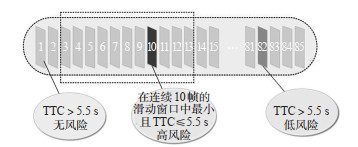
图 1 车辆碰撞风险等级判定示意图
Figure 1. Schematic diagram of vehicle collision risk level determination

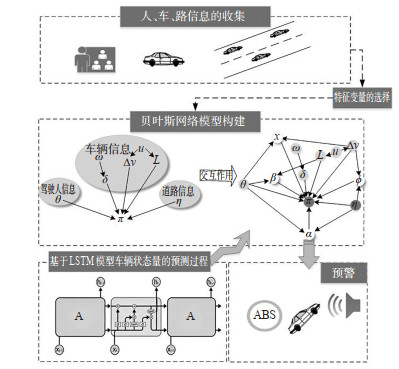
图 3 基于LSTM-BN的车辆碰撞风险实时预测流程图
Figure 3. Flowchart of real-time vehicle collision risk prediction based on LSTM-BN
表 1 自然驾驶平台原始数据集
Table 1. Raw dataset from the naturalistic driving platform
名称 单位 名称 单位 数据帧编号 车道偏移量 m 本车车速 m/s 相对速度 m/s 油门踏板开度 % 车头时距 s 制动压力 MPa 车头间距 m 转向盘角度 (°) 本车加速度 m/s2 横摆角速度 (°)/s 熟练类型 经度 (°) 道路类型 纬度 (°) TTC s 距右车道线距离 m  下载: 导出CSV
表 2 变量描述性统计表
Table 2. Descriptive statistics of variables
变量 均值 标准差 最小值 最大值 车速 27.91 27 0.06 98.44 转向盘角度 -4.64 23 -545.3 421 车道偏移量 0.15 0.4 -1.67 1.76 车头间距 13.38 12 0.72 68.05 速度差 0.03 0.8 -6.9 4.7 加速度 0 0.5 -28.13 19.53
下载: 导出CSV
表 3 变量离散类型和判别条件
Table 3. Variable discrete types and discrimination criteria
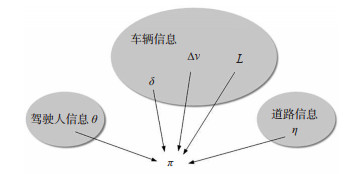
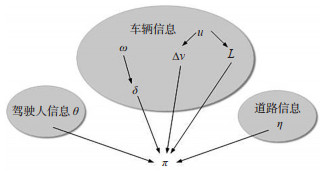
变量 定义 离散类型 离散判别条件及类型 ω 转向盘角度 01234 四分位数 Δv 相对速度 01234 四分位数 L 车头间距 01234 四分位数 u 加速度波动率 0 0 1 位于0~2之间 2 大于2 θ 熟练类型 0 不熟练 1 熟练 η 道路类型 0 快速路 1 高速路 δ 车道偏移量 01234 四分位数 π 风险类型 0 TTC > 5.5s无风险 1 TTC≤5.5s低风险 TTC在连续10帧的滑动窗口 2 中最小且TTC≤5.5s
高风险
下载: 导出CSV
表 4 交互项离散类型及判别条件
Table 4. Discrete types and discrimination criteria of interaction terms
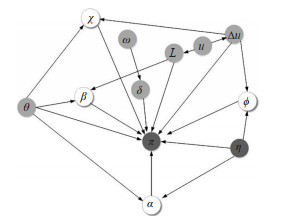
变量 定义 离散类型 离散判别条件 α 熟练类型和道路类型的交互项 0 不熟练、快速路 1 不熟练、高速路 2 熟练、快速路 3 熟练、高速路 β 熟练类型与车头间距的交互项 0-9 熟练类型、车头间距四分位数 χ 熟练类型与速度差的交互项 0-9 熟练类型、速度差四分位数 φ 道路类型与速度差的交互项 0-9 道路类型、速度差四分位数
下载: 导出CSV
表 5 模型对比结果
Table 5. Model comparison results
模型 准确率 精确率 召回率 F1值 Kappa系数 AUC LSTM-BN 0.91 0.91 0.91 0.90 0.81 0.77 LSTM-BN(无交互) 0.84 0.80 0.84 0.81 0.63 0.76 SVM 0.84 0.77 0.84 0.80 0.69 0.75 RF 0.79 0.82 0.89 0.85 0.80 0.89 SVR-BN 0.85 0.91 0.85 0.86 0.64 0.85 ARIMA-BN 0.84 0.87 0.84 0.84 0.69 0.84 MLP 0.89 0.87 0.89 0.85 0.80 0.79 Logistic 0.85 0.77 0.85 0.81 0.70 0.75
下载: 导出CSV
表 6 不同采样时段LSTM-BN模型结果
Table 6. LSTM-BN model results for different sampling time periods
采样时段 准确率 精确率 召回率 F1值 Kappa系数 AUC 1 0.88 0.83 0.88 0.85 0.64 0.75 2 0.91 0.91 0.91 0.90 0.81 0.77 3 0.86 0.80 0.86 0.83 0.66 0.76 4 0.93 0.94 0.93 0.93 0.79 0.77 5 0.92 0.86 0.92 0.89 0.48 0.73
下载: 导出CSV
表 7 不同驾驶人LSTM-BN模型结果
Table 7. LSTM-BN model results for different drivers
驾驶人 准确率 精确率 召回率 F1值 Kappa系数 AUC 1 0.98 0.97 0.98 0.97 0.94 0.81 2 0.87 0.96 0.87 0.91 0.62 0.73 3 0.86 0.86 0.86 0.86 0.72 0.86 4 0.95 0.93 0.95 0.94 0.80 0.76 5 0.93 0.94 0.93 0.93 0.79 0.77
下载: 导出CSV
表 8 不同路段LSTM-BN模型结果
Table 8. LSTM-BN model results in different road sections
道路 准确率 精确率 召回率 F1值 Kappa系数 AUC 高速路1 0.92 0.93 0.92 0.92 0.82 0.80 高速路2 0.88 0.86 0.88 0.86 0.72 0.80 快速路1 0.91 0.85 0.91 0.88 0.79 0.78 快速路2 0.90 0.85 0.90 0.87 0.77 0.79 快速路3 0.90 0.89 0.90 0.89 0.80 0.77
下载: 导出CSV
-
[1] 刘怿轩, 张慧永, 王猛, 等. 跟驰自动驾驶车时人驾车行为研究: 实证与建模[J]. 交通运输工程与信息学报, 2023, 21 (6): 14-28。LIU Y X, ZHANG H Y, WANG M, et al. Analyzing human driving behavior when following autonomous vehicle: real vehicle testing and modeling[J]. Journal of Transportation Engineering and Information, 2023, 21(6): 14-28. (in Chinese) [2] WEN J H, WU C Z, ZHANG R Y, et al. Rear-end collision warning of connected automated vehicles based on a novel stochastic local multivehicle optimal velocity model[J]. Accident Analysis & Prevention, 2020, 148: 105800. [3] MINDERHOUD M. Extended time-to-collision measures for road traffic safety assessment[J]. Accident Analysis & Prevention, 2001, 33(1): 89-97. [4] ZENG Q, WANG Q, ZHANG K, et al. Analysis of the injury severity of motor vehicle-pedestrian crashes at urban intersections using spatiotemporal logistic regression models[J]. Accident Analysis & Prevention, 2023, 189: 107119. [5] FOUNTAS G, FONZONE A, GHARAVI N, et al. The joint effect of weather and lighting conditions on injury severities of single-vehicle accidents[J]. Analytic Methods in Accident Research, 2020, 27: 100124. doi: 10.1016/j.amar.2020.100124 [6] 朱冰, 朴奇, 赵健, 等. 基于路面附着系数估计的汽车纵向碰撞预警策略[J]. 汽车工程, 2016, 38(4): 446-452.ZHU B, PU Q, ZHAO J, et al. Vehicle longitudinal collision warning strategy based on road adhesive coefficient estimation[J]. Automotive Engineering, 2016, 38(4): 446-452. (in Chinese) [7] ZHENG L, SAYED T, ESSA M. Bayesian hierarchical modeling of the non-stationary traffic conflict extremes for crash estimation[J]. Analytic Methods in Accident Research, 2019, 23: 100100. doi: 10.1016/j.amar.2019.100100 [8] GU R F, SONG P L, SZE N N, et al. A semi-parameter copula model for vehicle damage severity in lane-changing related crashes[J]. Accident Analysis & Prevention, 2025, 214: 107979. [9] LI R, PEREIRA F C, BEN-AKIVA M E, et al. Competing risk mixture model and text analysis for sequential incident dura- tion prediction[J]. Transportation Research Part C: Emerging Technologies, 2015, 24: 74-85. [10] LEE J Y, ABDEL-ATY M, CAI Q, et al. Effects of emergency medical services times on traffic injury severity: a random effects ordered probit approach[J]. Traffic Injury Prevention, 2018(6): 1-19. [11] GAO X W, JIANG X K, HAWORTH J, et al. Uncertainty-aware probabilistic graph neural networks for road-level traffic crash prediction[J]. Accident Analysis & Prevention, 2024, 208: 107801. [12] PUNIA D, KUMAR R. A YOLOv3-powered edge computing technique for real-time rear-end collision prediction in autonomous vehicles[J]. Applied Soft Computing, 2025: 113981. [13] XIONG X X, CHEN L, LIANG J. A new framework of vehicle collision prediction by combining SVM and HMM[J]. IEEE Transactions on Intelligent Transportation Systems, 2018, 19 (3): 699-710. doi: 10.1109/TITS.2017.2699191 [14] ZHU J, MA Y, LOU Y. Multi-vehicle interaction safety of connected automated vehicles in merging area: a real-time risk assessment approach[J]. Accident Analysis & Prevention, 2022, 166: 106546。 [15] 姚志洪, 郝慧君, 巫雪梅, 等. 考虑自动驾驶的混合交通流路段阻抗函数[J]. 交通运输工程与信息学报, 2021, 19(4): 1-12.YAO Z H, HAO H J, WU X M, et al. Cost function of mixed traffic flow with autonomous driving[J]. Journal of Transportation Engineering and Information, 2021, 19(4): 1-12. (in Chinese) [16] 何仁, 赵晓聪, 王建强. 人-车-路交互下的驾驶人风险响应度建模[J]. 中国公路学报, 2020, 33(9): 236-250.HE R, ZHAO X C, WANG J Q. Modeling of driving risk response under human-vehicle-road interaction[J]. China Journal of Highway and Transport, 2020, 33(9): 236-250. (in Chinese) [17] OVIEDO-TRESPALACIOS O, AFGHARI A P, HAQUE M M. A hierarchical Bayesian multivariate ordered model of distracted drivers'decision to initiate risk-compensating behaviour[J]. Analytic Methods in Accident Research, 2020, 26: 100121. doi: 10.1016/j.amar.2020.100121 [18] MEGIAS-ROBLES A, SANCHEZ-LOPEZ M, FERNANDEZ-BERROCAL P. The relationship between self-reported ability emotional intelligence and risky driving behaviour: consequences for accident and traffic ticket rate[J]. Accident Analysis & Prevention, 2022, 174: 106760. [19] 伊轩轩, 潘婷, 贺世明. 城市隧道边墙对不同车道驾驶人的行为影响研究[J]. 交通信息与安全, 2025, 43(3): 66-73. doi: 10.3963/j.jssn.1674-4861.2025.03.007YI X X, PAN T, HE S M. A study on the influence of side wall effect of urban tunnel on driver's eye movement and behavior characteristics[J]. Journal of Transport Information and Safety, 2025, 43(3): 66-73. (in Chinese) doi: 10.3963/j.jssn.1674-4861.2025.03.007 [20] WANG G, ZHANG J, KONG X. Study on passenger comfort based on human-bus-road coupled vibration[J]. Applied Sciences, 2020, 10(9): 3254. doi: 10.3390/app10093254 [21] WANG J, LIU K, LI H. LSTM-based graph attention network for vehicle trajectory prediction[J]. Computer Networks, 2024, 248: 110477. doi: 10.1016/j.comnet.2024.110477 [22] WU J B, WEN H Y, QI W W. A new method of temporal and spatial risk estimation for lane change considering conventional recognition defects[J]. Accident Analysis & Prevention, 2020, 148: 105796. [23] ITOH M, INAGAKI T. Design and evaluation of steering protection for avoiding collisions during a lane change[J]. Ergonomics, 2014, 57(3): 361-373. doi: 10.1080/00140139.2013.848474 [24] LARRANAGA P, KARSHENAS H, BIELZA C, et al. A re-view on evolutionary algorithms in Bayesian network learning and inference tasks[J]. Information Sciences, 2013, 233: 109. doi: 10.1016/j.ins.2012.12.051 [25] YANG M, ZHANG B, WANG T, et al. Vehicle interactive dynamic graph neural network-based trajectory prediction for internet of vehicles[J]. IEEE Internet of Things Journal, 2024, 11(22): 35777-35790. doi: 10.1109/JIOT.2024.3362433 [26] 张兰芳, 王淑丽, 陈程, 等. 基于自然驾驶数据的高速公路出口区换道风险模型[J]. 同济大学学报(自然科学版), 2019, 47 (10): 1446-1453.ZHANG L F, WANG S L, CHEN C, et al. Lane-change risk model of freeway off-ramp areas based on natural driving data[J]. Journal of Tongji University (Natural Science), 2019, 47 (10): 1446-1453. (in Chinese) [27] LI K, WANG S, CONG R. Game dynamics of route choice in heterogenous population[J]. Physics Letters A, 2022, 421: 127775. doi: 10.1016/j.physleta.2021.127775 -

 点击查看大图
计量
- 文章访问数: 67
- HTML全文浏览量: 24
- PDF下载量: 10
- 被引次数: 0