



A Coordinated Optimization Method for Peak-Shaving Operation of Key Port Crane Equipment
-
摘要: 智能化和绿色化已成为未来港口发展的必然趋势。电气化改造后,港口关键设备均由港口微电网供电,安全稳定的电力供给是实现港口高效运输作业的保障。以自动化集装箱码头中的关键大型起重设备为研究对象,研究了1种面向港口微电网削峰填谷的作业协调优化调度策略。构建岸桥(ship-to-shore crane,STS)和轨道式场桥(rail-mounted gantry crane,RMG)的通用负荷计算模型,根据设备双循环作业周期的阶段划分,形成标准工况下的多阶段、全时域负荷曲线。在负荷建模的基础上,结合港口集中式储能的充放电能力,提出了起重设备集群作业周期与储能系统协同运行的精确优化模型;通过引入逻辑变量刻画多机设备所处的运行阶段与功率水平,构建考虑设备集群聚合功率冲击的约束条件与目标函数;求解优化模型获得多台设备的最优启动时刻,实现港口装备集群负荷波动平抑与能量利用效率提升。针对设备运行和储能容量配置进行了仿真分析,验证了多设备协调调度方法能够有效抑制峰谷差,在所考虑的场景下峰值功率下降20%以上。通过精确优化算法和启发式优化算法的比较分析,验证了精确优化方法的最优性与扩展能力;同时,给出了设备随机运行时的启动时刻可行域,明确了非理想情况下安全启动组合,给出了非标准工况下所提优化模型的扩展,体现出良好的工程实用价值。Abstract: Intelligent and green development is an inevitable trend for future port development. After electrification upgrades, key port equipment is supplied by the port microgrid, and a safe and stable power supply is the foundation for efficient port transportation operations. Focusing on critical large-scale port cranes in automated container terminals, this study investigates a coordinated operational scheduling strategy for peak shaving and valley filling in port microgrids. A unified load-calculation model for ship-to-shore cranes (STS) and rail-mounted gantry cranes (RMG) is established. By dividing the stages of the equipment's dual-cycle operating process, a multi-stage, full-time-horizon load profile under standard working conditions is developed. Building on the load modeling and considering the charge-discharge capability of centralized port energy storage, an exact optimization model is proposed for the coor-dinated operation between the operating cycles of crane clusters and the energy storage system. Logical variables are introduced to characterize the operating stage and power level of each machine, and constraints and an objective function are formulated to account for aggregated power impacts from equipment clusters. Solving the optimization model yields the optimal start times for multiple machines, thereby smoothing load fluctuations of port equipment clusters and improving energy utilization efficiency. Simulation analyses are conducted for equipment operation and energy storage capacity configuration, verifying that the multi-equipment coordinated scheduling method can effectively reduce the peak-valley difference, achieving more than a 20% reduction in peak power in the considered scenarios. Comparative analyses between exact optimization and heuristic optimization validate the optimality and scalability of the exact approach. In addition, the feasible region of start times under stochastic equipment operation is provided, identifying safe start-time combinations under non-ideal conditions. An extension of the proposed optimization model to non-standard operating conditions is also presented, demonstrating strong engineering practicality.
-
Key words:
- port microgrid /
- lifting equipment /
- peak shaving and valley filling /
- exact optimization
-

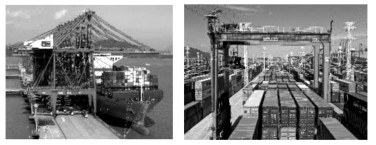
图 1 宁波舟山港的岸桥和场桥设备
Figure 1. Ship-to-shore (STS) and rail-mounted gantry (RMG) cranes in Ningbo-Zhoushan port.

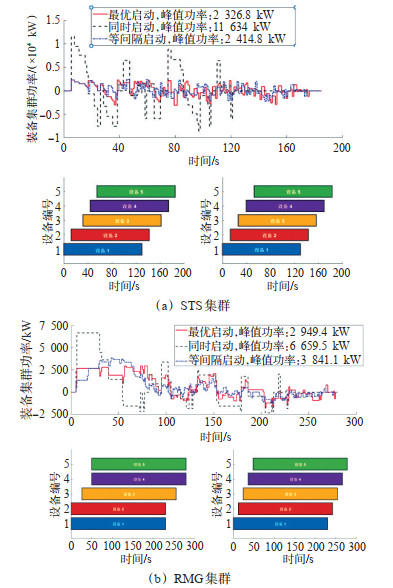
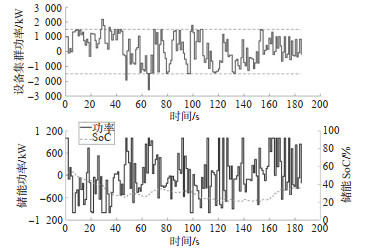
图 3 无储能情况下港口起重设备集群协调运行
Figure 3. Cooperative operation of port cranes without energy storage

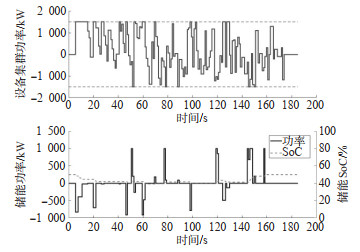
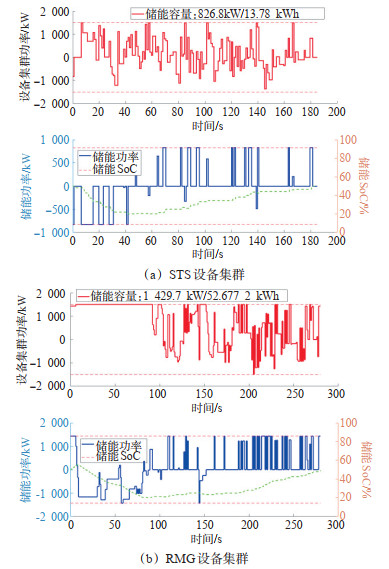
图 5 精确优化下STS设备集群与储能系统协调运行
Figure 5. Cooperative operation of cranes with energy storage using exact optimization

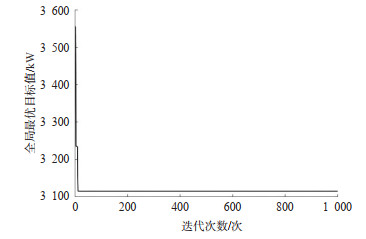
图 6 PSO优化下STS设备集群与储能系统协调运行
Figure 6. Cooperative operation of cranes with energy storage using the PSO algorithm

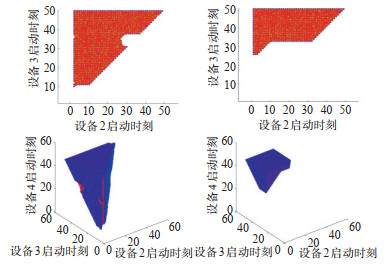
图 7 港口设备集群注入功率约束下储能容量的优化配置
Figure 7. Optimal sizing energy storage under the constrained power injections of port cranes

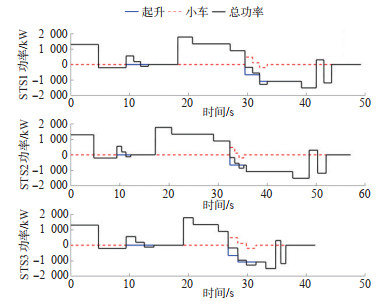
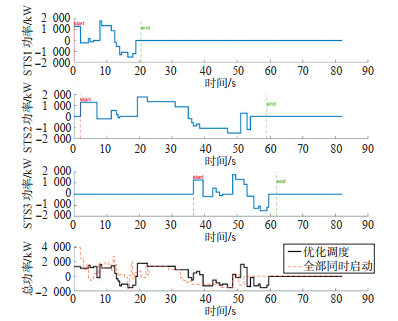
图 9 实际工况下3台STS设备的功率负荷曲线
Figure 9. Power load profiles of 3 STS devices under realistic working condition

图 10 实际工况下3台STS的协调运行效果
Figure 10. Coordinated operation of 3 STS devices under realistic working condition
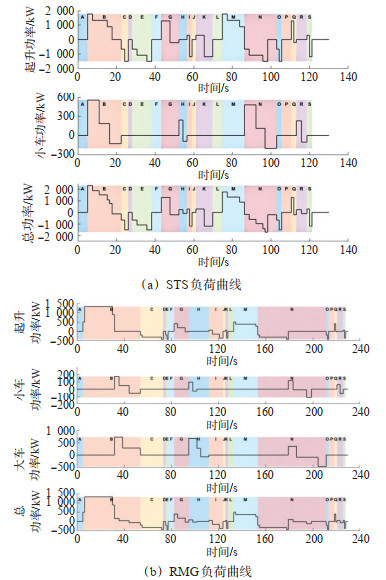
表 1 双循环作业下STS的运行阶段与运行时间
Table 1. STS operational stages and time in double cycle
带载状态 循环作业阶段 加速、匀速、减速时间/s 起升机构 小车 满载(集卡到船舱) A:对接集装箱 5.0 B:上升逆风向外移动 2.5/7.5/2.5 6.0/5.4/6.0 C:下降到导向轨上方 1.8/0/1.8 D:进入导向轨 2 E:继续下降并停止 2.5/5.1/2.5 空载(船舱内取箱) F:脱离集装箱 5.0 G:起升机构上升 4.5/0/4.5 2.1/0/2.1 H:逆风移动 I:下降到导向轨上方 1.3/0/1.3 J:进入导向轨 2.0 K:继续下降并停止 4.3/0/4.3 满载(船舱到集卡) L:对接集装箱 5.0 M:起升机构上升 2.5/6.4/2.5 6.0/4.7/6.0 N:下降顺风向内移动 2.5/7.1/2.5 O:下降到运输集卡 1.3/0/1.3 空载(集卡取箱) P:脱离集装箱 5.0 Q:起升机构上升 1.3/0/1.3 2.7/0/2.7 R:向内顺风移动 S:下降到码头集装箱 1.3/0/1.3  下载: 导出CSV
表 2 精确优化与PSO算法的求解效果比较
Table 2. Comparison of the exact optimization and the PSO algorithm
设备数量 5 10 20 Gurobi/PSO STS 峰值功率/kW 2 326/2 414 3 846/3 405 -/5484 计算时间/s 28/0.7 3 000/0.9 -/3.6 RMG 峰值功率/kW 2 949/3 115 5 832/6 230 -/11 987 计算时间/s 140/0.8 3 000/1.6 -/5.9
下载: 导出CSV
-
[1] 袁裕鹏, 袁成清, 徐洪磊, 等. 中国水路交通与能源融合发展路径探析[J]. 中国工程科学, 2022, 24(3): 184-194.YUAN Y P, YUAN C Q, XU H L, et al. Pathway for integrated development of waterway transportation and energy in China[J]. Strategic Study of CAE, 2022, 24(3): 184-194. (in Chinese) [2] 封学军, 王海鹏, 王慧茹, 等. 近零碳视角下港口混合可再生能源系统建设效果评估方法[J]. 交通信息与安全, 2024, 42 (5): 99-110. doi: 10.3963/j.jssn.1674-4861.2024.05.010FENG X J, WANG H P, WANG H R, et al. An assessment framework for the implementation effectiveness of port hybrid renewable energy systems from a near-zero-carbon perspective[J]. Journal of Transport Information and Safety, 2024, 42(5): 99-110. (in Chinese) doi: 10.3963/j.jssn.1674-4861.2024.05.010 [3] SADIQ M, SU C L, TERRICHE Y, et al. Toward next-generation smart ports: a case study on seaport microgrids customized for islands[J]. IEEE Transactions on Industry Applications, 2024, 60(5): 7681-7692. doi: 10.1109/TIA.2024.3425800 [4] 黄逸文, 黄文焘, 卫卫, 等. 大型海港综合能源系统物流-能量协同优化调度方法[J]. 中国电机工程学报, 2022, 42(17): 6184-6196.HUANG Y W, HUANG W T, WEI W, et al. Logistics-energy collaborative optimization scheduling method for large seaport integrated energy system[J]. Proceedings of the CSEE, 2022, 42(17): 6184-6196. (in Chinese) [5] PARISE G, PARISE L, MARTIRANO L, et al. Wise port and business energy management: port facilities, electrical power distribution[J]. IEEE Transactions on Industry Application, 2016, 52(1): 18-24. doi: 10.1109/TIA.2015.2461176 [6] 赵浩威, 钟鸣, 李林锋, 等. 基于改进组合赋权的港口自洽能源系统规划方案综合评价方法[J]. 交通信息与安全, 2024, 42(5): 148-162. doi: 10.3963/j.jssn.1674-4861.2024.05.014ZHAO H W, ZHONG M, LI L F, et al. Comprehensive evaluation of port self-sufficient energy system planning schemes via improved combined weightin[J]. Journal of Transport Information and Safety, 2024, 42(5): 148-162. (in Chinese) doi: 10.3963/j.jssn.1674-4861.2024.05.014 [7] 郭斌. 储能在新能源及用户侧削峰填谷的经济性评估研究[D]. 上海: 东华大学, 2022.GUO B. Economic assessment of energy storage for peak shaving and valley filling in renewable energy integration and demand-side applications[D]. Shanghai: Donghua University, 2022. [8] TAKALANI R, MASISI L. Energy consumption optimization strategy for port cranes based on Pontryagin's minimum principle and filtering strategies[J]. IEEE Access, 2025, 13: 64991-65003. doi: 10.1109/ACCESS.2025.3559006 [9] PARISE G, PARISE L, Malerba A, et al. Comprehensive peak-shaving solutions for port cranes[J]. IEEE Transactions on Industry Applications, 2017, 53(3): 1799-1807. doi: 10.1109/TIA.2016.2645514 [10] KERMANI M, SHIRDARE E, Parise G, et al. A comprehensive technoeconomic solution for demand control in ports: energy storage systems integration[J]. IEEE Transactions on Industry Applications, 2022, 58(2): 1592-1601. doi: 10.1109/TIA.2022.3145769 [11] ALASALI F, HABEN S, HOLDERBAUM W. Stochastic optimal energy management system for RTG cranes network using genetic algorithm and ensemble forecasts[J]. Journal of Energy Storage, 2019, 24: 100759. doi: 10.1016/j.est.2019.100759 [12] TANG G L, QIN M, ZHAO Z Y, et al. Performance of peak shaving policies for quay cranes at container terminals with double cycling[J]. Simulation Modelling Practice and Theory: International Journal of the Federation of European Simulation Societies, 2020, 104: 102129 doi: 10.1016/j.simpat.2020.102129 [13] GEERLINGS H, HEIJ R, VAIN DUIN R. Opportunities for peak shaving the energy demand of ship-to-shore quay cranes at container terminals[J]. Journal of Shipping and Trade, 2018, 3(1): 3 doi: 10.1186/s41072-018-0029-y [14] 张德文. 智慧绿色集装箱码头[M]. 北京: 清华大学出版社, 2020.ZHANG D W. Smart and green container terminals[M]. Beijing: Tsinghua University Press, 2020. (in Chinese) [15] 杨京昊, 董明望, 辜勇. 基于Simulink的混合动力起重机建模与仿真[J]. 起重运输机械, 2020(9): 55-60.YANG J H, DONG M W, GU Y. Modeling and simulation of a hybrid-powered crane in Simulink[J]. Hoisting and Conveying Machinery, 2020(9): 55-60. (in Chinese) [16] 陆建锋. 港口起重机储能回馈系统应用[J]. 港口装卸, 2025(1): 41-43.LU J F. Implementation of an energy storage-based regenerative energy recovery system for port cranes[J]. Port Operation, 2025(1): 41-43. (in Chinese) [17] 王枭, 何怡刚, 马恒瑞, 等. 面向电网辅助服务的虚拟储能电厂分布式优化控制方法[J]. 电力系统自动化, 2022, 46 (10): 181-188.WANG X, HE Y G, MA H R, et al. Distributed optimization control method of virtual energy storage plants for power grid ancillary services[J]. Automation of Electric Power Systems, 2022, 46(10): 181-188. (in Chinese) [18] 史峰, 王辉. MATLAB智能算法30个案例分析[M]. 北京: 北京航空航天大学出版社, 2011SHI F, WANG H. 30 case studies of intelligent algorithms in MATLAB[M]. Beijing: Beihang University Press, 2011. (in Chinese) -

 点击查看大图
计量
- 文章访问数: 7
- HTML全文浏览量: 3
- PDF下载量: 1
- 被引次数: 0