



An Optimization of Arrival and Departure Aircraft Scheduling in Multi-Airport Terminal Areas Considering Complex Air Traffic Control Decisions
-
摘要: 从战术级流量管理视角出发,在微观运行尺度上优化多机场终端区航班交通流在时间与空间上的分布,实现进离场交通流的动态管理与有序高效运行。分析多机场终端区的特殊空域结构,建立多机场终端区进离场时空节点-链路图;结合“多机场-多航班进离场-多路径”实际管制需求及措施,分别在走廊口点、终端空域、进近空域和跑道等关键资源节点综合考虑多种复合管制决策因素,提出考虑路径选择、过点时序、速度调配、等待程序利用,以及动态时域飞行间隔等决策变量的线性化约束条件;以最小化进离场航班的累计调度偏差和最小化进场航班的空中等待时长为目标函数,构建考虑标称路径和多路径的2种混合整数线性规划调度模型;以成都终端区为研究对象,分别在常态运行、离场高峰运行和进场高峰运行3种典型背景下开展仿真验证。仿真结果表明:所提的2种模型均能够生成无冲突航班调度计划。与传统调度模型相比,在常态运行和离场高峰运行场景中,每架航班的调度偏差最大可降低约15.8 s。在进场高峰运行场景中,每架进场航班的空中等待时长最大可减少约42.3 s。Abstract: From a tactical flow management perspective, this study focuses on optimizing the temporal and spatial distribution of flight traffic at the microscopic operational level within multi-airport terminal areas, to enable dynamic management of arrival and departure flows and achieve orderly and efficient operations. This paper analyzes the unique airspace structure of multi-airport terminal areas and constructs a spatiotemporal node-link graph to represent arrival and departure operations. Then, based on actual air traffic control requirements, it incorporates multiple decision factors, including route selection, waypoint sequencing, speed adjustments, holding procedures, and dynamic time-domain separation, at critical resource nodes such as entry points, terminal airspace, approach airspace, and runways. Meanwhile, two mixed-integer linear programming scheduling models are proposed: one based on nominal paths and another incorporating multiple route options. The objective is to minimize cumulative scheduling deviations for all flights while also reducing air holding times for arriving aircraft. Finally, this study uses the Chengdu terminal area as a case study and conducts simulation verification under three typical operational scenarios: normal operations, departure peak operations, and arrival peak operations. The simulation result demonstrates that both proposed models are capable of generating conflict-free flight schedules. In both normal operation and departure peak scenarios, the two models exhibit similar performance, reducing the average scheduling deviation per aircraft by up to approximately 15.8 s compared to other scheduling models. In the arrival peak scenario, the model incorporating multiple paths shows superior performance, reducing the average air holding time per arriving aircraft by up to 42.3 s compared to other models.
-

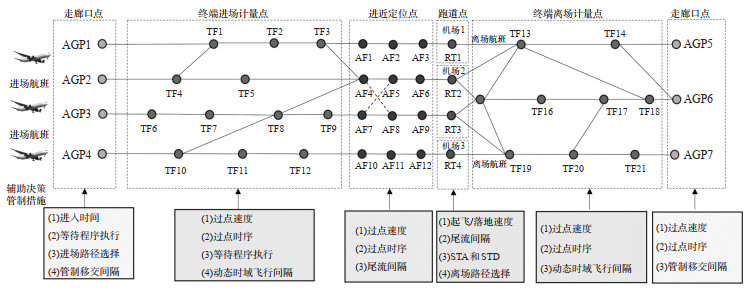
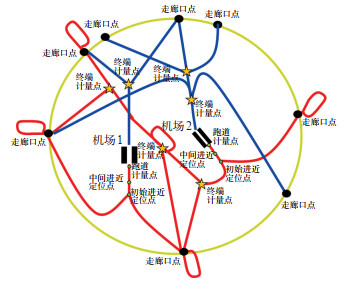
图 2 多机场终端区时空节点-链路图及各阶段辅助决策管制措施
Figure 2. Spatio-temporal node-link diagrams of multi-airport terminal and scheduling intervention to assist decision-making

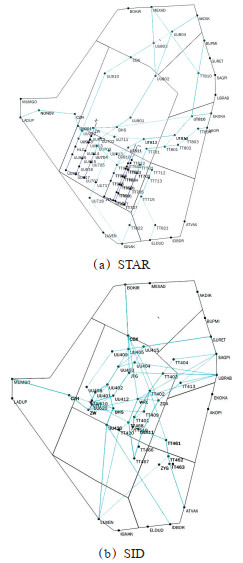
图 3 成都终端区STAR和SID(“南-北运行方向”)
Figure 3. Chengdu terminal area STAR and SID("south-north operation direction")

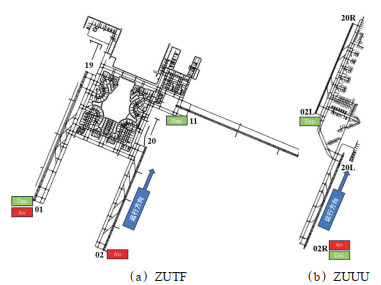
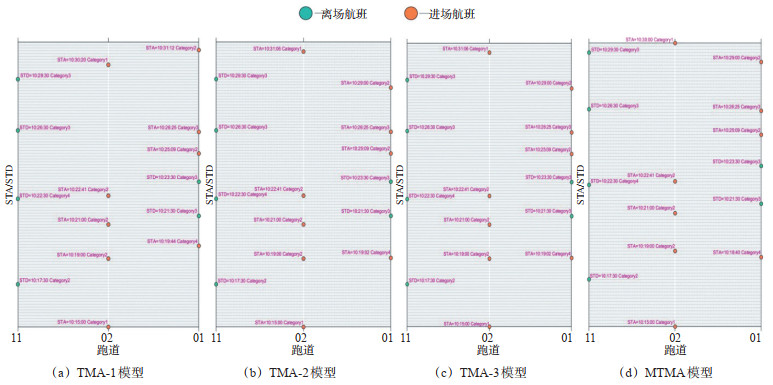
图 4 ZUUU和ZUTF的跑道运行模式(“南-北运行方向”)
Figure 4. Runway operating modes for ZUUU and ZUTF ('north-south operating direction')

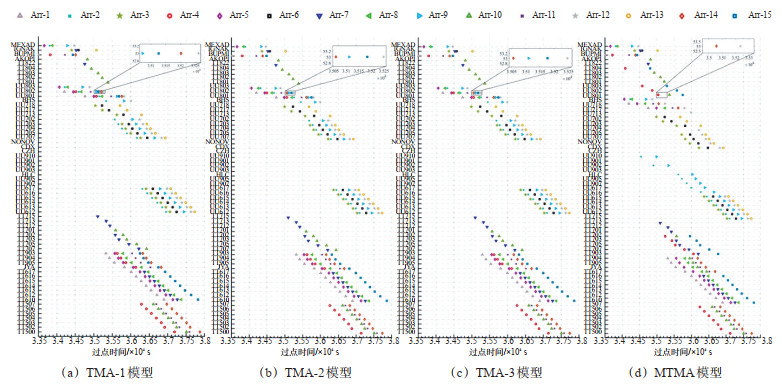
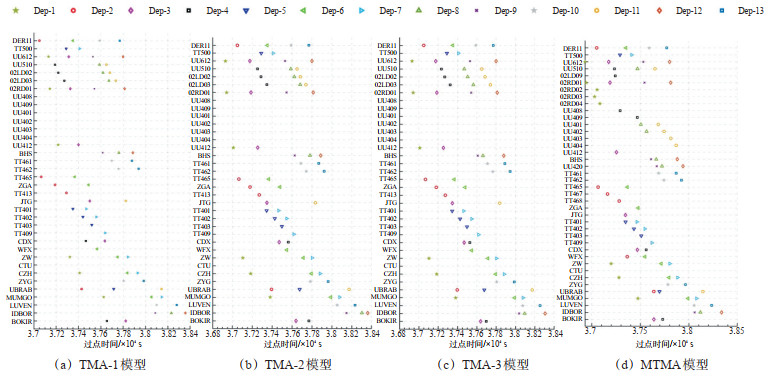
图 5 进场航班终端区过点时间和顺序
Figure 5. Passing times and sequencing of arrival aircraft at terminal metering points

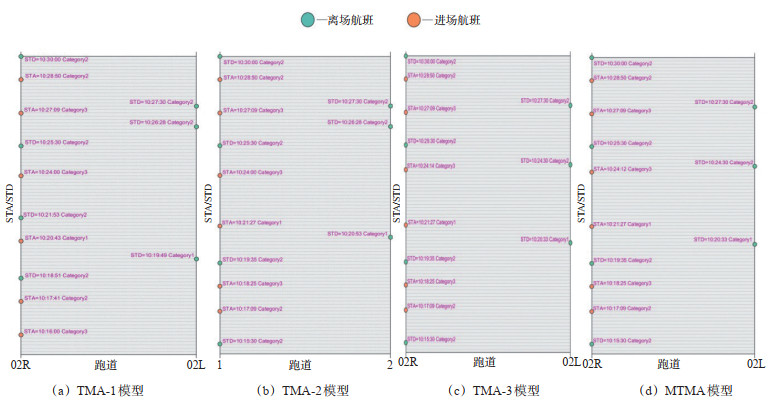
图 6 离场航班终端区过点时间和顺序
Figure 6. Passing times and sequencing of departure aircraft at terminal metering points
表 1 连续航班对类型尾流时间间隔
Table 1. Minimum runway separation criteria for various types of the leader-follow aircraft
单位: s 前序进场 后序进场 前序离场 后序进场 轻型 中型 大型 重型 轻型 中型 大型 重型 轻型 87 76 76 69 轻型 112 99 99 99 中型 145 101 76 69 中型 112 99 99 99 大型 145 101 101 103 大型 112 99 99 99 重型 174 127 127 103 重型 112 99 99 99 前序离场 后序离场 前序进场 后序离场 轻型 中型 大型 重型 轻型 中型 大型 重型 轻型 60 60 60 60 轻型 60 60 60 60 中型 60 60 60 60 中型 60 60 60 60 大型 60 60 60 60 大型 60 60 60 60 重型 60 60 60 60 重型 60 60 60 60  下载: 导出CSV
表 2 实验模型名称及说明
Table 2. Scheduling model description
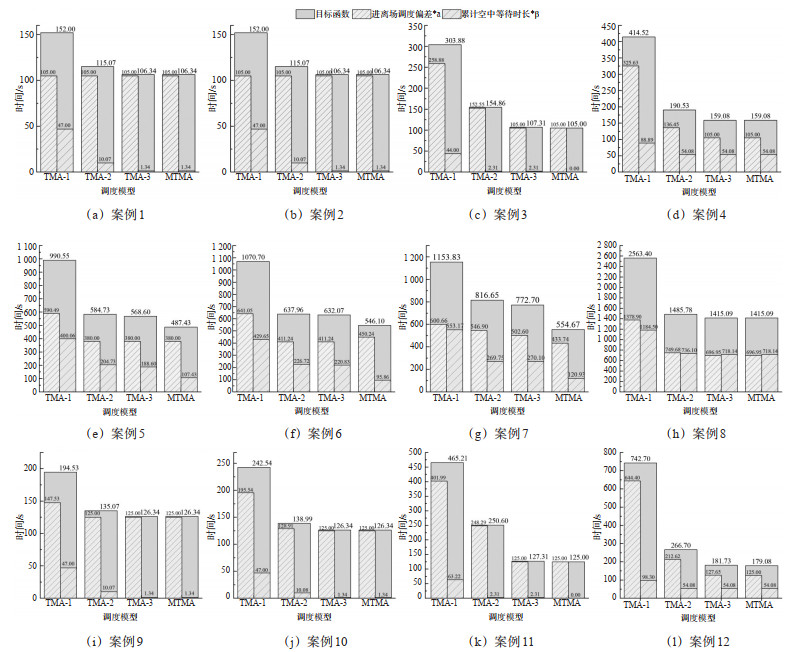
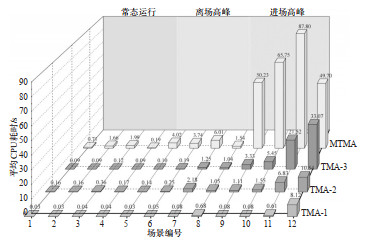
模型 说明 TMA-1 标称路径匀速飞行航班调度模型:航班依据标称路径进离场,并仅在走廊口实施等待程序。进入终端空域后,航班以历史统计的平均速度匀速飞行 TMA-2 标称路径速度决策航班调度模型:航班依据标称路径进离场,且仅可在走廊口实施等待程序。进入终端空域后,航班在首个终端计量点和LAF点参与速度决策,并根据决策速度保持匀速飞行 TMA-3 2.3所提融入多路径下多机场终端区进离场运行模型:航班依据标称路径进离场,模型启用终端计量点等待程序。进入终端空域后,航班在每个终端计量点和进近计量点参与速度决策 MTMA 2.4所提融入多路径下多机场终端区进离场运行模型:航班启用多路径进离场,模型启用终端计量点等待程序。航班进入终端空域后,可在每个终端计量点和进近计量点参与速度决策
下载: 导出CSV
表 3 进场航班计划信息
Table 3. Planned information for arrival aircraft
状态 类型 目的机场 计划跑道 走廊口点 ETA Arr1 1 ZUTF '02' BUMPI 10:15:00 Arr2 3 ZUUU '02R' MEXAD 10:16:00 Arr3 2 ZUUU '02R' IGNAK 10:17:00 Arr4 4 ZUTF '01' BUMPI 10:18:00 Arr5 2 ZUTF '02' MEXAD 10:19:00 Arr6 1 ZUUU '02R' IGNAK 10:20:00 Arr7 2 ZUTF '02' IGNAK 10:21:00 Arr8 2 ZUTF '02' MEXAD 10:22:00 Arr9 3 ZUUU '02R' MEXAD 10:24:00 Arr10 2 ZUTF '01' AKOPI 10:25:00 Arr11 3 ZUTF '01' BUMPI 10:26:00 Arr12 3 ZUUU '02R' MEXAD 10:27:00 Arr13 2 ZUUU '02R' IGNAK 10:28:00 Arr14 2 ZUTF '01' BUMPI 10:29:00 Arr15 1 ZUTF '02' BUMPI 10:30:00
下载: 导出CSV
表 4 离场航班计划信息
Table 4. Planned information for departure aircraft
状态 类型 目的机场 计划跑道 走廊口点 ETD Dep1 2 ZUUU '02R' MUMGO 10:15:30 Dep2 2 ZUTF '11' UBRAB 10:17:30 Dep3 2 ZUUU '02R' BOKIR 10:18:30 Dep4 1 ZUUU '02L' BOKIR 10:19:30 Dep5 3 ZUTF '01' UBRAB 10:21:30 Dep6 4 ZUTF '11' MUMGO 10:22:30 Dep7 3 ZUTF '01' MUMGO 10:23:30 Dep8 2 ZUUU '02L' IDBOR 10:24:30 Dep9 2 ZUUU '02R' IDBOR 10:25:30 Dep10 3 ZUTF '11' LUVEN 10:26:30 Dep11 2 ZUUU '02L' UBRAB 10:27:30 Dep12 2 ZUUU '02R' IDBOR 10:28:30 Dep13 3 ZUTF '11' LUVEN 10:29:30
下载: 导出CSV
表 5 多案例航班基础信息表
Table 5. Flight plan information for multiple instances
案例号 航班数量 进场/离场航班数量 运行状态 场景描述 案例1 20 10/10 常态 Aa 案例2 20 10/10 常态 Bb 案例3 20 10/10 常态 Cc 案例4 20 10/10 常态 Dd 案例5 28 10/18 离场高峰 A 案例6 28 10/18 离场高峰 B 案例7 28 10/18 离场高峰 C 案例8 28 10/18 离场高峰 D 案例9 28 18/10 进场高峰 A 案例10 28 18/10 进场高峰 B 案例11 28 18/10 进场高峰 C 案例12 28 18/10 进场高峰 D 注:a.所有进离场走廊口可用,进离场航班走廊口点随机分配。b. 受流控限制,仅东方和北方走廊口可用,进场走廊口点仅有MEXAD、AKDIK、BUPMI、AKOPI、EKOKA可用;离场航班走廊口点仅有BOKIP、SAGIB、UBRAB可用。c.受流控限制,仅北方走廊口可用,进场走廊口点仅有MEXAD、AKOPI可用;离场走廊口点仅有BOKIP可用。d.受流控限制,仅南方走廊口可用,进场走廊口点仅有IGNAK(无备选路径),离场走廊口点仅有LUVEN可用。
下载: 导出CSV
-
[1] 侯昌波, 夏朝禹, 田文, 等. 机场群一体化运行: 集成进离场与场面运行技术研究综述[J]. 科学技术与工程, 2023, 23 (12): 4943-4957.HOU C B, XIA C Y, TIAN W, et al. Integrated operation of metroplex: a review of integrated arrival and departure and surface operations technology[J]. Science and Technology and Engineering, 2023, 23(12): 4943-4957. (in Chinese) [2] 朱永文, 陈志杰, 蒲钒, 等. 空中交通智能化管理的科学与技术问题研究[J]. 中国工程科学, 2023, 25(5): 174-184.ZHU Y W, CHEN Z J, PU F, et al. Scientific and technological issues for the intelligent management of air traffic[J]. Strategic Study of CAE, 2023, 25(5): 174-184. (in Chinese) [3] ABEYRATNE R. The aviation system block upgrades: legal and regulatory issues[J]. Air and Space Law, 2014, 39(2): 131-154. [4] GING A, ENGELLAND S, CAPPS A, et al. Airspace technology demonstration 2 (atd-2) technology description document (tdd)[R]. Washington: National Aeronautics and Space Administration, 2018. [5] TORARANI D. Application of merging optimization to an arrival manager algorithm considering trajectory-based operations[J]. Transportation Research Part C: Emerging Technologies, 2019, 109: 40-59. doi: 10.1016/j.trc.2019.09.015 [6] NG K, LEE C K M, CHAN F T S, et al. Review on meta-heuristics approaches for airside operation research[J]. Applied Soft Computing, 2018, 66: 104-133. doi: 10.1016/j.asoc.2018.02.013 [7] 江灏, 刘继新. 进离场航班优化调度研究综述[J]. 航空计算技术, 2021, 51(4): 130-134.JIANG H, LIU J X. Survey review of arrival and depar-ture flight optimal scheduling[J]. Aeronautical Computing Technique, 2021, 51(4): 130-134. (in Chinese) [8] 张军峰, 马曌, 杜卓铭, 等. 多跑道混合运行模式进场航班动态鲁棒调度[J]. 航空学报, 2025, 46(7): 284-297.ZHANG J F, MA Z, DU Z M, et al. Dynamic robust scheduling of aircraft arrival in multi-runway mixed operation mode[J]. Acta Aeronautica et Astronautica Sinica, 2025, 46 (7): 284-297. (in Chinese) [9] NG W, RIBEIRO N A, JORGE D. An optimization approach for the terminal airspace scheduling problem[J]. Transportation Research Part C: Emerging Technologies, 2024, 169: 104856. doi: 10.1016/j.trc.2024.104856 [10] 夏朝禹, 刘卫东, 胡明华, 等. 考虑速度控制和等待程序利用的终端区空域运行优化[J]. 交通运输工程与信息学报, 2025, 23(2): 171-188.XIA C Y, LIU W D, HU M H, et al. Terminal area airspace operation optimization with consideration of speed control and utilization of holding[J]. Journal of Transportation Systems Engineering and Information Technology, 2025, 23(2): 171-188. (in Chinese) [11] 马晓萱, 张军峰, 朱玲. 复杂多跑道机场离场运行的动态协同调度[J]. 交通运输工程与信息学报, 2024, 22(4): 154-165.MA X X, ZHANG J F, ZHU L. Dynamic collaborative scheduling of departure operations of complex multi-runway airport[J]. Journal of Transportation Engineering and Information, 2024, 22(4): 154-165. (in Chinese) [12] 向征, 周鼎凯, 孙赫阳, 等. 基于强化学习的终端区离场排序研究[J]. 航空计算技术, 2023, 53(3): 30-34.XIANG Z, ZHOU D K, SUN H Y, et al. Research on departure sequencing in multi-airport terminal area based on reinfocement learning[J]. Aeronautical Computing Technique, 2023, 53(3): 30-34. (in Chinese) [13] DESAI J, PRAKASH R. An optimization framework for terminal sequencing and scheduling: the single runway case[C]. The Second Asia-Pacific Conference on Complex Systems Design & Management, Singapore: Springer, 2016. [14] SAMA M, DARIANO A, PALAGACHEV K, et al. Integration methods for aircraft scheduling and trajectory optimization at a busy terminal manoeuvring area[J]. Or Spectrum, 2019, 41: 641-681. doi: 10.1007/s00291-019-00560-1 [15] NG K K H, LEE C K M, CHAN F T S, et al. A two-stage robust optimisation for terminal traffic flow problem[J]. Applied Soft Computing, 2020, 89: 106048. doi: 10.1016/j.asoc.2019.106048 [16] CECEN R K, CETEK C, KAYA O. Aircraft sequencing and scheduling in TMAs under wind direction uncertainties[J]. The Aeronautical Journal, 2020, 124: 1896-1912. doi: 10.1017/aer.2020.68 [17] 王建忠, 丁小芹, 王树伟. 考虑潜在冲突的进离场航班协同排序[J]. 交通运输系统工程与信息, 2023, 23(5): 312-320.WANG J Z, DING X Q, WANG S W. Collaborative sequencing of arrival and departure aircraft considering potential conflicts[J]. Journal of Transportation Systems Engineering and Information Technology, 2023, 23 (5): 312-320. (in Chinese) [18] 马园园, 胡明华, 尹嘉男, 等. 多机场终端区进离场交通流协同排序方法[J]. 航空学报, 2017, 38(2): 225-237.MA Y Y, HU M H, YIN J N, et al. Collaborative sequencing and scheduling method for arrival and departure traffic flow in multi-airport terminal areas[J]. Acta Aeronautica et Astronautica Sinica, 2017, 38(2): 225-237. (in Chinese) [19] XUE M, ZELINSKI S. Optimal integration of departures and arrivals in terminal airspace[J]. Journal of Guidance, Control, and Dynamics, 2014, 37(1): 207-213. doi: 10.2514/1.60489 [20] 张军峰, 葛腾腾, 郑志祥. 多机场终端区进离场航班协同排序研究[J]. 交通运输系统工程与信息, 2017, 17(2): 197-204.ZHANG J F, GE T T, ZHENG Z X. Collaborative arrival and departure sequencing for multi-airport terminal area[J]. Journal of Transportation Systems Engineering and Information Technology, 2017, 17(2): 197-204. (in Chinese) [21] XIA C Y, WEN Y, Hu M H, et al. Microscopic-level collaborative optimization framework for integrated arrival-departure and surface operations: integrated runway and taxiway aircraft sequencing and scheduling[J]. Aerospace, 2024, 11(12): 1042. doi: 10.3390/aerospace11121042 [22] 乐美龙, 吴宪晟, 胡钰明. 基于滚动时域控制的多路径进场航班排序优化[J]. 北京航空航天大学学报, 2023, 49(12): 3222-3229.LUE M L, WU X S, HU Y M. Arrival flights optimal sequencing with multi-path selection based on rolling horizon control[J]. Journal of Beijing University of Aeronautics and Astronautics, 2023, 49(12): 3222-3229. (in Chinese) [23] 张兆宁, 刘珂璇. 基于替代航路的进场航班排序优化方法[J]. 数学的实践与认识, 2019, 49(12): 191-198.ZHANG Z N, LIU K X. Approach flight sequencing optimisation method based on alternative routes[J]. Journal of Mathematics in Practice and Theory, 2019, 49(12): 191-198. (in Chinese) [24] NG K, CHEN C H, LEE C K M. Mathematical programming formulations for robust airside terminal traffic flow optimisation problem[J]. Computers & Industrial Engineering, 2021, 154: 107119. [25] 夏朝禹, 刘卫东, 胡明华, 等. 飞行区进离场航班跑道和滑行道双层协同优化调度方法[J]. 交通信息与安全, 2024, 42 (5): 42-53. doi: 10.3963/j.jssn.1674-4861.2024.05.005XIA C Y, LIU W D, HU M H, et al. Research on bi-layer coordinated optimization scheduling of runway and taxiway for arriving and departing flights in airfield area[J]. Journal of Transport Information and Safety, 2024, 42(5): 42-53. (in Chinese) doi: 10.3963/j.jssn.1674-4861.2024.05.005 [26] HUO Y. Optimization of arrival air traffic in the terminal area and in the extended airspace[D]. Toulouse: Université Paul Sabatier-Toulouse Ⅲ, 2022. [27] XIA C Y, WU Z Y, YANG C R, et al. Combining arrival-departure scheduling with runway configuration mode switches[C]. IEEE 5th International Conference on Civil Aviation Safety and Information Technology, Dali: IEEE, 2023. -

 点击查看大图
计量
- 文章访问数: 10
- HTML全文浏览量: 3
- PDF下载量: 0
- 被引次数: 0