



An EEG-based Workload Recognition Method for Civil Aviation Student Pilots
-
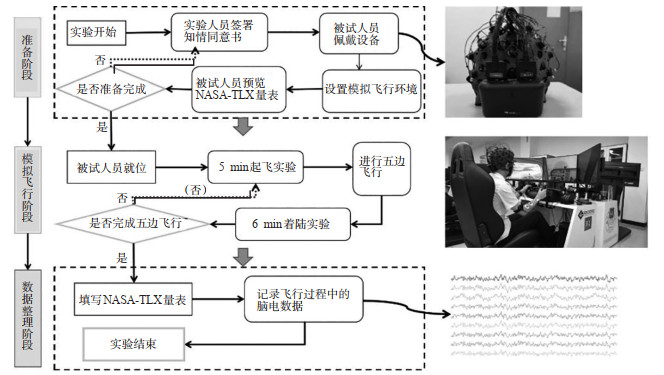
摘要: 民航飞行学员的工作负荷水平直接影响飞行安全。针对基于脑电信号(electroencephalogram,EEG)的民航飞行学员工作负荷识别方法存在模型泛化能力不足、对跨频段与空间特征利用不充分等问题,研究了基于EEG特征的民航飞行学员工作负荷识别方法:①提出了主客观相结合的评估框架,通过在模拟飞行环境中采集不同任务场景下民航飞行学员的脑电信号及任务负荷评估量表(NASA task load index, NASA-TLX)数据,以此同步获取飞行学员工作负荷的客观生理测量和主观负荷数据;②针对传统研究中多孤立考察单一频段,从而忽视频段间的交互关系,采用独立样本t检验分析,筛选出具有显著差异性的脑电特征参数(P < 0.05)。进一步结合全脑功率谱密度激活图,分析不同工作负荷下θ、δ、α、β频段与跨频段功率比值的神经响应机制和空间分布特性;③利用提取后的全频段及各子频段的脑电特征进行模型训练,建立基于卷积神经网络(convolutional neural network,CNN)和长短期记忆网络(long short-term memory,LSTM)的工作负荷识别模型,以此实现对工作负荷演变的精准识别。实验发现:所选特征能够区分不同负荷下的神经调控模式,在高工作负荷时,民航飞行学员的α、θ、β频段能量上升,而δ频段能量下降。其中,θ节律通过额-顶-右颞环路实现资源优先调配,而α频段在左颞—顶—前额通路呈现抑制干扰的功能增强;本文模型在识别脑电特征时,实现了对脑电信号的空间分布模式和时域动态特征的同步捕捉。本文混合模型在测试集准确率达到94.5%,准确率优于传统单一模型CNN、LSTM、Transformer;α频段的测试集准确率达到95.5%,能够有效识别飞行员的工作负荷。Abstract: The workload of civil aviation student pilots directly impacts flight safety. To address the limitations of existing electroencephalogram (EEG) based pilot workload recognition methods, such as poor model generalization and insufficient utilization of cross-band and spatial features. This study investigates and develops an EEG-based approach for workload recognition in civil aviation student pilots. An integrated subjective-objective evaluation framework is established. EEG signals and NASA Task Load Index (NASA-TLX) data are collected from student pilots under different task scenarios in a simulated flight environment to concurrently acquire both objective physiological measurements and subjective workload assessments. To overcome the limitation of traditional studies that isolate individual frequency bands and neglect inter-band interactions, an independent samples t-test is applied to identify EEG features with significant differences (P < 0.05). Furthermore, by incorporating whole-brain power spectral density activation maps, the neural response mechanisms, and spatial distribution patterns of the θ, δ, α, and β bands, as well as cross-band power ratios, are analyzed under varying workload levels. Third, the extracted EEG features from the full frequency band and each sub-frequency band are used for model training, and a hybrid model based on convolutional neural network (CNN) and long short-term memory (LSTM) for workload recognition is developed to achieve accurate recognition of workload states. Experimental results showed that the selected features could distinguish the neural regulation modes under different workloads. At high workload, the spectral power of the α, θ, and β bands increased in civil aviation student pilots, while the spectral power of the δ band decreased. Specifically, the θ rhythm facilitated the priority allocation of resources through a frontal-parietal and right temporal circuit, while α rhythms exhibited enhanced interference suppression along the left temporal-parietal-prefrontal pathway. The constructed model successfully captured both the spatial and temporal dynamics of EEG signals. Moreover, the hybrid model achieved a test accuracy of 94.5%, outperforming traditional single models such as CNN, LSTM, and Transformer. Notably, using α-band features alone yielded a test accuracy of 95.5%, confirming the efficacy of the proposed method in identifying pilot workload states.
-
Key words:
- flight safety /
- workload /
- EEG signal /
- machine learning /
- feature analysis
-

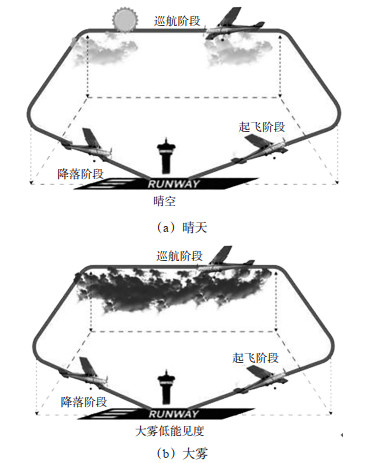
图 2 不同天气条件下的模拟五边飞行
Figure 2. Simulated five-sided flight under different weather conditions

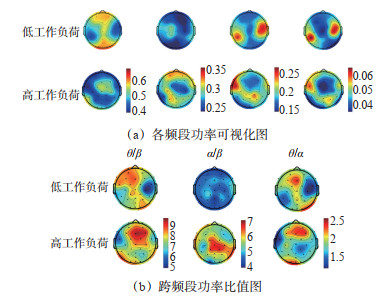
图 7 不同工作负荷下各频段脑电功率图及跨频段功率比值图
Figure 7. Power maps of each EEG frequency band and cross-band power ratio maps under different workloads

图 9 不同工作负荷下全脑模型训练结果
Figure 9. Whole-brain model training results under different workloads

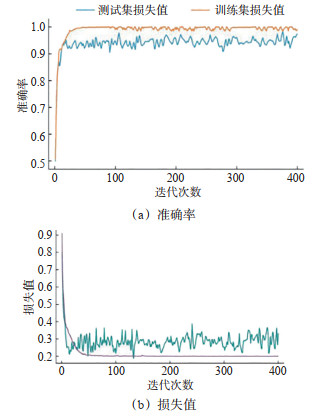
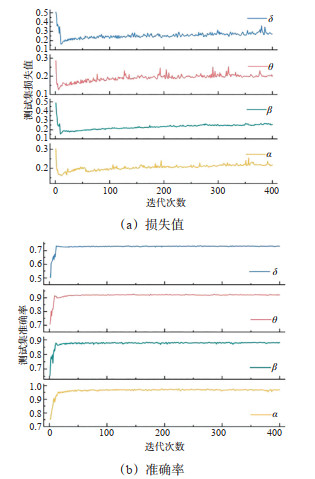
图 10 各频段全脑模型训练准确率和损失值结果
Figure 10. Accuracy and loss value results of whole-brain model training in different frequency bands
表 1 五边飞行各阶段定义及飞行参数
Table 1. Definition of each phase of the Five-Sided flight and flight parameters
飞行阶段 飞行与跑道关系 任务描述 一边飞行 与跑道方向相同 起飞后爬升,表速101 km/h抬轮,保持爬升率大于0 km/h 二边飞行 与跑道成90° 保持航迹90°飞行,二转弯横滚坡度小于30° 三边飞行 与跑道平行但相反 保持航迹360°飞行,高度应保持在335 m 四边飞行 与跑道成90° 保持270°飞行,转弯时横滚坡度小于30° 五边飞行 与跑道方向相同 对准跑道,进近下降率小于9 km/h,轨迹偏离小于15 m,跑道入口高于跑道标高15 m以上  下载: 导出CSV
表 2 脑电各频段作用机理
Table 2. Mechanisms of Action for each EEG frequency band
频段 频率/Hz 作用机理 δ >0.5~4 与决策不确定性或错误监测相关 θ >4~8 与工作记忆负载、心理努力和认知控制相关 α >8~14 通过抑制调控脑力资源,与优化信息处理有关 γ >14~30 与积极的、活跃的认知过程相关
下载: 导出CSV
表 3 提取后的脑电数据特征
Table 3. Extracted EEG data features
样本号 PSD ESD 分类 δ θ α β δ θ α β 1 0.273 32 0.192 33 0.122 10 0.034 63 0.559 02 0.535 56 0.411 01 0.651 17 晴天 2 0.267 13 0.110 18 0.069 91 0.031 41 0.734 87 0.602 11 0.396 76 0.669 37 晴天 3 0.471 46 0.278 88 0.114 10 0.057 87 1.886 25 1.146 61 0.711 43 1.316 32 晴天 4 0.290 84 0.206 35 0.124 27 0.045 67 1.848 24 1.018 98 0.646 92 1.214 12 大雾 5 0.321 72 0.170 21 0.246 96 0.038 73 0.891 06 0.726 65 0.628 51 0.682 29 大雾 ⋮ ⋮ ⋮ ⋮ ⋮ ⋮ ⋮ ⋮ ⋮ ⋮
下载: 导出CSV
表 4 不同情境下各频段全脑平均PSD和ESD
Table 4. Average PSD and ESD of all brain frequency bands under different situation
类别 组别 低工作负荷 高工作负荷 F P PSD/[(μV)2/Hz] δ 0.596 3±0.287 08 0.550 8±0.250 27 1.551 <0.001 θ 0.261 9±0.111 60 0.323 3±0.151 36 52.94 0.009 α 0.145 1±0.062 35 0.214 2±0.131 26 15.422 <0.001 β 0.030 4±0.012 27 0.051 0±0.035 53 10.324 <0.001 ESD/(μV2· s) α 2.676 2±1.334 06 2.199 0±1.372 25 0.288 <0.001 β 1.747 2±1.183 89 1.617 2±0.874 11 1.730 0.022 θ 4.228 7±1.884 29 5.666 5±1.462 89 9.228 <0.001 δ 9.027 6±4.446 12 16.094 0±1.040 32 10.167 <0.001
下载: 导出CSV
表 5 CNN-LSTM模型参数
Table 5. Parameters of the CNN-LSTM model
参数 参数值 输入层 输入节点数 10 卷积层filters 32 卷积层kernel_size 5 CNN层 卷积层激活函数 relu 卷积层padding 1 池化层pool_size 2 LSTM层 LSTM激活函数 Sigmoid 输出节点数 1 损失函数 binary_crossentropy 输出层 batch_size 128 学习率 0.001 epoch 400
下载: 导出CSV
表 6 不同工作负荷模型实验对比
Table 6. Comparison of experiments with different workload models
模型 准确率/% 精确率/% F1分数/% CNN 92.33 92.37 92.27 LSTM 92.84 92.57 92.17 Transformer 93.39 93.17 93.67 CNN-LSTM 94.89 94.87 94.88
下载: 导出CSV
-
[1] 夏朝禹, 刘卫东, 胡明华, 等. 飞行区进离场航班跑道和滑行道双层协同优化调度方法[J]. 交通信息与安全, 2024, 42(5): 42-53. doi: 10.3963/j.jssn.1674-4861.2024.05.005XIA Z Y, LIU W D, HU M H, et al. A bi-layer coordinated optimization scheduling method of runway and taxiway for arriving and departing flights in airfield area[J]. Journal of Transport Information and Safety, 2024, 42(5): 42-53. (in Chinese) doi: 10.3963/j.jssn.1674-4861.2024.05.005 [2] LI Y, CHEN H, XIN X, et al. The influence of mindfulness on mental state with regard to safety among civil pilots[J]. Journal of Air Transport Management, 2020, 84: 101768. doi: 10.1016/j.jairtraman.2020.101768 [3] 王逸凡, 孙有朝, 刘勋, 等. 起飞阶段民机驾驶舱人机系统风险分析方法研究[J]. 交通信息与安全, 2024, 42(4): 42-52. doi: 10.3963/j.jssn.1674-4861.2024.04.005WANG Y F, SUN Y Z, LIU X, et al. A risk analysis of human-machine system of civil aircraft in take-off stage[J]. Journal of Transport Information and Safety, 2024, 42(4): 42-52. (in Chinese) doi: 10.3963/j.jssn.1674-4861.2024.04.005 [4] KELLY D, EFTHYMIOU M. An analysis of human factors in fifty controlled flight into terrain aviation accidents from 2007 to 2017[J]. Journal of Safety Research, 2019, 69(6): 155-165. [5] 王福旺, 王宏, 罗旭. 基于EEG与EOG信号的疲劳驾驶状态综合分析[J]. 东北大学学报(自然科学版), 2014, 35(2): 175-178.WANG F W, WANG H, LUO X. Comprehensive analysis of fatigue driving based on EEG and EOG[J]. Journal of Northeastern University(Natural Science), 2014, 35(2): 175-178. (in Chinese) [6] 张宁宁, 陈飒. 基于心率变异性的飞行员脑力负荷特征[J]. 科学技术与工程, 2024, 24(13): 5634-5641.ZHANG N N, CHEN S. Mental workload characteristics of pilots based on heart rate variability[J]. Science Technology and Engineering, 2024, 24(13): 5634-5641. (in Chinese) [7] DIAS N S, CARMO J P, MENDES P M, et al. Wireless instrumentation system based on dry electrodes for acquiring EEG signals[J]. Medical Engineering & Physics, 2012, 34(7): 972-981. [8] 李葳宁, 韩宗昌, 邢晨光. 基于脑电信号的飞行员认知负荷实时监测评估系统[J]. 航空科学技术, 2024, 35(11): 95-103.LI W N, HAN Z C, XING C G. Real-time mental workload monitoring and evaluation system based on EEG signals of pilots[J]. Aeronautical Science & Technology, 2024, 35(11): 95-103. (in Chinese) [9] 郝锐, 郑欣, 李怡霖. 基于生理信号的危险作业人员心理负荷识别研究[J]. 东北大学学报(自然科学版), 2024, 45 (4): 600-608.HAO R, ZHENG X, LI Y L. Research on identifying the psychological load of operators in hazardous operations based on physiological signals[J]. Journal of Northeastern University (Natural Science), 2024, 45(4): 600-608. (in Chinese) [10] GUO M Y, DUAN P Y, JIN X P, et al. A performance-based mental workload identification method for special vehicle crews[J]. Physiology & Behavior, 2025, 288: 114706. [11] DOMINI J, LEONIE M, ALEXANDER R. The tactile signal detection task and why it could change how we measure workload[J]. Applied Ergonomics, 2025, 124: 104404. doi: 10.1016/j.apergo.2024.104404 [12] CHEN W Y, SAWARAGI T, HIRAOKA T. Comparing driver reaction and mental workload of visual and auditory take-over request from perspective of driver characteristics and eye-tracking metrics[J]. Transportation Research Part F: Traffic Psychology and Behaviour, 2023, 97: 396-410. doi: 10.1016/j.trf.2023.07.012 [13] 邹策. 基于多生理信息融合的驾驶疲劳检测方法研究[D]. 秦皇岛: 燕山大学, 2018.ZOU C. Research on driving fatigue detection method based on multi-physiological information fusion. [D]. Qinhuangdao: Yanshan University, 2018. (in Chinese) [14] SOARES S M P, PRYSTAUKA Y, DELUCA V, et al. Brain correlates of attentional load processing reflect degree of bilingual engagement: evidence from EEG[J]. NeuroImage, 2024, 298: 120786. doi: 10.1016/j.neuroimage.2024.120786 [15] VAN WEELDEN E, ALIMARDANI M, WILTSHIRE T J, et al. Aviation and neurophysiology: a systematic review[J]. Applied Ergonomics, 2022, 105: 103838. doi: 10.1016/j.apergo.2022.103838 [16] VAN WEELDEN E, WILTSHIRE T J, ALIMARDANI M, et al. Exploring the impact of virtual reality flight simulations on EEG neural patterns and task performance[J]. Cognitive Systems Research, 2024, 88: 101282. doi: 10.1016/j.cogsys.2024.101282 [17] CHAKLADAR D D, DEY S, ROY P P, et al. EEG-based mental workload estimation using deep BLSTM-LSTM network and evolutionary algorithm[J]. Biomedical Signal Processing and Control, 2020, 60: 101989. doi: 10.1016/j.bspc.2020.101989 [18] BEIRAMVAND M, SHAHBAKHTI M, LIPPING T. Evaluating mental workload through cross-entropy analysis of two prefrontal EEG channels[C]. 9th European Medical and Biological Engineering Conference, Portoroz, Slovenia: IFMBE, 2024. [19] SAFARI M, SHALBAF R, BAGHERZADEH S, et al. Classification of mental workload using brain connectivity and machine learning on electroencephalogram data[J]. Scientific Reports, 2024, 14: 9153. doi: 10.1038/s41598-024-59652-w [20] 白杰. 绿色牵引滑行模式下的飞行员脑力负荷研究[D]. 天津: 中国民航大学, 2024.BAI J. Study on mental workload of pilots in green aircraft towing taxi mode[D]. Tianjin: Civil Aviation University of China, 2024. (in Chinese). [21] HYVARINEN A, OJA E. Independent component analysis: algorithms and applications[J]. Neural Networks, 2000, 13 (4-5): 411-430. doi: 10.1016/S0893-6080(00)00026-5 [22] 储银雪. 基于脑电功率图谱的飞行员疲劳状态识别[D]. 上海: 上海交通大学, 2019.CHU Y X. Pilot fatigue state recognition based on EEG power spectrum[D]. Shanghai: Shanghai Jiao Tong University, 2019. (in Chinese) -

 点击查看大图
计量
- 文章访问数: 6
- HTML全文浏览量: 4
- PDF下载量: 0
- 被引次数: 0