



A Travel Time Prediction Model for Rescue Vehicles Based on Tensor Decomposition
-
摘要: 救援车辆在城市道路中行驶时具有优先通行权,针对救援车辆的行驶特性预测其在城市道路网络中的行程时间为救援活动开展提供支持,能有效提高救援效率。考虑城市道路交通拥堵状态构建基于张量分解的救援车辆行程时间预测模型(rescue vehicles travel time prediction model based on tensor decomposition, RTPT),该模型框架集成了融合拥堵状态的张量分解算法、救援车辆行驶特性挖掘方法和救援车辆行程时间预测算法。融合拥堵状态的张量分解算法利用车辆轨迹数据构建城市道路行程时间张量,并采用融合拥堵状态的Tucker张量分解算法补全缺失数据;救援车辆行驶特性挖掘方法通过挖掘救援车辆与社会车辆的行驶模式的关联性,构建救援车辆在城市道路路网中的行程时间张量;救援车辆行程时间预测算法构建拥堵概率张量,以道路拥堵概率为权重,预测救援车辆在不同数据稀疏度和不同时间段下的行程时间。将构建的RTPT模型与其他模型进行对比验证模型性能,实验结果表明:RTPT的平均绝对误差与基于驾驶人的道路行程时间估计方法(driver-based road trip time estimation,DRTE)、移动平均法(moving average,MA)、历史平均法(historical average,HA)相比平均分别降低了32.44%、70.66%、74.50%;RTPT的均方根误差和DRTE、MA、HA相比平均分别降低了24.28%、69.73%、74.67%,RTPT在预测范围和数据稀疏性的所有情况下都表现出最小的误差。随着数据稀疏度和预测时段的增加,RTPT的预测误差范围变动基本保持在1 s以内,显示出其良好的稳定性与鲁棒性。RTPT利用拥堵概率张量更好地表述救援车辆行驶特殊性,涵盖了交通路网信息,从而提高了预测精度。Abstract: Rescue vehicles have the right of way when driving on urban roads, and predicting their travel time in the urban road network can provide support for rescue activities according to the driving characteristics of rescue vehicles, which can effectively improve rescue efficiency. This paper proposes a model for predicting the travel time of rescue vehicles based on tensor decomposition considering congestion, termed the rescue vehicles travel time prediction model based on tensor decomposition (RTPT). The RTPT model integrates tensor decomposition algorithm, travel characteristics extraction, and a travel time prediction algorithm, all considering road congestion states. The tensor decomposition algorithm fused with congestion state constructs an urban road travel time tensor based on vehicle trajectory data, applying congestion-informed Tucker tensor decomposition to complete missing data. The travel characteristics extraction method examines the distinct driving patterns of rescue vehicles in contrast to social vehicles, constructing a travel time tensor for rescue vehicles in the urban road network. In the travel time prediction algorithm, a congestion probability tensor is constructed to weight the road congestion probabilities for predicting rescue vehicles travel time across varying data sparsity and time intervals. Experimental results show that RTPT achieves a substantial reduction in average absolute error, outperforming traditional methods: driver-based road trip time estimation (DRTE), moving average (MA), and historical average (HA) by 32.44%, 70.66% and 74.50%, respectively. Additionally, the model reduces the root mean square error by 24.28%, 69.73% and 74.67%, compared to DRTE, MA, and HA, respectively, exhibiting minimal error across all prediction scenarios and data conditions. With the increase of data sparsity and prediction period, the variation of the prediction error range of RTPT is basically kept within 1 s, showing its good stability and robustness. The integration of the congestion probability tensor significantly enhances the model ability to reflect the unique driving characteristics of rescue vehicles while incorporating comprehensive traffic network information, resulting in improved prediction accuracy.
-

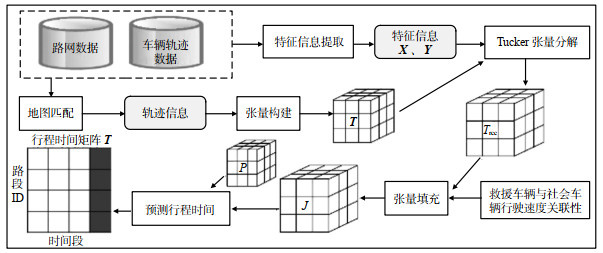
图 3 基于张量分解的救援车辆行程时间预测模型框架
Figure 3. The data-driven model framework for predicting travel time for rescue vehicles

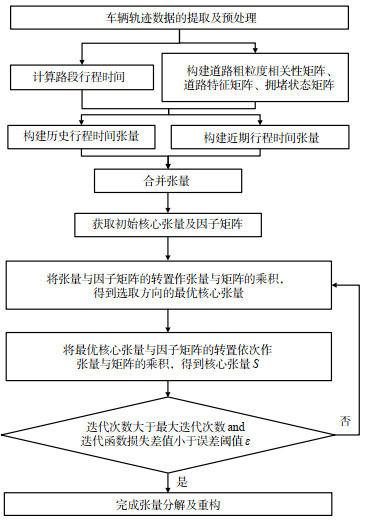
图 4 城市道路行程时间张量分解及重构流程图
Figure 4. Flow diagram of tensor decomposition and reconstruction of urban road travel time

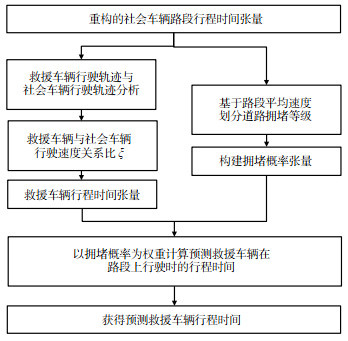
图 5 救援车辆行程时间预测流程图
Figure 5. Flowchart for prediction of travel time for rescue vehicles

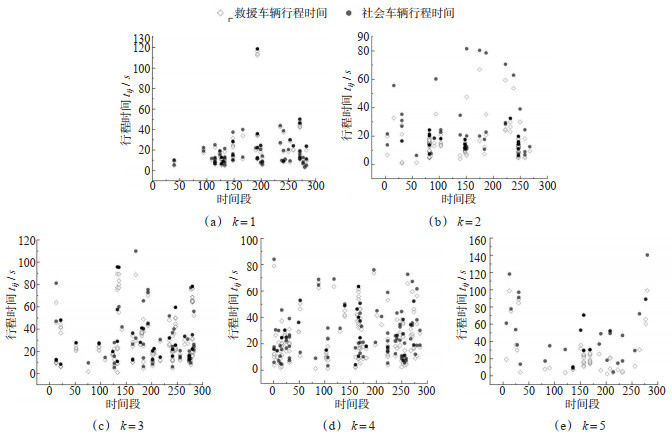
图 6 不同拥堵等级下救援车辆与社会车辆行程时间比对
Figure 6. Comparison of travel time between rescue vehicles and social vehicles under different congestion levels

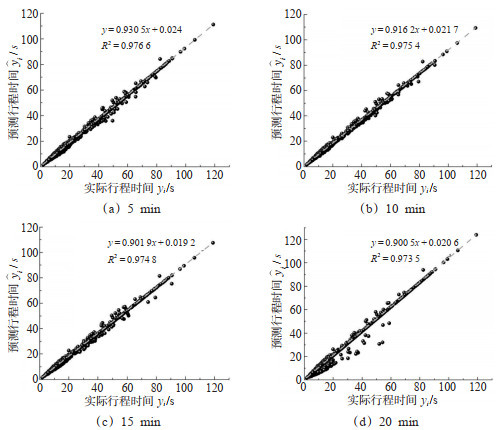
图 7 实际行程时间和RTPT预测行程时间对比图
Figure 7. Comparison chart of the actual travel time and the predicted travel time of RTPT

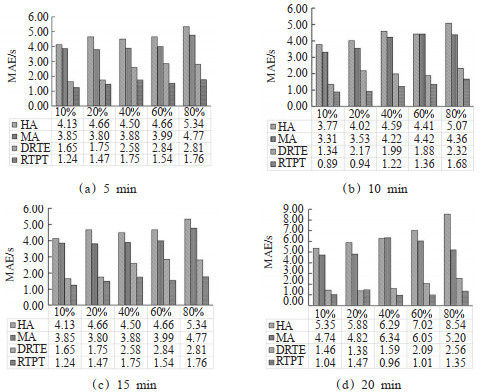
图 8 不同稀疏度下不同时段内各模型预测的平均绝对误差
Figure 8. The average absolute error of each model prediction in different time periods under different sparsity

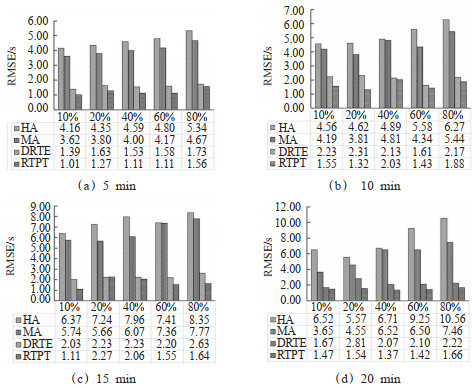
图 9 不同稀疏度下不同时段内各模型预测的均方根误差
Figure 9. Root mean square error predicted by each model in different time periods under different sparsity
表 1 路段平均行程速度与交通拥堵度的对应关系
Table 1. The correspondence between the average travel speed and traffic congestion
限速值/(km/h) 平均行程速度/(km/h) 80 ≥ 45 [30, 45) [20, 30) [14, 20) [0, 14) 70 ≥ 40 [30, 40) [20, 30) [14, 20) [0, 14) 60 ≥ 35 [30, 35) [20, 30) [14, 20) [0, 14) 50 ≥ 30 [25, 30) [15,25) [7, 15) [0, 7) 40 ≥ 25 [20, 25) [15,20) [7, 15) [0, 7) <40 [25, 40) [20, 25) [10, 20) [5, 10) [0, 5) 交通拥堵等级 1 2 3 4 5  下载: 导出CSV
表 2 数据信息
Table 2. Data information
数据集 数据类型 地点 时间跨度 地图匹配方法 时间间隔/min 出租车数据 出租车GNSSS轨迹数据 深圳市 2018.10 IVMM 5 救援车辆数据 救援车辆轨迹数据 深圳市 2018.10 IVMM 5
下载: 导出CSV
表 3 模型数据统计
Table 3. Model data statistics
符号 大小 非零项比例/% Tr 36 377×288×5 0.033 Th 36 377×288×5 0.46 J 36 377×288×5 1 p 36 377×288×5 1 X 576×9 1 Y 36 377×3 1
下载: 导出CSV
-
[1] TANG C, HU W, HU S, et al. Urban traffic route guidance method with high adaptive learning ability under diverse traffic scenarios[J]. IEEE Transactions on Intelligent Transportation Systems, 2021, 22(5): 2956-2968. doi: 10.1109/TITS.2020.2978227 [2] BRENDAN M, LAWRENCE, JENNIFER A. OXLEY. You say one route, we observe four: Using naturalistic observation to understand route-choices in cyclists[J]. Safety Science, 2019, 119: 207-213. doi: 10.1016/j.ssci.2019.01.004 [3] ALALI Z T, ALABADY S A. Techniques and methods for managing disasters and critical situations[J]. Nat Hazards, 2024, 120: 6943-6989. doi: 10.1007/s11069-024-06573-6 [4] TAN Z Y, ZHANG Q, WEI L, et al. A simulation-based optimization for deploying multiple kinds road rescue vehicles in urban road networks[J]. Computers & Industrial Engineering, 2023, 181: 109333. [5] WEN H Y, LIN Y F, WU J B. Co-Evolutionary optimization algorithm based on the future traffic environment for emergency rescue path planning[J]. IEEE ACCESS, 2020(8): 148125-148135. [6] HUANG L P, YANG Y J, CHEN H C, et al. Context-aware road travel time estimation by coupled tensor decomposition based on trajectory data[J]. Knowledge-Based Systems, 2022, 245: 108596. doi: 10.1016/j.knosys.2022.108596 [7] XING Y, HAO Y Q. Research on travel time prediction of expressway in peak period based on Greenberg model[J]. International Journal of Simulation and Process Modelling, 2022, 19. 1-2: 54-61. [8] MARTÍNEZ DÍAZ M, SORIGUERA F. Short-term prediction of freeway travel times by fusing input-output vehicle counts and GPS tracking data[J]. Transportation Letters, 2021, 13. 3: 193-200. [9] WANG Q Q, LI H M, XIONG W X. Research on expressway travel time prediction based on exclusive disjunctive soft set[J]. MATEC Web of Conferences, 2020, 308: 02005. doi: 10.1051/matecconf/202030802005 [10] 金广垠, 沙恒宇, 张金雷, 等. 基于路段-路口联合建模的对偶图卷积网络的行程时间估计方法[J]. 地球信息科学学报, 2023, 25(7): 1500-1513.JIG G Y, SHA H Y, ZHANG J L, et al Travel time estimation method based on dual graph convolutional networks via joint modeling of road segments and intersections[J]. Journal of Geo-information Science, 2023, 25(7): 1500-1513. (in Chinese) [11] CHEN T, CAI Y, CHEN L, et al. Trajectory and velocity planning method of emergency rescue vehicle based on segmented three-dimensional quartic bezier curve[J]. IEEE Transactions on Intelligent Transportation Systems, 2023, 24 (3): 3461-3475. doi: 10.1109/TITS.2022.3224785 [12] SHAO Z, MA Z, LIU S, et al. Optimization of a traffic control scheme for a post-disaster urban road network[J]. Sustainability, 2018, 10(1): 68. [13] LU K, LIU J, ZHOU X, et al. A review of big data applications in urban transit systems[J]. IEEE Transactions on Intelligent Transportation Systems, 2021, 22(5): 2535-2552. doi: 10.1109/TITS.2020.2973365 [14] 祝浩祈, 王甫红, 张万威, 等. 一种城市环境下GNSS/ MEMS IMU车载实时精密定位方法[J]. 武汉大学学报(信息科学版), 2023, 48(7): 1232-1240. (in Chinese)ZHU H Q, WANG F H, ZHANG W W, et al. Real-Time precise positioning method for vehicle-borne GNSS/MEMS IMU integration in urban environment[J]. Geomatics and Information Science of Wuhan University, 2023, 48(7): 1232-1240. (in Chinese) [15] ZHANG Z W, WANG H J, FAN Z P, et al. Missing road condition imputation using a multi-view heterogeneous graph network from GPS trajectory[J]. IEEE Transactions on Intelligent Transportation Systems, 2023, 24(5): 4917-4931. doi: 10.1109/TITS.2023.3243087 [16] 赵亚伟, 陈艳晶, 管伟. 基于多维时间序列的ETC短时交通流量预测模型[J]. 交通运输系统工程与信息, 2016, 16 (4): 191-198.ZHAO Y W, CHEN Y J, GUAN W. ETC short-term traffic flow prediction model based on multi-dimensional time series[J]. Journal of Transportation Systems Engineering and Information Technology, 2016, 16(04): 191-198. (in Chinese) [17] 钟颖, 邵毅明, 吴文文, 等. 基于XGBoost的短时交通流预测模型[J]. 科学技术与工程, 2019, 19(30): 337-342.ZHONG Y, SHAO Y M, WW W W, et al. Short-Term traffic flow prediction based on XGBoost[J]. Science Technology and Engineering, 2019, 19(30): 337-342. (in Chinese) [18] 许淼, 刘宏飞, 苏岳龙. 考虑交通事件影响的城市道路行程时间预测[J]. 中国公路学报, 2021, 34(12): 229-238.XU M, LIU H F, SU Y L. Urban road travel time prediction considering impact of traffic event[J]. China Journal of Highway and Transport, 2021, 34(12): 229-238. (in Chinese) [19] PAN Z Y, WANG Z Y, WANG W F, et al. Matrix factorization for spatio-temporal neural networks with applications to urban flow prediction[C]. The 28th ACM International Conference on Information and Knowledge Management. Beijing, China: Association for Computing Machinery, 2019. [20] 邴其春, 赵盼盼, 任参政, 等. 基于时序数据分解重构的短时交通流预测方法[J]. 交通信息与安全, 2024, 42(6): 112-122. doi: 10.3963/j.jssn.1674-4861.2024.06.012BING Q C, ZHAO P P, REN C Z, et al. A short-term traffic flow prediction method based on time series data decomposition and reconstruction[J]. Journal of Transport Information and Safety, 2024, 42(6): 112-122. (in Chinese) doi: 10.3963/j.jssn.1674-4861.2024.06.012 [21] TANG K, CHEN S Y, A J. Khattak, et al. Deep architecture for citywide travel time estimation incorporating contextual information[J]. Journal of Intelligent Transportation Systems, 2021, 25: 313-329. doi: 10.1080/15472450.2019.1617141 [22] TANG K, CHEN S Y, LIU Z Y, et al. A tensor-based Bayesian probabilistic model for citywide personalized travel time estimation[J]. Transportation Research Part C: Emerging Technologies, 2018, 90: 260-280. doi: 10.1016/j.trc.2018.03.004 [23] GAO C, GUO H L, SHENG W D. GP4: Gaussian process proactive path planning for the stochastic on time arrival problem[J]. IEEE Transactions on Vehicular Technology, 2021, 70(10): 9849-9862. doi: 10.1109/TVT.2021.3109169 [24] WANG Y L, ZHENG Y, XUE Y X. Travel time estimation of a path using sparse trajectories[C]. The 20th ACM SIGKDD International Conference on Knowledge Discovery and Data Mining, New York USA: Association for Computing Machinery, 2014. [25] TANG K, CHEN S Y, KHATTAK A J. Personalized travel time estimation for urban road networks: a tensor-based context-aware approach[J]. Expert Syst. Appl, 2018, 103: 118-132. doi: 10.1016/j.eswa.2018.02.033 [26] YU Q, JIAN Y. TransBigData: A python package for transportation spatio-temporal big data processing analysis and visualization[J]. Open Source Softw, 2022, 7: 4021. doi: 10.21105/joss.04021 [27] YUAN J, ZHENG Y, ZAHNG C Y, et al. An interactive-voting based map matching algorithm[C]. The 11th International Conference on Mobile Data Management, Kansas City, USA: IEEE Computer Society, 2010. [28] GHOSAL S S. Travel time prediction of taxis using tensor factorization[C]. The ACM India Joint International Conference on Data Science and Management of Data, Goa, India: Association for Computing Machinery, 2019. -

 点击查看大图
计量
- 文章访问数: 6
- HTML全文浏览量: 2
- PDF下载量: 1
- 被引次数: 0