



An Analysis of Driving Maneuver Behavior on Urban Underground Helical Ramps Based on Acceleration Data
-
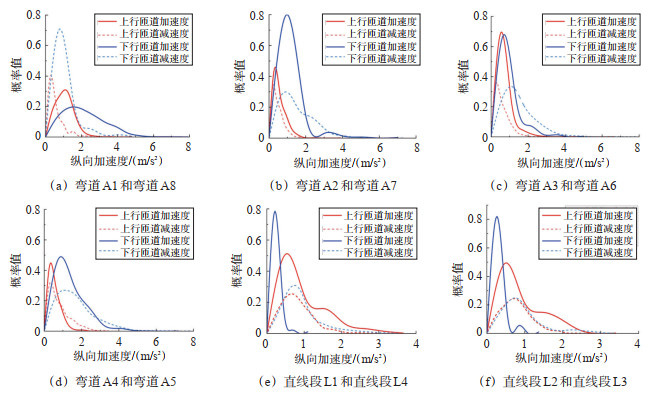
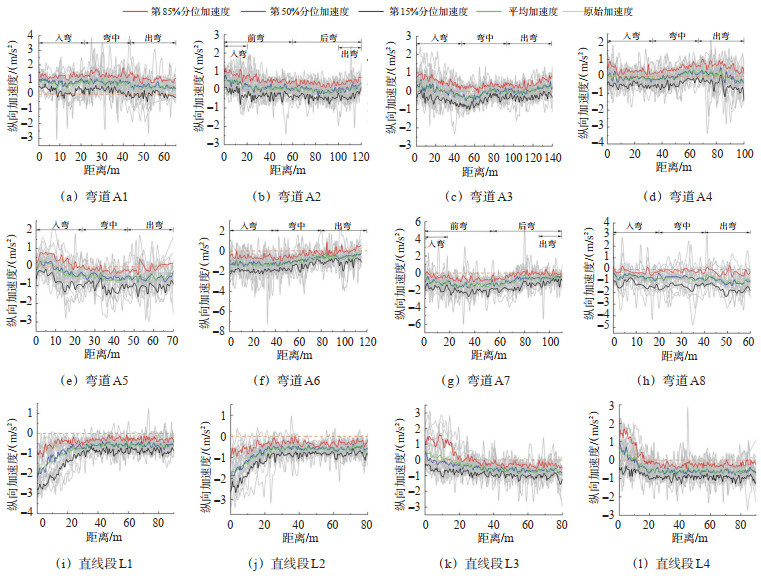
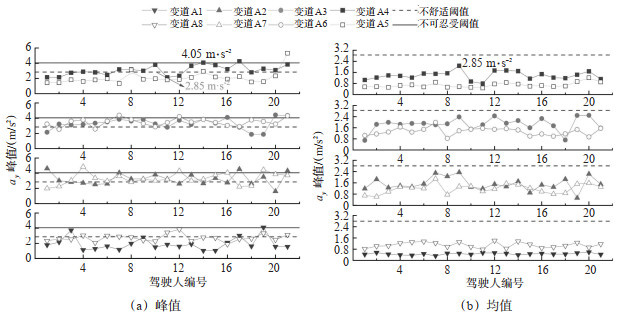
摘要: 城市地下螺旋匝道因其复杂的线形与受限的驾驶环境,易引发驾驶人产生心理压抑和时空错觉。为揭示并量化驾驶人在城市地下螺旋匝道的纵向和横向操纵行为特征,选取21名驾驶人在重庆市渝中区解放碑地下环道-洪崖门地下道进行实车驾驶实验。利用微机械式航姿参考系统采集了自然驾驶状态下的纵向和横向加速度数据,分析了螺旋匝道内车辆的纵向加速度概率分布特性和横向舒适性,并采用多元方差分析方法评估了车辆加速度在不同弯道半径及坡度范围下的变化,随后构建了弯道半径、纵坡和纵向/横向加速度的关系度量模型。结果表明:①螺旋匝道的加、减速度实测数据呈正偏态分布,其中上行弯道的加速度分布区间大于减速度分布区间,驾驶人更倾向于加速操纵,而下行弯道和直线段则相反;直线段的减速度偏好值均高于加速度偏好值,并且普通弯道的加、减速度偏好值均高于小半径弯道;②螺旋匝道弯道的纵向加速度变化特征主要表现为入弯降低阶段、中段会发生波动或趋于平缓阶段和出弯增加阶段;上行方向的直线段纵向加速度表现为逐渐增大并趋于平缓,而下行则呈递减后趋于平缓的趋势;③螺旋匝道各个弯道横向加速度均值的特征分位值与峰值的特征分位值之间的差值均在1 m/s2以上,其中左转弯道的行驶舒适性低于右转弯道,但普通弯道的行驶舒适性高于小半径弯道;④纵向加速度、制动减速度和横向加速度受弯道半径和纵坡坡度单独作用的效果均不显著(p >0.05),但受二者耦合作用效果显著(p < 0.001)。Abstract: Urban underground spiral ramps, with complex alignment and confined environments, often cause driver stress and spatiotemporal disorientation. To examine and quantify driver behavior on these ramps, 21 participants completed real-vehicle driving tests on the Hongyamen Underground Road and the Jiefangbei Underground Ring Road in Yuzhong District, Chongqing. The longitudinal and lateral acceleration data under natural driving conditions are collected using a micro-mechanical attitude and heading reference system. The probability distribution characteristics of longitudinal acceleration and lateral comfort of vehicles on the helical ramps are analyzed. The multivariate analysis of variance method is used to evaluate the changes in vehicle acceleration across different curve radii and slope ranges. Then, the relationship measurement model of curve radius, longitudinal slope and longitudinal/lateral acceleration is constructed. The results show that: ①The measured acceleration and deceleration data of the helical ramp exhibit positive skewness. The upward ramp curve has a broader acceleration range than deceleration, indicating that drivers tend to accelerate more in this section. Conversely, in the downward ramp curve and straight section, deceleration prevails. The deceleration preference value in the straight section exceeds the acceleration preference value. Moreover, both acceleration and deceleration preference values in standard-radius curves are higher than those in small-radius curves. ② The longitudinal acceleration variation characteristics of the helical ramp curve are primarily manifested in three stages: the decrease stage at the curve, a middle stage with fluctuations or stabilization, and the increase stage at the curve. The longitudinal acceleration in the upward direction gradually increases before becoming gentle, while in the downward direction, it initially decreases and then stabilizes. ③The difference between the characteristic quantile values of the lateral acceleration's mean and peak value of each curve on the helical ramps is above 1 m/s2. Driving comfort is lower on left-turning curves than on right-turning curves, and comfort on standard-radius curves is higher than on small-radius curves. ④Longitudinal acceleration, braking deceleration, and lateral acceleration are not significantly affected by the radius of the bend and the slope of the longitudinal slope (p >0.05) but are significantly affected by their coupling effect (p < 0.001).
-

图 3 螺旋匝道纵向加速度概率密度分布曲线
Figure 3. Probability density distribution curve of longitudinal acceleration for the helical ramp

图 4 螺旋匝道纵向加速度变化特性
Figure 4. Longitudinal acceleration variation characteristics of spiral ramp

图 5 螺旋匝道弯道横向加速度统计特征
Figure 5. Statistical characteristics of lateral acceleration on the helical ramp curve

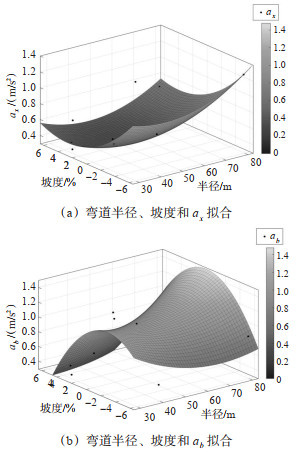
图 6 螺旋匝道弯道纵向加速度与线形参数曲面拟合结果
Figure 6. Curve fitting results of longitudinal acceleration and linear parameters on the helical ramp curve

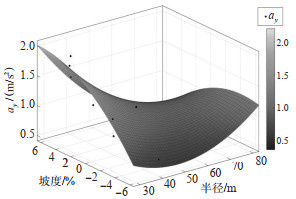
图 7 螺旋匝道弯道横向加速度与线形参数曲面拟合结果
Figure 7. Curve fitting results of lateral acceleration and linear parameters on the helical ramp curve
表 1 实验对象的主要技术参数
Table 1. Main technical parameters of the test roads
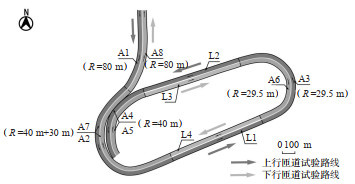
市道 曲线半径/m 弯道类型 编号 纵坡值/% 超高率/% 坚曲线最小半径/m 上行匝道 80 普通 A1 5.9 1.5 500 40+30 连续 A2 2.9 2.0 550 29.5 小半径 A3 2.9 2.0 500 40 小半径 A4 5.9 2.0 550 下行市道 40 小半径 A5 5.9 2.0 550 29.5 小半径 A6 2.9 2.0 500 40+30 连续 A7 2.9 2.0 550 80 普通 A8 5.9 1.5 500  下载: 导出CSV
表 2 螺旋匝道纵向加速度偏好值
Table 2. Longitudinal acceleration preference values for the helical ramp
类型 上行匝道 下行匝道 A1 A2 L1 A3 L2 A4 A5 L3 A6 L4 A7 A8 加速度偏好值/(m/s2) 1.20 0.45 0.54 0.70 0.51 0.35 0.45 0.26 0.70 0.22 0.96 0.71 减速度偏好值/(m/s2) 0.25 0.34 0.65 0.35 0.72 0.34 0.56 0.73 1.07 0.74 0.88 1.38
下载: 导出CSV
表 3 螺旋匝道弯道的横向加速度典型特征分位值
Table 3. Typical characteristic quantiles of lateral acceleration on the helical ramp curve
分位值/(m/s2) 弯道A1 弯道A2 弯道A3 弯道A4 弯道A5 弯道A6 弯道A7 弯道A8 均值 峰值 均值 峰值 均值 峰值 均值 峰值 均值 峰值 均值 峰值 均值 峰值 均值 峰值 15th 0.42 1.24 1.19 2.58 1.55 2.73 1.09 2.41 0.53 1.55 0.97 2.89 0.78 2.3 0.87 2.3 25th 0.45 1.48 1.3 2.62 1.69 3.01 1.17 2.72 0.56 1.76 1.08 3.15 0.93 2.93 0.93 2.38 50th 0.49 1.75 1.47 3.02 1.89 3.32 1.38 3.08 0.62 1.9 1.34 3.49 1.22 3.21 1.07 2.63 75th 0.53 2.46 1.87 3.78 2.17 3.8 1.6 3.7 0.81 2.28 1.48 3.8 1.4 3.83 1.27 3.01 85th 0.56 2.91 2.17 4.16 2.41 3.95 1.72 3.83 0.9 3.01 1.53 4 1.54 4.19 1.33 3.22 90th 0.58 3.33 2.29 4.43 2.46 4.16 1.73 3.96 0.92 3.25 1.58 4.25 1.56 4.36 1.35 3.38 95th 0.6 3.92 2.37 4.59 2.48 4.41 1.91 4.17 1.09 4.57 1.81 4.35 1.72 4.66 1.39 3.63
下载: 导出CSV
表 4 多因素方差分析结果
Table 4. Results of the multivariate analysis of variance
加速度类型 半径 纵坡 半径和纵坡耦合 F值 p值 F值 p值 F值 p值 纵向加速度 0.126 0.884 0.122 0.827 4.837 1.883×10⁻⁵ 制动减速度 0.834 0.436 0.371 0.690 6.854 6.223×10⁻⁸ 横向加速度 0.008 0.993 0.029 0.971 18.219 3.496×10⁻²⁰
下载: 导出CSV
-
[1] 徐进, 崔强, 林伟, 等. 螺旋匝道和螺旋桥的小客车行驶速度特征[J]. 中国公路学报, 2019, 32(7): 158-171.XU J, CUI Q, LIN W, et al. Speed behavior of passenger cars on helical ramps and helical bridges[J]. China Journal of Highway and Transport, 2019, 32(7): 158-171. (in Chinese) [2] JIN S, YANG J X, LIU Z C. Modeling and analysis of car-following for intelligent connected vehicles considering expected speed in helical ramps[J]. Sustainability, 2022, 14(24): 16732-16732. doi: 10.3390/su142416732 [3] 郑展骥, 郑礼伟, 许宇轩, 等. 基于实车数据的城市地下螺旋匝道小客车运行特性研究[J]. 中国公路学报, 2024, 37(9): 273-288.ZHENG Z J, ZHENG L W, XU Y X, et al. Operating characteristics of urban underground helical ramp passenger cars based on field driving data[J]. China Journal of Highway and Transport, 2024, 37(9): 273-288. (in Chinese) [4] 冯忠祥, 杨苗苗, 马昌喜, 等. 城市下穿隧道纵坡坡度和速度对驾驶人心率增长率的影响[J]. 中国公路学报, 2018, 31 (4): 66-77.FENG Z X, YANG M M, MA C X, et al. Effect of slope and velocity on drivers'heart rate growth in urban underpass tunnel longitudinal section[J]. China Journal of Highway and Transport, 2018, 31(4): 66-77. (in Chinese) [5] 杜志刚, 梅家林, 倪玉丹, 等. 基于视觉需求的城市水下特长隧道光环境评价与优化综述[J]. 交通运输工程学报, 2020, 20(6): 48-61.DU Z G, MEI J L, NI Y D, et al. Review on evaluation and optimization of light environment of extra-long urban underwater tunnel based on visual demands[J]. Journal of Traffic and Transportation Engineering, 2020, 20(6): 48-61. (in Chinese) [6] 徐进, 刘小明, 胡静. 基于自然驾驶数据的螺旋匝道(桥)驾驶人心理负荷分析[J]. 交通运输系统工程与信息, 2020, 20(3): 212-218.XU J, LIU X M, HU J. Analysis of driver mental load on helical ramps and helical bridges based on naturalistic driving data[J]. Journal of Transportation Systems Engineering and Information Technology, 2020, 20(3): 212-218. (in Chinese) [7] SINGH H, KATHURIA A. Analyzing driver behavior under naturalistic driving conditions: A review[J]. Accident Analysis & Prevention, 2021, 150: 105908. [8] 倪娜, 杨少伟, 潘兵宏, 等. 终南山公路隧道交通事故特征及预防措施研究[J]. 现代隧道技术, 2018, 55(4): 25-32.NI N, YANG S W, PAN B H, et al. Traffic accident characteristics and prevention measures for the Zhongnanshan highway tunnel[J]. Modern Tunnelling Technology, 2018, 55(4): 25-32. (in Chinese) [9] 张立成, 张婷, 蔡学锐, 等. 驾驶行为分类方法及量化评估综述[J]. 汽车技术, 2024, (5): 1-14.ZHANG L C, ZHANG T, CAI X R, et al. Review of classification methods and quantitative evaluation of driving behavior[J]. Automobile Technology, 2024, (5): 1-14. (in Chinese) [10] 黄艳国, 许伦辉, 罗强, 等. 加速度变化对道路平面线形行车舒适性评价方法[J]. 广西师范大学学报(自然科学版), 2014, 32(2): 1-8.HUANG Y G, XU L H, LUO Q, et al. An evaluation method of riding comfort of road alignment with acceleration change[J]. Journal of Guangxi Normal University(Natural Science Edition), 2014, 32(2): 1-8. (in Chinese) [11] 高镇海, 蔡荣贵, 孙天骏, 等. 人机共驾下的驾驶行为数据滤波方法[J]. 吉林大学学报(工学版), 2024, 54(3): 589-599.GAO Z H, CAI R G, SUN T J, et al. Data⁃filtering method for driving behavior based on vehicle shared autonomy[J]. Journal of Jilin University(Engineering and Technology Edition), 2024, 54(3): 589-599. (in Chinese) [12] EBOLI L, MAZZULLA G, PUNGILLO G. Combining speed and acceleration to define car users' safe or unsafe driving behavior[J]. Transportation Research Part C: Emerging Technologies, 2016, 68: 113-125. doi: 10.1016/j.trc.2016.04.002 [13] GARCÍA Y, ALTAMINA A, ECHAVEGUREN T, et al. Acceleration and deceleration models on horizontal curves on two-lane rural roads in san juan, argentina[J]. Revista Politécnica, 2017, 39(2): 41-50. [14] BABIĆ D, BRIJS T. Low-cost road marking measures for increasing safety in horizontal curves: A driving simulator study[J]. Accident Analysis & Prevention, 2021, 153: 106013. [15] 徐进, 崔强, 常旭, 等. 苜蓿叶形互通立交进/出口的纵向驾驶行为特征[J]. 东南大学学报(自然科学版), 2019, 49 (6): 1205-1214.XU J, CUI Q, CHANG X, et al. Longitudinal driving behavior characteristics at approaching/departing areas of clover leaf interchange[J]. Journal of Southeast University(Natural Science Edition), 2019, 49(6): 1205-1214. (in Chinese) [16] 徐进, 李建兴, 林伟, 等. 螺旋匝道(桥)小客车横向行驶特性实测研究[J]. 西南交通大学学报, 2019, 54(6): 1129-1138.XU J, LI J X, LIN W, et al. Field tests on lateral operational characteristics of passenger cars on helical ramps (bridges)[J]. Journal of Southwest Jiao Tong University, 2019, 54 (6): 1129-1138. (in Chinese) [17] 徐进, 王延鹏, 陈海源, 等. 山区公路回头曲线小客车纵向行驶特性及运行速度模型[J]. 吉林大学学报(工学版), 2023, 53(12): 3432-3445.XU J, WANG Y P, CHEN H Y, et al. Longitudinal driving characteristics and operating speed prediction model of cars on hairpin curves of mountainous roads[J]. Journal of Jilin University(Engineering and Technology Edition), 2023, 53 (12): 3432-3445. (in Chinese) [18] 王延鹏, 张杰, 潘存书, 等. 高速公路小净距互通立交车辆纵向运行特性[J]. 交通信息与安全, 2024, 42(2): 147-157. doi: 10.3963/j.jssn.1674-4861.2024.02.015WANG Y P, ZHANG J, PAN C S, et al. Longitudinal operational characteristics of cars between small-spacing interchanges on freeway[J]. Journal of Transport Information and Safety, 2024, 42(2): 147-157. (in Chinese) doi: 10.3963/j.jssn.1674-4861.2024.02.015 [19] 陈志贵, 王雪松, 张晓春, 等. 山区高速公路驾驶人加减速行为建模[J]. 中国公路学报, 2020, 33(7): 167-175.CHEN Z G, WANG X S, ZHANG X C, et al. Modeling of driver acceleration and deceleration behavior in mountain freeways[J]. China Journal of Highway and Transport, 2020, 33(7): 167-175. (in Chinese) [20] KONG X, DAS S, JHA K, et al. Understanding speeding behavior from naturalistic driving data: Applying classification based association rule mining[J]. Accident Analysis & Prevention, 2020, 144: 105620. [21] DIAS C, OGUCHI T, WIMALASENA K. Drivers' speeding behavior on expressway curves: exploring the effect of curve radius and desired speed[J]. Transportation Research Record, 2018, 2672(17): 48-60. doi: 10.1177/0361198118778931 [22] 徐进, 杨奎, 鲁工圆, 等. 基于自然驾驶的山区公路行驶舒适性研究[J]. 西南交通大学学报, 2017, 52(2): 309-318.XU J, YANG K, LU G Y, et al. Investigation on driving comfort of passenger cars on mountain roads based on naturalistic driving[J]. Journal of Southwest Jiao Tong University, 2017, 52(2): 309-318. (in Chinese) [23] 张兰芳, 朱佩玄, 杨旻皓, 等. 基于数据驱动的城市地下快速路跟驰行为模型构建[J]. 同济大学学报(自然科学版), 2021, 49(5): 661-669.ZHANG L F, ZHU P X, YANG M H, et al. Modeling of car-following behavior on urban underground expressways based on data-driven methods[J]. Journal of Tongji University(natural science), 2021, 49(5): 661-669. (in Chinese) [24] 上海市政工程设计研究总院(集团)有限公司. 城市道路路线设计规范: CJJ 193-2012[S]. 北京: 中国建筑工业出版社, 2012.Shanghai Municipal Engineering Design Institute(Group) Co., Ltd. Code for design of urban road engineering: CJJ 193-2012[S]. Beijing: China Architecture & Building Press, 2012. (in Chinese) [25] 张玉, 刘俊, 林伟, 等. 互通立交迂回式匝道纵向加速度特性[J]. 科学技术与工程, 2021, 21(26): 11411-11418.ZHANG Y, LIU J, LIN W, et al. Longitudinal acceleration characteristics of ramp at interchange with detour. Science Technology and Engineering, 2021, 21(26): 11411-11418. (in Chinese) [26] 彭志群. 道路平面线形舒适性评价方法研究[D]. 西安: 长安大学, 2005.PENG Z Q. Study on the evaluation method of road horizontal alignment comfort[D]. Xi'an: Chang'an University, 2005. (in Chinese) [27] XU J, YANG K, SHAO Y M, et al. An experimental study on lateral acceleration of cars in different environments in Sichuan, Southwest China[J]. Discrete Dynamics in Nature and Society, 2015, 2015(1): 494130. [28] LIU H B, RODGERS M O, LIU F C, et al. Bayesian approach in estimating the road grade impact on vehicle speed and acceleration on freeways[J]. Transportmetrica A: Transport Science, 2020, 16(3): 602-625. doi: 10.1080/23249935.2020.1722280 [29] HAN L, DU Z G. Unraveling the complex interplay between curved tunnels and drivers' physiological responses: An HRV perspective[J]. Transportation Research Part F: Traffic Psychology and Behavior, 2025, 108: 39-53. doi: 10.1016/j.trf.2024.11.020 -

 点击查看大图
计量
- 文章访问数: 6
- HTML全文浏览量: 3
- PDF下载量: 1
- 被引次数: 0