



Identification and Traffic Impact Analysis of Merging Behavior in Expressway Weaving Areas
-
摘要: 城市快速路交织区的复杂交通行为显著影响通行效率与安全水平。为深入揭示主线与辅路汇入车辆间的微观交互机理,本研究以武汉市珞狮路高架快速路为实证对象,基于1.2 km路段、3.5 h连续采集的大规模高分辨率车辆轨迹数据(时间分辨率0.1 s,空间分辨率0.1 m),系统性地提出并定义了4种交互换道模式:竞争模式、协作-竞争模式、协作模式与竞争-协作模式。创新性地引入安全替代指标(surrogate safety measures,SSMs)进行多维度量化约束,涵盖碰撞时间(time-to-collision,TTC)、跟车时距(GAP)、车辆速度差,以及横向偏移量等关键参数,实现了对车辆纵横向动态及复杂相互作用的全过程刻画。为实现对换道模式的精准、自动化辨识,研究构建并优化了1个基于极端梯度提升(extreme gradient boosting,XGBoost)算法的换道行为辨识模型。在模型构建中,通过对原始数据进行严格筛选,改变了传统研究中对数据约束的模糊性,剔除了前后交叉汇入等干扰数据,最终标定出1 049条典型的稳定汇入案例用于建模。实验结果表明:该模型的准确率达到91.83%,显著优于随机森林、支持向量机等基准模型。进一步的交通流影响规律分析表明,竞争-协作换道模式通过优化车辆间协作与竞争关系,展现出最佳综合效益:跨线行驶时间最短,起始位置更早,目标车道后车最大减速度绝对值最小,TTC值最大,且侧向冲突占比最低。该模式在提升换道效率的同时有效降低冲突风险,为智能交织区管控及协同式自动驾驶决策提供了理论支撑。Abstract: The complex traffic behaviors in urban expressway weaving areas significantly impact traffic efficiency and safety. To deeply investigate the interaction characteristics between vehicles merging from mainlines and auxiliary roads, this study, based on large-scale vehicle trajectory data from the Luoshi Road Elevated Expressway in Wuhan, systematically proposes and defines four interactive lane-changing patterns: competitive, cooperative-competitive, cooperative, and competitive-cooperative. This classification framework, by innovatively introducing surrogate safety measures (SSMs) for quantitative constraints, comprehensively covering key parameters such as time-to-collision (TTC), following distance (GAP), vehicle speed differential, and lateral offset of vehicles. To achieve accurate and automated identification of these lane-changing patterns, the study constructs and optimizes a behavior identification model based on the eXtreme Gradient Boosting (XGBoost) algorithm. During model construction, rigorous data filtering addressed the ambiguity of data constraints found in traditional research by removing confounding data such as intersecting merges, ultimately resulting in 1 049 typical, stable merging cases for modeling. The experimental results show that the model achieves an accuracy of 91.83%. Further analysis of traffic flow impacts reveals that the competitive-cooperative lane-changing pattern demonstrates the best overall benefits in enhancing lane-changing efficiency and ensuring driving safety. It achieves this by optimizing the cooperative and competitive relationships between vehicles, which effectively reduces the risk of traffic conflicts.
-

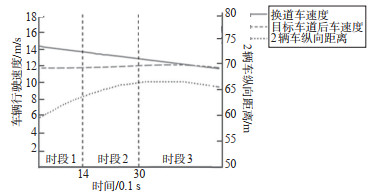
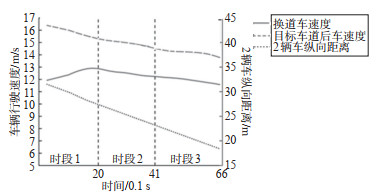
图 4 无交互模式车辆汇入过程车辆状态时变
Figure 4. Time-varying vehicle state in the process of merging with no interaction mode

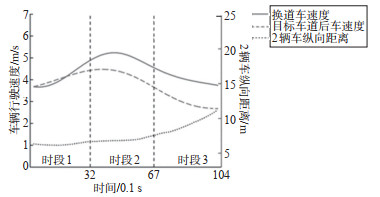
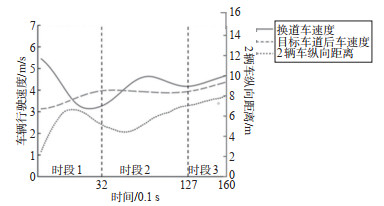
图 5 竞争模式车辆汇入过程车辆状态时变
Figure 5. Time-varying vehicle state in the merging process under competitive mode

图 6 协作-竞争模式车辆汇入过程车辆状态时变
Figure 6. Time-varying vehicle state in the merging process under cooperation-competition mode

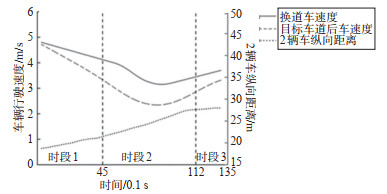
图 7 协作模式车辆汇入过程车辆状态时变
Figure 7. Time-varying vehicle state in the merging process under cooperation mode

图 8 竞争-协作模式车辆汇入过程车辆状态时变
Figure 8. Time-varying vehicle state in the merging process under competition-cooperation mode

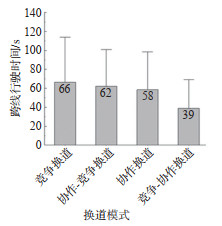
图 12 换道车跨线行驶时间对比
Figure 12. Comparison of lane change vehicle line-crossing driving time

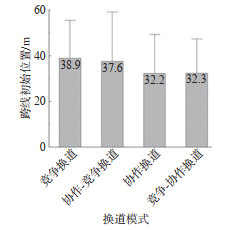
图 13 换道车辆跨线初始位置对比
Figure 13. Comparison of initial line-crossing positions of lane change vehicles

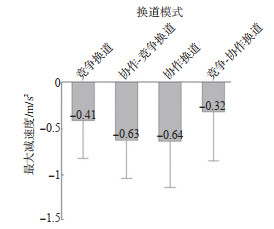
图 14 目标车道后车最大减速度对比
Figure 14. Comparison of maximum deceleration of following vehicles in the target lane

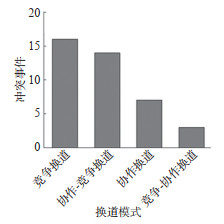
图 16 不同换道模式下侧向冲突结
Figure 16. Lateral Conflict Outcomes under Different Lane-Changing Modes
表 1 交互作用参数满足条件
Table 1. Interaction parameters meet the conditions
SSMs参数 交互作用 无交互作用 tTTC/s 0~6 >6 tGAP/s 0~3 >3 车间距/m 0~50 >50  下载: 导出CSV
表 2 交互与非交互换道案例数统计表
Table 2. Interactive and non-interactive lane-changing cases statistics table
换道模式 案例数量 非交互换道 388 交互换道 661
下载: 导出CSV
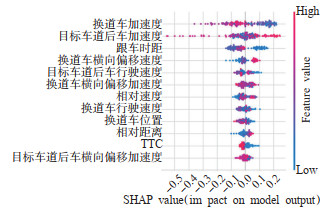
表 3 特征变量列表
Table 3. List of feature variables
特征类型 特征名 单位 换道车特征 纵向速度 m/s 横向速度 m/s 纵向加速度 m/s2 横向加速度 m/s2 车头横向位置 m 车尾横向位置 m 目标车道后车特征 质心横向位置 m 后车纵向速度 m/s 横向速度 m/s 纵向加速度 m/s2 横向加速度 m/s2 2辆车之间特征 2辆车之间纵向距离 m 2辆车之间碰撞时间TTC s 2辆车之间相对速度 m/s 2辆车之间跟车时距GAP m
下载: 导出CSV
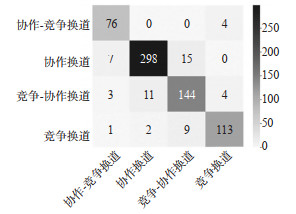
表 4 模型辨识结果对比
Table 4. XGBoost model results
模型 准确率% 召回率% 精确率% F1分数% 逻辑回归 83.41 77.19 83.16 79.34 SVM 88.79 87.44 87.58 87.46 RF 91.70 91.34 90.19 90.72 XGBoost 91.83 91.85 90.57 91.55
下载: 导出CSV
表 5 交互换道模式分布情况
Table 5. Distribution of interactive lane-changing patterns
换道模式 案例 竞争换道 121 协作-竞争换道 79 协作换道 285 竞争-协作换道 176
下载: 导出CSV
表 6 车辆交互模式下跨线行为统计
Table 6. Statistics of vehicle line-crossing behavior and following vehicle behavior
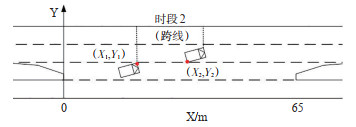
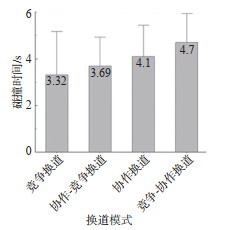
换道模式 研究案例 换道车行为 目标车道后车行为 跨线行驶时间/s 跨线开始位置/m 最大减速度/(m/s2) 安全替代指标分析/s 竞争换道 121 6.6(4.8) 38.9(16.6) -0.41(0.41) 3.32(1.86) 协作-竞争换道 79 6.2(3.8) 37.6(21.5) -0.63(0.41) 3.69(1.24) 协作换道 285 5.8(4.0) 32.2(17.1) -0.64(0.50) 4.10(1.35) 竞争-协作换道 176 3.9(3.0) 32.3(15.1) -0.32(0.58) 4.70(1.25) 非参数检验 P 0.000 0.000 0.000 0.014
下载: 导出CSV
-
[1] 李佳硕, 郑展骥, 顾欣, 等. 考虑快速路交织区驾驶人强行变道行为的交通冲突机理分析[J]. 交通信息与安全, 2023, 41 (3): 1-11. doi: 10.3963/j.jssn.1674-4861.2023.03.001LI J S, ZHENG Z J, GU X, et al. Traffic conflict mechanism analysis considering drivers' forced lane change behavior in expressway weaving areas[J]. Journal of Transport Information and Safety, 2023, 41(3): 1-11. (in Chinese) doi: 10.3963/j.jssn.1674-4861.2023.03.001 [2] 韩皓, 谢天. 基于注意力Seq2Seq网络的高速公路交织区车辆变道轨迹预测[J]. 中国公路学报, 2020, 33(6): 106-118.HAN H, XIE T. Vehicle lane change trajectory prediction in highway weaving areas based on attention Seq2Seq network[J]. China Journal of Highway and Transport, 2020, 33 (6): 106-118. (in Chinese) [3] 李霞, 赵晓东, 张孝铭, 等. 基于熟悉度的人机混驾交通流车辆换道模型构建[J]. 北京交通大学学报, 2023, 47(1): 65-73.LI X, ZHAO X D, ZHANG X M, et al. Construction of a lane-changing model for human-machine hybrid traffic flow based on familiarity[J]. Journal of Beijing Jiaotong University, 2023, 47(1): 65-73. (in Chinese) [4] HIDAS P. Modelling vehicle interactions in microscopic simulation of merging and weaving[J]. Transportation Research Part C: Emerging Technologies, 2005, 13(1): 37-62. doi: 10.1016/j.trc.2004.12.003 [5] SUN D, ELEFTERIADOU L. A driver behavior-based lane-changing model for urban arterial streets[J]. Transportation Science, 2014, 48(2): 184-205. doi: 10.1287/trsc.1120.0435 [6] 叶颖俊, 倪颖, 孙剑. 高密度瓶颈交通流主动-回应汇入行为定义与建模[J]. 中国公路学报, 2022, 35(8): 278-290.YE Y J, NI Y, SUN J. Definition and modeling of proactive-reactive merging behavior in high-density bottleneck traffic flow[J]. China Journal of Highway and Transport, 2022, 35 (8): 278-290. (in Chinese) [7] WANG E G, SUN J, JIANG S, LI F. Modeling the various merging behaviors at expressway on-ramp bottlenecks using support vector machine models[J]. Transportation Research Procedia, 2017, 25: 1327-1341. doi: 10.1016/j.trpro.2017.05.157 [8] 东野长梅, 石建军. 合流区竞争与协作换道判定方法与特性研究[J]. 交通运输研究, 2018, 4(6): 38-46.DONGYE C M, SHI J J. Method and characteristics of competitive and cooperative lane change decision at merging area[J]. Transportation Research, 2018, 4(6): 38-46. (in Chinese) [9] CHAUVHAN P, KANAGARAJ V, ASAITHAMBI G. Understanding the mechanism of lane changing process and dynamics using microscopic traffic data[J]. Physica A: Statistical Mechanics and its Applications, 2022, 593: 126981. doi: 10.1016/j.physa.2022.126981 [10] 曲大义, 黑凯先, 郭海兵, 等. 车联网环境下车辆换道博弈行为及模型[J]. 吉林大学学报(工学版), 2022, 52(1): 101-109.QU D Y, HEI K X, GUO H B, et al. Vehicle lane change game behavior and model in V2X environment[J]. Journal of Jilin University(Engineering Edition), 2022, 52(1): 101-109. (in Chinese) [11] 刘超, 罗如意, 刘春青, 等. 基于路侧多机视频目标关联与轨迹拼接的车辆连续轨迹构建方法[J]. 交通信息与安全, 2023, 41(3): 80-91. doi: 10.3963/j.jssn.1674-4861.2023.03.009LIU C, LUO R Y, LIU C Q, et al. Continuous vehicle trajectory construction method based on roadside multi-camera video target association and trajectory stitching[J]. Journal of Transport Information and Safety, 2023, 41(3): 80-91. (in Chinese) doi: 10.3963/j.jssn.1674-4861.2023.03.009 [12] 张航, 马宝林, 储泽宇, 等. 基于数据驱动的快速路合流区加速车道长度的研究[J]. 重庆交通大学学报(自然科学版), 2024, 43(5): 53-60. (in Chinese) [13] 吕能超, 郑梦凡, 郝威, 等. 基于客观风险感知特性的前向碰撞预警算法优化与标定[J]. 交通运输工程学报, 2020, 20 (2): 172-183.LYU N C, ZHENG M F, HAO W, et al. Optimization and calibration of forward collision warning algorithm based on objective risk perception characteristics[J]. Journal of Traffic and Transportation Engineering, 2020, 20(2): 172-183. (in Chinese) [14] ZHENG L, SAYED T, ESSA M. Validating the bivariate extreme value modeling approach for road safety estimation with different traffic conflict indicators[J]. Accident Analysis & Prevention, 2019, 123: 314-323. [15] 张方方, 王长君, 王俊骅. 城市快速路匝道合流区车辆交互行为模式[J]. 中国公路学报, 2022, 35(9): 66-79.ZHANG F F, WANG C J, WANG J H. Vehicle interaction behavior patterns at urban expressway on-ramp merging areas[J]. China Journal of Highway and Transport, 2022, 35 (9): 66-79. (in Chinese) [16] 刘通, 徐磊, 张学连, 等. 基于多源参数的高速工况驾驶行为模式识别方法[J]. 重庆交通大学学报(自然科学版), 2023, 42(11): 88-97.LIU T, XU L, ZHANG X L, et al. Driving behavior pattern recognition method under highway conditions based on multi-source parameters[J]. Journal of Chongqing Jiaotong University(Natural Science), 2023, 42(11): 88-97. (in Chinese) [17] 施添华, 何小平, 胡耀敏. 基于Stacking集成学习的信源数估计方法[J]. 信息技术, 2022, (1): 26-31.SHI T H, HE X P, HU Y M. Source number estimation method based on Stacking ensemble learning[J]. Information Technology, 2022(1): 26-31. (in Chinese) [18] 戢晓峰, 乔新. 建成环境对行人交通事故严重程度的非线性影响[J]. 交通运输系统工程与信息, 2023, 23(1): 314-323.JI X F, QIAO X. Non-linear impact of built environment on pedestrian crash severity[J]. Journal of Transportation Systems Engineering and Information Technology, 2023, 23(1): 314-323. (in Chinese) [19] 吕能超, 彭凌枫, 吴超仲, 等. 区分冲突类型的路段实时碰撞风险预测模型[J]. 中国公路学报, 2022, 35(1): 93-108.LYU N C, PENG L F, WU C Z, et al. Real-time collision risk prediction model by crash type on roadway segments[J]. China Journal of Highway and Transport, 2022, 35(1): 93-108. (in Chinese) [20] LYU N C, CAO Y, WU C Z, et al. Driving behavior and safety analysis at OSMS section for merged, one-way freeway based on simulated driving safety analysis of driving behaviour[J]. PLoS One, 2020, 15(2): e0228238. doi: 10.1371/journal.pone.0228238 [21] DAS S. Estimating likelihood of future crashes for crash-prone drivers[J]. Journal of Traffic and Transportation Engineering (English Edition), 2015, 2(3): 145-157. doi: 10.1016/j.jtte.2015.03.003 [22] 王畅, 付锐, 张琼, 等. 换道预警系统中参数TTC特性研究[J]. 中国公路学报, 2015, 28(8): 91-101.WANG C, FU R, ZHANG Q, et al. Study on TTC characteristics in lane change warning system[J]. China Journal of Highway and Transport, 2015, 28(8): 91-101. (in Chinese) [23] 邬岚, 陈雨欣, 陈茜, 等. 城市连续隧道交织区主线交织车辆换道点选择行为研究[J]. 重庆交通大学学报(自然科学版), 2024, 43(5): 46-52.WU L, CHEN Y X, CHEN Q, et al. Lane-change point selection behavior of weaving vehicles on mainline in urban continuous tunnel weaving areas[J]. Journal of Chongqing Jiaotong University(Natural Science), 2024, 43(5): 46-52. (in Chinese) [24] CHEN Y H, WU C J, BAI Q W, et al. Traffic characteristics and safety analysis of expressway off-ramp junction[J]. Journal of Zhejiang University(Engineering Science), 2022, 56 (2): 379-387. [25] 吕能超, 杜子君, 吴超仲, 等. 多车道高速公路出口开口段安全特性分析[J]. 交通运输系统工程与信息, 2021, 21(3): 120-130.LYU N C, DU Z J, WU C Z, et al. Safety characteristics analysis of multi-lane highway exit gore areas[J]. Journal of Transportation Systems Engineering and Information Technology, 2021, 21(3): 120-130. (in Chinese) [26] 李鹏飞, 石建军, 刘小明. 城市快速路竞争与协作换道行为特征分析[J] 公路交通科技, 2016, 33(12): 130-139.LI P F, SHI J J, LIU X M. Characteristic analysis of competitive and cooperative lane-changing behavior on urban expressways[J]. Journal of Highway and Transportation Research and Development, 2016, 33(12): 130-139. (in Chinese) [27] ZHAO S E, WANG J X, LI Y L. Lane changing trajectory planning of intelligent vehicle based on multiple objective optimization[J]. Journal of Traffic and Transportation Engineering, 2021, 21(2): 232-242. -

 点击查看大图
计量
- 文章访问数: 15
- HTML全文浏览量: 9
- PDF下载量: 3
- 被引次数: 0