



A Traffic Guidance Mechanism for En-route Incidents Considering Driver Behavioral Responses
-
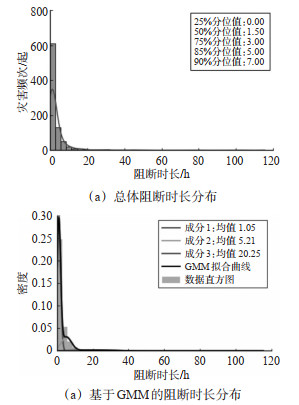
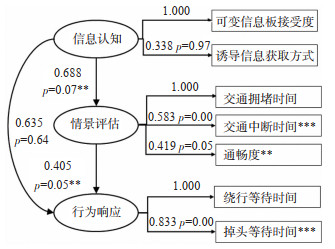
摘要: 现有交通诱导策略体系多基于仿真环境下的均质假设,缺乏考虑真实场景下驾驶人行为响应机制,难以适应灾害多发区的应急交通管控需求。以西藏自治区为研究对象,系统分析灾害条件下驾驶人行为特征及其对诱导信息的响应规律,研究了基于事件特征识别和行为响应特征的多灾害场景动态交通诱导策略体系。基于地质灾害与交通阻断数据,采用高斯混合模型(Gaussian mixture model,GMM)识别事件阻断特征与时长分布,将在途突发事件划分为完全阻断型、条件通行型和临时管控型3类。结合驾驶人问卷调查数据,运用Apriori关联规则算法和结构方程模型(structural equation model, SEM)量化驾驶人对信息认知、诱导信息类型、发布位置和等待时长的响应特征。结果表明:信息认知对情景评估、情景评估对行为响应的路径系数分别为0.688(p =0.07)、0.635(p =0.05),诱导信息正向显著影响驾驶人决策行为;驾驶人对连续中断的耐受性阈值为3 h,诱导信息需求呈三级分层特征,较高关注事件类型、拥堵里程及最佳行驶路线等一级信息;短信与二维码组合推送是最有效的信息传递方式。在此基础上,提出“空间分级-时序递进”的动态诱导策略体系,构建路径级(远端绕行)、路段级(节点管控)与临时通行级(短时响应)3类诱导模式,并嵌入应急优先通行机制。基于交通仿真平台对单幅路段封闭的条件通行型事件动态管控策略开展验证分析,显示动态信号管控策略下平均等待时间较人工管控减少21.5%。Abstract: Existing traffic guidance strategies are predominantly developed under homogeneous assumptions within simulation environments, lacking consideration of real-world driver behavioral response mechanisms. Consequently, they fail to meet the requirements of emergency traffic management in disaster-prone areas. To address this gap, this study takes the Tibet Autonomous Region as a case area, systematically analyzing driver behavioral characteristics and their responses to guidance information under disaster conditions. A dynamic traffic guidance framework is proposed based on event feature recognition and behavioral response characteristics across multi-hazard scenarios. Using geological hazard and traffic blockage data, the Gaussian mixture model (GMM) is employed to identify event-blockage characteristics and duration distributions. Categorizing en-route incidents into three types: complete blockage, conditional passage, and temporary control. Based on driver survey data, the Apriori association rule algorithm and structural equation model (SEM) are utilized to quantify drivers'responses to information cognition, types of guidance information, release locations, and waiting times. The results show that the path coefficients from information cognition to situational assessment and from situational assessment to behavioral response are 0.688 (p =0.07) and 0.635 (p =0.05), respectively, indicating that guidance information significantly and positively affects driver decision-making. Drivers'tolerance threshold for continuous interruptions is approximately 3 h, and their demand for guidance information exhibits a three-tier hierarchical structure, with primary attention given to event type, congestion distance, and optimal driving route. The combination of short messaging service (SMS) and quick response (QR) code distribution proves to be the most effective means of information delivery. On this basis, a"spatially hierarchical-temporally progressive"dynamic guidance strategy framework is established, consisting of three modes: route-level (long-distance diversion), segment-level (node control), and temporary-passage-level (short-term response), integrated with an emergency priority mechanism. Finally, validation using a traffic simulation platform for conditional passage events involving single-lane closures demonstrates that the proposed dynamic signal-control strategy reduces average waiting time by 21.5% compared to manual control, thereby significantly improving traffic operational efficiency under disaster conditions.
-

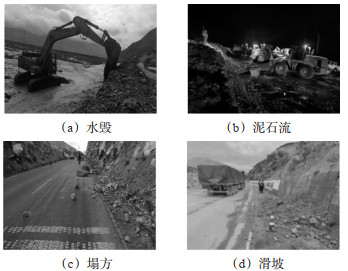
图 2 青藏公路不同灾害事件示例
Figure 2. Example of repairing different disaster events on Qinghai-Tibet highway

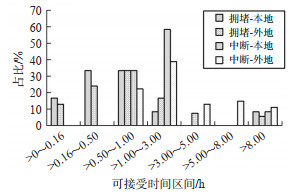
图 5 不同出行目的下的交通拥堵容忍度分布
Figure 5. Distribution of traffic congestion tolerance for different purposes

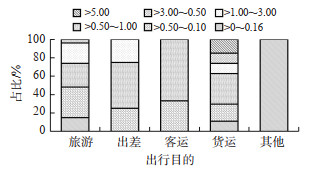
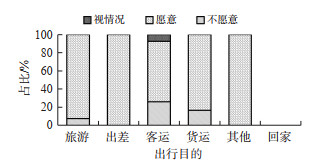
图 6 不同出行目的对交通诱导信息的接受意愿分布
Figure 6. Distribution of drivers' acceptance traffic guidance information by driver type

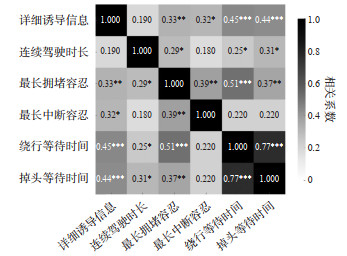
图 7 交通行为特征相关性热力图
Figure 7. Heat map of correlation of traffic behavioral characteristics

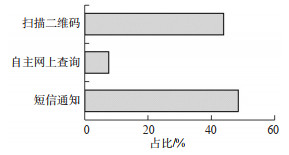
图 9 突发事件下诱导信息获取方式
Figure 9. Modes of traffic guidance information acquisition for emergencies

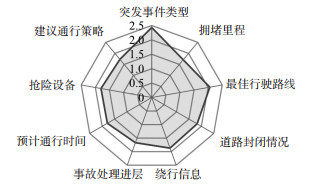
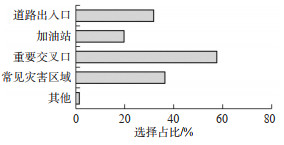
图 10 灾害事件交通诱导位置有效性认知分布
Figure 10. Distribution of perceived effectiveness of traffic guidance locations for emergencies

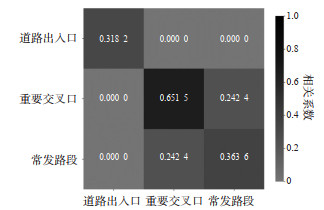
图 11 交通诱导位置组合强度热力图
Figure 11. Heat map of combined intensity of traffic guidance locations

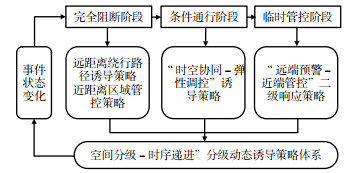
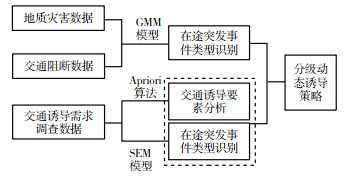
图 13 “空间分级-时序递进”分级动态诱导体系
Figure 13. Hierarchical and dynamic guidance strategy system based on spatial stratification and temporal progression

图 17 G318八宿—波密段SUMO仿真过程
Figure 17. SUMO simulation process of the G318 Basu-Bomi section
表 1 在途突发事件分类与特征
Table 1. Classification and characteristics of in-transit emergencies
在途突发事件类型 核心特征 诱导策略需求 完全阻断型事件 道路完全中断且修复周期超过20 h(如大型山体滑坡、路基塌陷) 建立“空间分级管控+动态信息诱导”协同机制,实现应急资源与滞留车流的有效调控 交通流突变:上下游形成停滞界面与通行真空带[17]引发路网韧性链式衰减与二次风险 条件通行型事件 道路单车道交替通行且修复周期在5~20 h(如局部泥石流) 建立动态优先级协调机制;交通管控指令的精准触达与驾驶人行为响应效率直接影响处置成效 拥堵传导效应显著 社会车辆与救援作业时空冲突 临时管控型事件 道路临时管制且修复周期小于5 h(如落石)短时扰动性强 建立短时响应机制(如:信息快速发布、制定动态交通管控措施),并确保管控措施的实施时效性 车辆无序自组织行为影响道路恢复周期[13]  下载: 导出CSV
表 2 驾驶人行为特征与交通诱导需求调研问卷架构
Table 2. Framework of survey questionnaire on driver behavior characteristics and traffic guidance demand
维度 题项示例 调研目标 驾驶人基本信息 性别x1、年龄x2、驾龄x3、是否本地驾驶人x4 识别不同群体行为差异 驾驶体验与容忍度 连续驾驶时长x5、可接受最长拥堵时间x6、可接受单次最长交通中断时间x7 评估驾驶人对突发事件的耐受水平 交通拥堵应对行为 绕行等待时间x8、拥堵主要原因x9 分析驾驶人对诱导信息的依赖程度 突发事件经历与信息获取 是否遇到中断x10、诱导信息获取方式x11 评估现有诱导措施的有效性 交通诱导信息需求 偏好信息类型x12(绕行路线、预计时间) 支撑诱导策略定制
下载: 导出CSV
表 3 交通拥堵接受度信度检验
Table 3. Traffic congestion acceptance reliability test results
选项 删除项后的标度平均值 删除项后的标度方差 修正后的项与总计相关性 删除项后Alpha 标准化Alpha x6 8.240 10.186 0.545 0.676 0.741 x7 8.740 12.102 0.319 0.790 x8 8.450 8.929 0.697 0.582 x9 8.060 9.289 0.596 0.645
下载: 导出CSV
表 4 交通拥堵接受度探索性因子分析
Table 4. Results of EFA of traffic congestion acceptability
题项 因子载荷 x6 0.74 x7 0.51 x8 0.89 x9 0.83
下载: 导出CSV
表 5 驾驶人个人属性统计特征
Table 5. Statistical characteristics of drivers' personal attributes
变量名称 选项 频率 百分比/% 性别 男 61 92.4 女 5 7.6 年龄/岁 >25~30 6 9.1 >30~40 25 37.9 >40~50 27 40.9 >50~60 8 12.1 驾龄/年 >0~1 2 3 >1~3 3 4.5 >3~5 3 4.5 >5 58 87.9 本地驾驶人或外地驾驶人 本地驾驶人(户籍或常住地在西藏) 12 18.2 外地驾驶人(户籍或常住地不在西藏) 54 81.8 出行目的 旅游 27 40.9 出差 4 6.1 货运 27 40.9 客运 6 9.1 其他 2 3 驾驶车型 小型车(座位≤19座的客车和载质量≤2 t的货车 34 51.5 中型车(座位≤9座的客车和2 t≤载质量≤7 t的货车 3 4.5 大型车(7 t≤载质量≤20 t的货车 19 28.8 汽车列车(载质量≤20 t的货车) 10 15.2
下载: 导出CSV
表 6 模型拟合评价结果
Table 6. Fitness test results
评价指标 GFI RMSE CFI 指标值 0.930 2 0.012 0 0.996 2 理想值 >0.90 < 0.05 >0.90
下载: 导出CSV
表 7 完全阻断型事件双模式诱导策略实施方案
Table 7. Dual-mode induced strategy implementation plan for complete blockage events
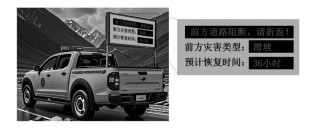
维度 特征 阻断特征 道路双向完全中断,修复周期>20 h 诱导需求 对灾害点双向路径的最近功能性分流交叉口实施绕行诱导,使其提前绕行。 阻止车辆进一步驶入受灾封控区,引导驾驶人在可控区域内安全调头折返,为应急抢险装备腾出作业空间。 诱导策略 远距离路径绕行 近距离区域管控 应用场景 发生大型山体滑坡、泥石流、路基塌陷等大型灾害,驾驶人尚未进入灾害区,且具备可替代通道。 发生大型山体滑坡、泥石流、路基塌陷等大型灾害,驾驶人已进入灾害影响区,且无替代路径。 诱导逻辑 决策前置性+分级传递+空间连续性 即时可达性+信息极简+明确指令 布设位置 双向最近功能性交叉口前500~1 000 m[19] 受灾段上游警告区或过渡区 发布方式 移动式智能信息发布车(LED+语音播报),短信+二维码信息板推送 移动诱导车LED滚动发布+ 定向语音广播+二维码信息板推送 信息内容 一级:灾害类型+位置+恢复时间; 模板:“事件类型+道路状态+建议行为+预计恢复时间” 二级:备用路线+施工动态 策略配置 供电:太阳能+锂电池双电源系统; 软件:二维码兼容HTML5结构,支持在iOS与Android系统上运行; 更新频率:“事件触发+每10 min更新”。 注:绕行指局部路径调整,如提前折返、引导至功能性交叉口或等待区等微诱导,而非长距离替代通道的选择。
下载: 导出CSV
表 8 条件通行型事件诱导策略实施方案
Table 8. Traffic guidance strategy implementation plan for conditional passage events
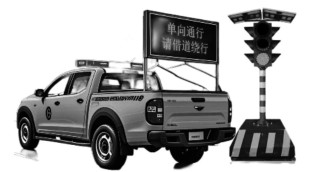
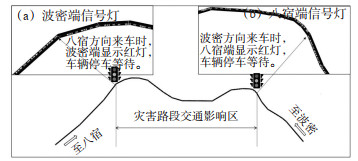
维度 特征 阻断特征 单幅受阻,需双向交替通行,修复周期5~20 h 诱导需求 道路未完全阻断,但通行能力显著下降,需通过人工干预维持基本交通秩序 诱导策略 动态信号管控 应用场景 发生小型泥石流、落石等灾害,导致半幅中断 诱导逻辑 时空协同+弹性调控 布设位置 灾害段两端出入口 发布方式 便携式智能信号灯+移动式智能信息发布车 信息内容 模版一:“单向通行,请排队等候” 模版二:“单向通行,请借道绕行” 策略配置 供电:太阳能+锂电池双电源系统 软件:二维码兼容HTML5结构,支持在iOS与Android系统上运行 更新频率:“事件触发+每10 min更新”
下载: 导出CSV
表 9 临时管控型事件诱导策略实施方案
Table 9. Traffic Guidance Strategy Implementation Plan for Temporary Control Events
维度 特征 阻断特征 小型滑坡、落石等短时中断,修复周期<5 h 诱导需求 精准诱导避免车辆无效排队与二次事故 诱导策略 短时响应与分级诱导 应用场景 道路落石等导致的短时可恢复的轻度阻断路段 诱导逻辑 远端预警+近端管控+分级信息传递 布设位置 上游交叉口与受灾入口处 发布方式 上游信息发布车+下游减速或停车标志+现场诱导屏 信息样式 一级:灾害信息+恢复时间 二级:恢复信息+通行建议(二维码信息板) 更新频率:“事件触发+每10 min更新” 策略配置 供电:太阳能+锂电池双电源系统 软件:二维码兼容HTML5结构,支持在iOS与Android系统上运行 更新频率:“事件触发+每10 min更新”
下载: 导出CSV
表 10 结果对比
Table 10. Comparison of results
方案 周期/min 方向 最大排队长度/m 平均延误/s 平均等待时间/s 人工控制 31.0 方向1 267 18.50 56.92 方向2 575 20.45 67.56 固定周期控制 30.3 方向1 297 22.45 65.66 方向2 589 19.80 61.01 人工-信号协同控制 24.2 方向1 245 19.24 46.59 方向2 493 17.88 53.03
下载: 导出CSV
-
[1] 洛松群培, 单增卓玛, 单增顿珠, 等. 普适型地质灾害监测预警系统应用及存在问题-以西藏拉萨、林芝为例[J]. 西藏科技, 2024, 46(5): 55-63.LUOSONG Q P, DANZENG Z M, DANZENG D Z, et al. Application and problems of universal geological hazard monitoring and early warning system: a case study of Lhasa and Nyingchi in Tibet[J]. Tibet Science and Technology, 2024, 46 (5): 55-63. (in Chinese) [2] 余明威, 郭永刚, 苏立彬. 西藏林芝地区崩滑流灾害影响因子定量评价[J]. 中国地质灾害与防治学报, 2024, 35(6): 33-43.YU M W, GUO Y G, SU L B. Quantitative evaluation of influencing factors for collapse, landslide, and debris flow disasters in Nyingchi, Tibet[J]. The Chinese Journal of Geological Hazard and Control, 2024, 35(6): 33-43. (in Chinese) [3] 何雅琴, 容煜伦, 柳祖鹏, 等. 基于水波原理的城市突发事件交通影响程度研究[J]. 交通运输系统工程与信息, 2017, 17 (5): 151-156.HE Y Q, RONG Y L, LIU Z P, et al. Traffic influence degree of urban traffic emergency based on water wave principle[J]. Journal of Transportation Systems Engineering and Information Technology, 2017, 17(5): 151-156. (in Chinese) [4] LEE S, PARK J, ABDEL-ATY M. Hazards-based duration time model with priorities considering unobserved heterogeneity using real-time traffic and weather big data[J]. Transportation Research Record: Journal of the Transportation Research Board. 2024, 2678(7): 1-12. [5] 丁宏飞, 刘博, 秦政, 等. 城市快速路交通事件影响范围研究[J]. 中国安全科学学报, 2016, 26(10): 151-156.DING H F, LIU B, QIN Z, et al. Study on the impact range of traffic incidents on urban expressways[J]. China Safety Science Journal, 2016, 26(10): 151-156. (in Chinese) [6] ZHOU H, TIAN Z. Modeling analysis of incident and roadway clearance time[J]. Procedia-Social and Behavioral Sciences, 2012, 43: 349-355. [7] KIDANDO E, MIHAYO M, SALUM J H, et al. Prediction of traffic incident clearance duration using neural network for multimodal data distribution[J]. Journal of Transportation Engineering, Part A: Systems, 2024, 150(9): 04023002. [8] 陈玲玲, 李凤, 杨家其, 等. 多因素影响下高速公路突发事件安全预警模型[J]. 中国安全科学学报, 2018, 28(1): 50-55.CHEN L L, LI F, YANG J Q, et al. Safety early warning model of freeway emergency influenced by multiple factors[J]. China Safety Science Journal, 2018, 28(1): 50-55. (in Chinese) [9] ALASIRI F, ZHANG Y, IOANNOU P A. Per-lane variable speed limit and lane change control for congestion management at bottlenecks[J]. IEEE Transactions on Intelligent Transportation Systems, 2023, 24(12): 13713-13728. doi: 10.1109/TITS.2023.3304566 [10] 白如玉, 焦朋朋, 陈越, 等. 基于强化学习的车道级可变限速控制策略[J]. 交通信息与安全, 2024, 42(1): 105-114.BAI R Y, JIAO P P, ZHANG T W, et al. Differential variable speed limit control strategy based on reinforcement learning[J]. Journal of Transport Information and Safety, 2024, 42(1): 105-114. (in Chinese) [11] 王超, 孔德兰, 李晨曦, 等. 考虑路网性能的交通事件影响下高速公路路径诱导策略[J]. 公路, 2024, 69(08): 288-295.WANG C, KONG D L, LI C X, et al. Route guidance strategy for expressways under traffic incidents considering road network performance[J]. Highway, 2024, 69(8): 288-295. (in Chinese) [12] 靳引利, 高鹏, 谭二龙, 等. 高速公路交通事故应急关键资源调配研究综述[J]. 交通运输工程学报, 2024, 24(6): 1-25.JIN Y L, GAO P, TAN E L, et al. Review on key emergency resource deployment for expressway traffic accidents[J]. Journal of Traffic and Transportation Engineering, 2024, 24 (6): 1-25. (in Chinese) [13] 戴程琳, 孙小飞, 刘安, 等. 交通事件下高速公路速度诱导策略影响分析[J]. 公路, 2023, 68(02): 379-386.DAI C L, SUN X F, LIU AN, et al. Impact analysis of speed guidance strategies for expressways under traffic incidents[J]. Highway, 2023, 68(2): 379-386. (in Chinese) [14] SONG Z, ZHANG W, CONG X, et al. Spatial-temporal resource assignment for variable guidance lanes under the intelligent vehicle infrastructure cooperative environment[J]. Journal of Transportation Engineering, Part A: Systems, 2025, 151(2): 04023001. [15] ZHAO W J, MA Z L, YANG K, et al. Impacts of variable message signs on en-route route choice behavior[J]. Transportation Research Part A: Policy and Practice, 2020, 139: 335-349. [16] GAN X F, WENG K X, ZHANG J. Evaluation of travel delay and accident risk at moving work zones, Journal of Transportation Safety & Security, 2019, 13(6): 622-641 [17] 吴玲, 刘建蓓, 张志伟, 等. 进藏公路交通阻断状态判别及预测模型[J]. 中外公路, 2025, 45(1): 42-52.WU L, LIU J B, ZHANG Z W, et al. Identification and prediction model of traffic interruption status on Tibet-access highways[J]. Journal of China & Foreign Highway, 2025, 45 (1): 42-52. (in Chinese) [18] 鲍彦莅, 王雪松, 尤志栋, 等. 货运驾驶人心理与行为调查分析[J]. 汽车与安全, 2020(5): 82-92.BAO Y L, WANG X S, YOU Z D, et al. Investigation and analysis of the psychology and behavior of freight drivers[J]. Automobile and Safety, 2020(5): 82-92. [19] 交通运输部公路科学研究院. 公路养护安全作业规范: JTG H30-2015[S]. 北京: 人民交通出版社股份有限公司, 2015.Research Institute of Highway Ministry of Transport. Specifications for safety operation of highway maintenance: JTG H30-2015[S]. Beijing: China Communications Press, 2015. (in Chinese) [20] 段克, 马社强, 闫学东, 等. 考虑排队长度的高速公路施工区动态信号控制策略[J]. 北京交通大学学报, 2024, 48(4): 131-140.DUAN K, MA S Q, YAN X D, et al. Dynamic signal control strategy for freeway work zones considering queue length[J]. Journal of Beijing Jiaotong University, 2024, 48(4): 131-140. (in Chinese) -


 点击查看大图
计量
- 文章访问数: 15
- HTML全文浏览量: 4
- PDF下载量: 4
- 被引次数: 0