



Impacts of Combinations of Visual Information on Sidewalls of Urban Long Tunnel on Drivers' Vehicle Control Abilities
-
摘要: 为探究不同侧壁视觉信息组合对城市特长隧道中不同车道的驾驶人车辆控制能力的影响,通过模拟驾驶实验,结合数理统计和因子分析,分析了不同视觉信息类型和车道位置的影响。结果表明:侧壁视觉信息组合和车道位置对车辆控制均具有显著影响,但不存在交互作用。在相同车道条件下,设有腰带线的场景1行车速度最高,分别较其他3种组合型场景高出5.2~9.8 km/h。纵向加速度亦以场景1最大,较其他场景高出0.08~0.14 m/s2。横向偏移方面,场景1较场景3和场景4偏移量增加0.17 m和0.16 m,横向加速度也显著更大(最高差值达0.051 m/s2)。在相同诱导方案下,车道位置差异显著:左、右车道速度分别高出中间车道3.2 km/h和2.1 km/h,左车道横向加速度较中间车道和右车道分别高出0.454 m/s2和0.495 m/s2。在相同场景下,左侧车道的驾驶行为指标整体高于中间车道和右侧车道,表明左侧与右侧车道行车风险相对较高。进一步通过因子分析发现,闭合型组合诱导方案对左右车道的车辆控制提升效果最为显著,而波浪型韵律图案更适用于提升中间车道的控制能力。建议实际工程中优先采用闭合型组合诱导方案,波浪型韵律图案可用于疲劳唤醒区以提升驾驶安全性。Abstract: To investigate the effects of different combinations of visual information on sidewalls on drivers'vehicle control abilities across various lanes in urban long tunnels, a driving simulation experiment was conducted. Statistical techniques and factor analysis were used to assess the influence of visual information types and lane positions. Results indicated that both combinations of visual information on sidewalls and lane positions significantly affected vehicle control performance, although no interaction effects were observed. Under the same lane condition, Scenario 1 (with horizontal stripes only) resulted in the highest driving speed, exceeding other three combination scenarios by 5.2~9.8 km/h. It also showed the highest longitudinal acceleration, surpassing others by 0.08~0.14 m/s2. In terms of lateral behavior, Scenario 1 exhibited greater lateral deviation than that in Scenarios 3 and 4 by 0.17 m and 0.16 m, respectively, and the maximum increase in lateral acceleration reached 0.051 m/s2. Under the same visual guidance condition, lane position also had a significant effect: driving speeds in the left and right lanes were 3.2 km/h and 2.1 km/h higher than that in the middle lane, respectively; the lateral acceleration in the left lane exceeded that of the middle and right lanes by 0.454 m/s2 and 0.495 m/s2, respectively. Overall, driving behavior indicators in the left lane were higher than those in the middle and right lanes, suggesting that the left and right lanes pose relatively higher driving risks. Further, factor analysis revealed that closed-type visual combinations were the most effective in enhancing vehicle control in the left and right lanes, while the wavy rhythmic pattern was better suited to improve control abilities in the middle lane. Therefore, it is recommended that closed-type visual combinations are prioritized in practical engineering applications, while wavy rhythmic patterns may be used in fatigue alert zones to enhance driving safety.
-
表 1 场景设施信息
Table 1. Scene and facility information
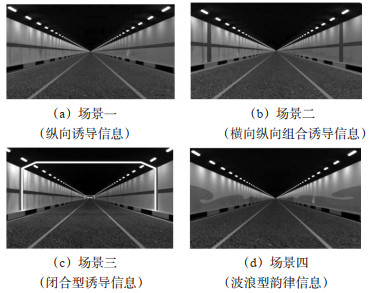
场景 设施 思路依据 场景一(纵向诱导信息) 腰带线 引导前进线形方向,明确纵向路权 场景二(横向纵向组合诱导信息) 腰带线、竖向条纹 在场景一(纵向诱导信息)的基础上增强横向路权 场景三(闭合型诱导信息) 腰带线、竖向条纹、LED矩形轮廓带 形成多频率空间视觉刺激,明确纵向路权、横向路权和竖向路权 场景四(波浪型波浪型韵律图韵律信息) 明确纵向路权、横向路权,同案 时满足韵律需求,符合心理节律,缓解驾驶疲劳  下载: 导出CSV
表 2 平均车速统计结果
Table 2. Average speed statistical results
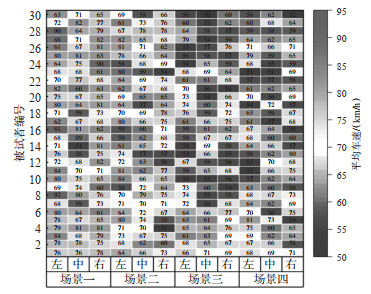
场景 车道 平均车速(/km/h) 超速比例/% 最小值 最大值 左侧车道 61.3 92.1 76.7 场景一 中间车道 54.5 89.2 53.3 右侧车道 60.1 90.4 60.0 左侧车道 58.4 84.5 43.3 场景二 中间车道 57.7 79.0 40.0 右侧车道 57.4 78.6 43.3 左侧车道 53.1 79.0 26.7 场景三 中间车道 50.7 71.5 13.3 右侧车道 54.1 77.4 16.7 左侧车道 51.5 81.2 20.0 场景四 中间车道 54.1 73.4 16.7 右侧车道 52.0 80.3 20.0 注:最小值和最大值表示计算所得的30位驾驶人的平均速度的最小值和最大值,即图 4中每一列的最小值与最大值。
下载: 导出CSV
表 3 行车速度主体间效应检验
Table 3. Results of the between-subjects effects test for speed
影响因素 自由度 显著性 改善场景 34.784 <0.001 车道位置 5.753 <0.001 改善场景与车道位置交互 0.704 0.647
下载: 导出CSV
表 4 纵向加速度统计结果
Table 4. Statistical results of longitudinal acceleration
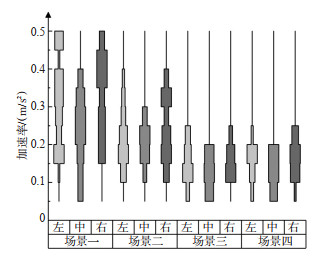
场景 车道 纵向加速度/(m/s2) 标准差 最小值 最大值 左侧车道 0.124 0.482 0.104 场景一 中间车道 0.086 0.397 0.085 右侧车道 0.154 0.495 0.099 左侧车道 0.120 0.384 0.071 场景二 中间车道 0.114 0.294 0.046 右侧车道 0.134 0.396 0.077 左侧车道 0.094 0.234 0.041 场景三 中间车道 0.064 0.194 0.036 右侧车道 0.103 0.224 0.039 左侧车道 0.086 0.219 0.038 场景四 中间车道 0.072 0.199 0.035 右侧车道 0.099 0.234 0.041 注:最小值和最大值表示计算所得的30位驾驶人的平均纵向加速度中的最小值和最大值。
下载: 导出CSV
表 5 车辆加速度主体间效应检验
Table 5. Tests for between-subjects effects for acceleration
影响因素 自由度 显著性 改善场景 93.954 <0.001 车道位置 18.113 <0.001 改善场景与车道位置交互 1.811 0.096
下载: 导出CSV
表 6 横向偏移量统计结果
Table 6. Statistical results of lateral offset
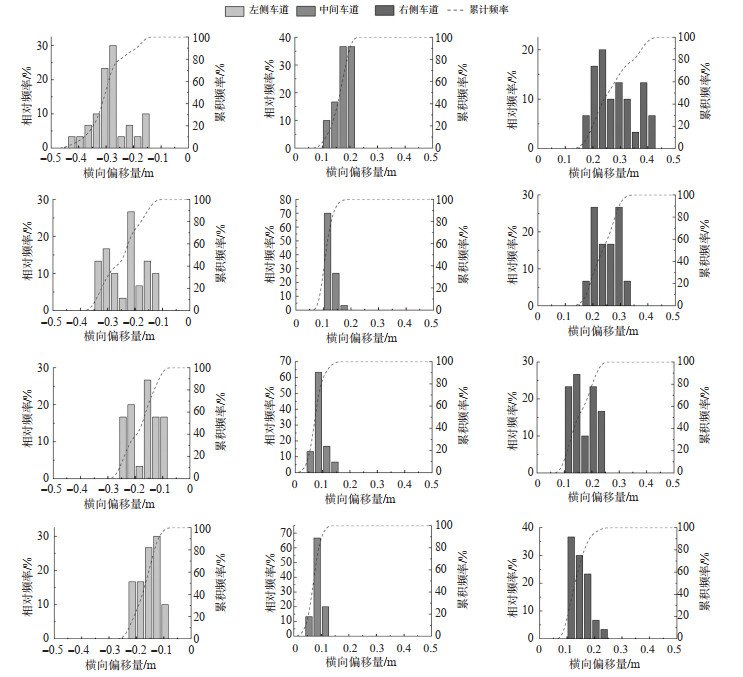
场景 车道 均值/m 标准差 范围/m 左侧车道 -0.284 0.067 -0.416~-0.154 场景一 中间车道 0.175 0.028 0.115~0.216 右侧车道 0.285 0.072 0.171~0.427 左侧车道 -0.234 0.066 -0.346~-0.114 场景二 中间车道 0.125 0.016 0.101~0.167 右侧车道 0.249 0.039 0.187~0.313 左侧车道 -0.166 0.051 -0.225~-0.084 场景三 中间车道 0.091 0.019 0.059~0.142 右侧车道 0.169 0.042 0.107~0.248 左侧车道 -0.157 0.035 -0.224~-0.106 场景四 中间车道 0.089 0.014 0.067~0.116 右侧车道 0.146 0.031 0.102~0.221
下载: 导出CSV
表 7 横向偏移量主体间效应检验
Table 7. Tests for between-subjects effects for lateral offset
影响因素 自由度 显著性 改善场景 11.642 <0.001 车道位置 2 716.701 <0.001 改善场景与车道位置交互 1.115 0.073
下载: 导出CSV
表 8 横向加速度统计结果
Table 8. Statistical results of lateral acceleration
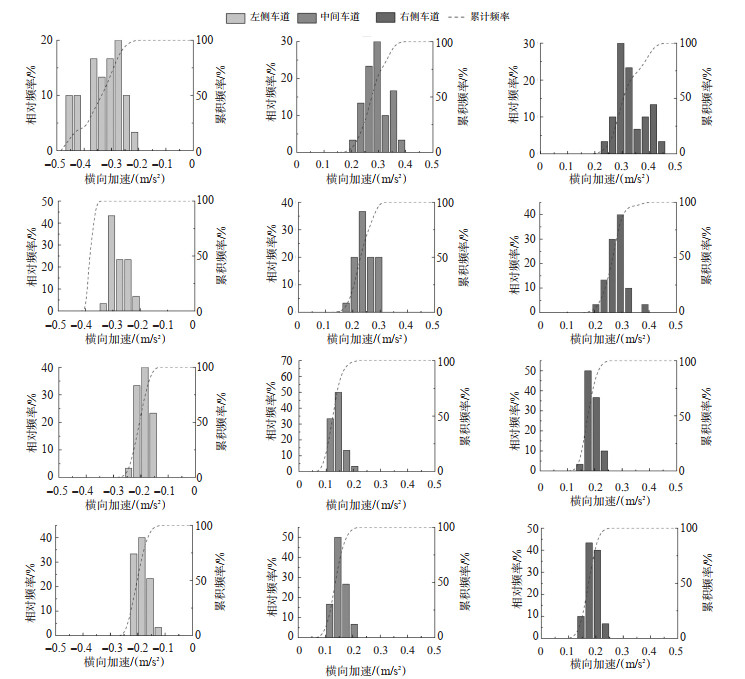
场景 车道 M/(m/s2) SD 范围/(m/s2) 左侧车道 -0.331 0.067 -0.454~-0.215 场景一 中间车道 0.292 0.042 0.218~0.375 右侧车道 0.332 0.052 0.245~0.447 左侧车道 -0.279 0.030 -0.311~-0.206 场景二 中间车道 0.244 0.028 0.183~0.294 右侧车道 0.285 0.033 0.218~0.394 左侧车道 -0.192 0.022 -0.237~-0.154 场景三 中间车道 0.142 0.021 0.106~0.205 右侧车道 0.190 0.024 0.158~0.224 左侧车道 -0.185 0.023 -0.224~-0.134 场景四 中间车道 0.152 0.200 0.117~0.201 右侧车道 0.186 0.021 0.157~0.244
下载: 导出CSV
表 9 横向加速度主体间效应检验
Table 9. Tests for between-subjects effects for lateral acceleration
影响因素 自由度 显著性 改善场景 43.845 <0.001 车道位置 7144.629 <0.001 改善场景与车道位置交互 1.094 0.081
下载: 导出CSV
表 10 KMO和巴特利特球形检验
Table 10. KMO and Bartlett's test of sphericity
KMO取样适切性量数 巴特利特球形度检验 近似卡方 自由度 显著性 0.860 61.641 6 <0.001
下载: 导出CSV
表 11 相关性检验
Table 11. Correlation test
变量 速度 加速度 横向偏移量 横向加速度 速度 1.0 0.94 0.94 0.83 加速度 0.94 1.0 0.93 0.95 横向偏移量 0.94 0.93 1.0 0.87 横向加速度 0.83 0.95 0.87 1.0
下载: 导出CSV
表 12 旋转后的成分矩阵
Table 12. Component matrix after rotation
成分 Y1 Y2 Zscore(速度) 0.867 0.470 Zscore(加速度) 0.828 0.588 Zscore(横向加速度) 0.541 0.791 Zscore(横向偏移量) 0.512 0.858
下载: 导出CSV
表 13 成分得分系数矩阵
Table 13. Matrix of component score coefficients
成分 Y1 Y2 Zscore(速度) 0.909 -0.708 Zscore(加速度) 0.602 -0.041 Zscore(横向加速度) -0.371 0.324 Zscore(横向偏移量) -1.132 1.787
下载: 导出CSV
表 14 各场景各车道下车辆失控风险因子得分
Table 14. Risk scores for driving under each lane for each scenario
场景 车道 Y1 Y2 Y 左侧车道 1.73 1.65 1.73 场景一 中间车道 0.07 -0.50 0.04 右侧车道 1.23 2.26 1.27 左侧车道 0.22 1.21 0.26 场景二 中间车道 -0.57 -1.37 -0.60 右侧车道 0.02 1.93 0.10 左侧车道 -0.39 -0.09 -0.38 场景三 中间车道 -0.86 -1.82 -0.90 右侧车道 -0.21 -0.11 -0.21 左侧车道 -0.32 -0.37 -0.33 场景四 中间车道 -0.66 -2.04 -0.72 右侧车道 -0.25 -0.75 -0.27
下载: 导出CSV
-
[1] CALIENDO C, DE GUGLIELMO M L. Accident rates in road tunnels and social cost evaluation[J]. Procedia-Social and Behavioral Sciences, 2012, 53(1): 166-177. [2] 中华人民共和国交通部. 公路隧道设计细则: JTG/T D70-2010[S]. 北京: 人民交通出版社, 2010.Ministry of Transport, People's Republic of China. Guidelines for design of highway tunnel: JTG/T D70-2010[S]. Beijing: China Communications Press, 2010. (in Chinese) [3] WILLIAMSON A, LOMBARDI D A, FOLKARD S, et al. The link between fatigue and safety[J]. Accident Analysis & Prevention, 2011, 43(2): 498-515. [4] 赵晓华, 鞠云杰, 李佳, 等. 基于驾驶行为和视觉特性的长大隧道突起路标作用效果评估[J]. 中国公路学报, 2020, 33 (6): 29-41.ZHAO X H, JU Y J, LI J, et al. Evaluation of the effect of RPMs in extra-long tunnels based on driving behavior and visual characteristics[J]. China Journal of Highway and Transport, 2020, 33(6): 29-41. (in Chinese) [5] JIAO F T, DU Z G, WONG Y D, et al. Influence of different visual guiding facilities in urban road tunnel on driver's spatial right-of-way perception[J]. Accident Analysis & Prevention, 2022, 172: 106688. [6] JIAO F T, DU Z G, WONG Y D, et al. Self-explaining performance of visual guiding facilities in urban road tunnels based on speed perception[J]. Tunnelling and Underground Space Technology, 2022, 122: 104371. doi: 10.1016/j.tust.2022.104371 [7] DU Z G, WANG S S, YANG L B, et al. Experimental study on the efficacy of retroreflective rings in the curved freeways tunnels[J]. Tunnelling and Underground Space Technology, 2021, 110: 103813. doi: 10.1016/j.tust.2021.103813 [8] DONG W H, LI Z D, LI Z, et al. Analysis of sidewall patterns in extra-long freeway tunnels based on driving behavior[M]// CICTP 2021. 2021: 1208-1217. [9] 宋子璇, 潘晓东, 李少帅, 等. 基于侧墙效应的隧道行车安全评价基础研究[J]. 公路工程, 2010, 35(3): 10-13, 18.SONG Z X, PAN X D, LI S S, et al. Study on driving safety evaluation based on tunnel sidewall effect[J]. Highway Engineering, 2010, 35(3): 10-13, 18. (in Chinese) [10] ZHAO X H, LIU Q Q, LI H J, et al. Evaluation of the effect of decorated sidewall in tunnels based on driving behavior characteristics[J]. Tunnelling and Underground Space Technology, 2022, 127: 104591. doi: 10.1016/j.tust.2022.104591 [11] 张南, 张祎, 鲍瀚涛. 驾驶模拟环境下高速公路特长隧道侧墙图案研究[J]. 公路, 2024, 69(12): 317-325.ZHANG N, ZHANG W, BAO H T, et al. Research on sidewall patterns of extra-long highway tunnels under driving simulation environment[J]. Highway, 2024, 69 (12) : 317-325. (in Chinese) [12] 尚婷, 谢磊, 连冠, 等. 公路特长隧道内疲劳唤醒区视觉行为特征研究[J]. 公路, 2024, 69(8): 260-273.SHANG T, XIE L, LIAN G, et al. Characterization of visual behavior in the fatigue arousal zone in highway extra-long tunnels[J]. Highway, 2024, 69(8): 260-273. (in Chinese) [13] QIN X C, ZHANG N A, ZHANG W H, et al. How does tunnel interior color environment influence driving behavior? Quantitative analysis and assessment experiment[J]. Tunnelling and underground space technology, 2020, 98: 103320. doi: 10.1016/j.tust.2020.103320 [14] CHEN P Y, CHEN F, ZHANG L, et al. Examining the influence of decorated sidewall in road tunnels using fMRI technology[J]. Tunnelling and Underground Space Technology, 2020, 99: 103362. doi: 10.1016/j.tust.2020.103362 [15] LYU N C, DU Z J, WEI H. Does connected environment contribute to the driving safety and traffic efficiency improvement in emergency events?[J]. Accident Analysis & Prevention, 2024, 208: 107810. [16] HE S M, DU Z G, MEI J L, et al. Measuring and evaluating the impact of visual guiding strategies in urban tunnel diverging areas on driver behavior: a simulated driving experiment[J]. Measurement, 2025: 117648. [17] 中华人民共和国住房和城乡建设部. 城市地下道路工程设计规范: CJJ221—2015[S]. 北京: 中国建筑工业出版社, 2015.Ministry of Housing and Urban-Rural Development, People's Republic of China. Code for design of urban underground road engineering: CJJ221—2015[S]. Beijing: China Architecture & Building Press, 2015. (in Chinese) [18] CALVI A, BLASⅡS M D, GUATTARI C. An empirical study of the effects of road tunnel on driving performance[J]. Procedia-Social and Behavioral Sciences, 2012, 53(1): 1099-1109. [19] 胡月琦. 高速公路隧道路段驾驶人心智游移及心理负荷与安全风险研究[D]. 西安: 长安大学, 2021.HU Y Q. Study on drivers' mind wandering, mental workload and safety risks in highway tunnles[D]. Xi'an: Chang'an University, 2021. (in Chinese) [20] 阎莹, 王虹婷, 万利, 等. 基于因子分析与熵值法的不同隧道侧向宽度下驾驶负荷模型[J]. 中国公路学报, 2023, 36 (2): 190-202.YAN Y, WANG H T, WAN L, et al. Driver load model under different tunnel lateral widths based on factor analysis and entropy method[J]. China Journal of Highway and Transport, 2023, 36(2): 190-202. (in Chinese) -

 点击查看大图
计量
- 文章访问数: 4
- HTML全文浏览量: 3
- PDF下载量: 0
- 被引次数: 0