



A Review on Vulnerable Road Users' Attitudes Toward Autonomous Vehicles
-
摘要: 自动驾驶技术的推广不仅取决于技术进步,更依赖于公众态度。车辆运行中必然与弱势道路使用者互动,包括行人、非机动车驾驶者、老年人、儿童和残障人士。深入研究这些群体对自动驾驶的态度及其影响因素,对促进技术的社会接受与安全落地具有重要意义。本综述首先梳理了自动驾驶汽车的潜在优势,随后重点回顾了弱势道路使用者对自动驾驶汽车的态度及其影响因素,旨在为未来研究者、技术开发者和行业决策者在技术优化与政策制定中提供参考。研究发现,大多数弱势道路使用者对自动驾驶持积极态度,其中行人和非机动车驾驶者中的年轻男性支持度更高,残疾人将其视为出行机遇,而老年人因适应性较弱更偏好传统车辆;同时,熟悉度的提升能够增强接受度。然而,安全性与可靠性仍是其信任的关键障碍:行人和非机动车驾驶者担忧道路交互风险,残疾人顾虑设计缺陷与自主性受限,老年人对新技术互动感到不安,儿童的家长则关切安全设施保障。本文还总结了若干国家在弱势道路使用者保护方面的政策与实践经验,可为自动驾驶时代的安全保障提供借鉴。最后,本文提出了未来研究方向,包括拓展研究对象与地域范围、引入体验式研究方法、开展纵向追踪研究、运用潜在类别分析识别群体差异,以及区分不同技术等级和运营模式进行情境化分析,以深化对弱势道路使用者态度演变的理解并为技术迭代与政策优化提供支持。Abstract: The widespread adoption of autonomous driving technology depends not only on technological progress but also on public attitudes. In real-world operations, autonomous vehicles inevitably interact with vulnerable road users, including pedestrians, cyclists, elderly people, children, and persons with disabilities. Investigating these groups' attitudes toward autonomous driving and the factors that shape them is crucial for fostering social acceptance and ensuring the safe deployment of this technology. This review outlines the potential advantages of autonomous vehicles. It focuses on the attitudes of vulnerable road users and their influencing factors, aiming to provide guidance for researchers, technology developers, and policymakers in technological improvement and policy design. The findings indicate that most vulnerable road users generally hold positive attitudes toward autonomous vehicles. Younger male pedestrians and cyclists show stronger support. Persons with disabilities view them as opportunities for enhanced mobility, whereas older adults, due to lower adaptability, tend to prefer conventional vehicles. Familiarity with the technology further improves acceptance. Nevertheless, safety and reliability remain critical barriers to trust. Pedestrians and cyclists worry about road interaction risks. Persons with disabilities are concerned about design flaws and loss of independence. Older adults feel uneasy about interacting with new technologies, and parents express concerns over child safety features. The review also summarizes policy measures and practices in several countries aimed at protecting vulnerable road users, offering lessons for safety assurance in the era of autonomous driving. Finally, it highlights future research directions, including expanding study populations and geographical scope, adopting experiential research methods, conducting longitudinal studies, applying latent class analysis to identify subgroup differences, and differentiating between technical levels and operational models. These efforts will advance the understanding of how vulnerable road users' attitudes evolve and provide valuable insights for technology development and policy refinement.
-
Key words:
- Autonomous vehicles /
- vulnerable road users /
- interactive attitude /
- adoption attitude /
- road safety
-

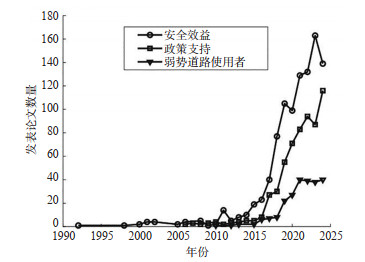
图 1 基于Web of Science核心期刊数据库的关键词年度文章量趋势
Figure 1. Trends in the number of annual articles based on keywords from the Web of science core collection

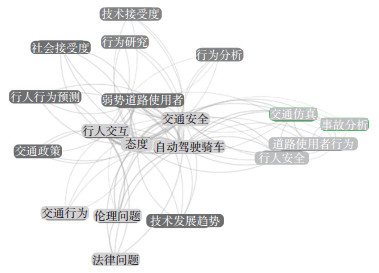
图 2 道路弱势群体与自动驾驶车辆文献关键词聚类
Figure 2. Clustering of keywords in literature on vulnerable road users and autonomous vehicles

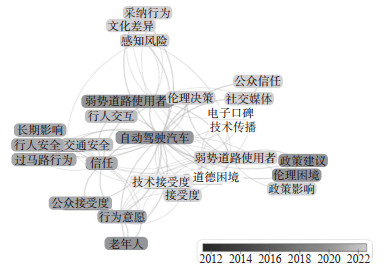
图 3 弱势道路使用者对自动驾驶汽车态度文献关键词共现聚类分析
Figure 3. Co-occurrence cluster analysis of keywords in literature on attitudes of vulnerable road users towards autonomous vehicles
表 1 非机动车和行人相关影响因素
Table 1. Influential factors related to attitudes of non-motorized drivers and pedestrians
作者 年份 调查地区/国家 影响因素 态度类型 Deb等[16] 2017 美国 性别、年龄、居住地、个人行为 交互态度 Penmetsa等[20] 2019 美国 交互 交互态度 Blau等[22] 2018 美国 性别、受教育水平、非机动车道类型 使用态度 Reig等[24] 2018 美国 对自动驾驶汽车的信任度、公司品牌、了解度 交互态度 Hulse等[25] 2023 英国 性别、年龄、交互 交互态度和使用态度 Xing等[26] 2022 美国 交互、自动驾驶汽车事故 交互态度 杨润等[27] 2018 中国 关注公众对自动驾驶技术的接受程度 使用态度 杨洁等[28] 2017 中国 消费者对自动驾驶汽车的接受度、 Pattinson等[29] 2024 美国 行人、骑行者对自动驾驶数据记录仪的态度、隐私权与安全性之间的妥协、数据共享对责任判定的影响 交互态度和使用态度  下载: 导出CSV
表 2 残疾人态度相关影响因素
Table 2. Influential factors related to attitudes of people with disabilities
作者 年份 调查地区/国家 调查对象 影响因素 态度类型 Bennett等[31] 2019 英国 行走障碍残疾人 对自动驾驶汽车技术的兴趣度、焦虑度、残疾程度、对自动驾驶汽车了解度 使用态度 Bennett等[32] 2024 美国 行走障碍残疾人 对自动驾驶汽车技术的兴趣度、焦虑度、残疾程度 使用态度 Brinkley等[34] 2020 美国 盲人和视力损伤者 对自动驾驶汽车了解度及初步看法、性别、年龄、受教育水平、工作状况、出行方式、视力残疾时间 交互态度 Kempapidis等[35] 2020 英国 残疾人 自动驾驶汽车使用经历和体验感 交互态度 Chen等[36] 2023 中国 残疾人 移动性提升、社会公平、环境可持续性 使用态度 Liu等[37] 2021 中国 行走障碍者 环境感知能力、安全性、自动辅助系统的可用性 交互态度 Li等[38] 2022 中国 行动受限者 道路适应性、技术接受度、出行独立性 使用态度 Sivakanthan等[39] 2024 美国 残疾人 自动驾驶的可访问性、交通设计考虑、消费与提供者的需求 交互态度 Harkin等[40] 2024 德国 行走障碍、盲人、老年人 对自动驾驶车辆的态度、焦虑、对自动驾驶的评估 使用态度
下载: 导出CSV
表 3 老年人态度相关影响因素
Table 3. Influential factors related to attitudes of older people
作者 年份 调查地区/国家 影响因素 态度类型 Doulabi等[43] 2022 美国 人口学因素、自动驾驶汽车交互、共享自动驾驶汽车感知态度、作为行人的过街行为 交互态度 Lajunen等[44] 2021 澳大利亚、加拿大、美国和英国 自动驾驶汽车自动化程度、安全性、信任度、享受性、可靠性、舒适性、易用性和吸引力等 使用态度 Rahman等[46] 2019 美国 性别、居住地、感知有用性、信任度、社会规范、自动驾驶汽车熟悉度 使用态度 Chinen等[49] 2024 日本 自动驾驶公交在老龄社会中的应用,尤其是60~70岁女性的正面看法,提升安全性和信任度 交互态度 Park等[50] 2024 美国 认知障碍老年人对自动驾驶汽车的看法,提升教育和模拟训练改善其接受度 使用态度 景鹏等[51] 2021 中国 信任、感知有用性、感知风险、面子意识、态度 使用态度
下载: 导出CSV
表 4 儿童父母态度相关影响因素
Table 4. Influential factors related to attitudes of children
作者 年份 调查地区/国家 调查对象 影响因素 态度类型 Tremoulet等[47] 2019 美国 儿童父母 自动驾驶汽车功能(是否有双向音频通信、安全带检查、自动锁定、安全乘客身份识别以及远程访问车辆信息等) 交互态度 Lee等[48] 2018 美国 儿童父母 父母的性别和居住地、孩子的年龄、汽车用于儿童的约束系统、父母乘坐自动驾驶汽车出行的意愿、父母采用自动驾驶技术的倾向 交互态度 Ma等[52] 2020 中国 小学生及其父母 感知风险、负面情绪对信任的影响;交通安全风险与车辆缺陷感知;父母和孩子对自动驾驶技术信任的差异和共同点 交互态度 Kuhn等[53] 2024 德国 儿童父母 自动驾驶汽车的道德决策、消费者福祉、父母对自动驾驶技术的态度 交互态度 Zhang等[54] 2024 中国 儿童父母 父母对自动驾驶汽车的接受程度、儿童对安全性的认知 使用态度 Mayoral等[55] 2024 美国 儿童 使用助行机器人促进儿童身体活动,探索儿童对新技术(如助行机器人和自动驾驶车辆)的态度和适应性 交互态度
下载: 导出CSV
-
[1] National Highway Traffic Safety Administration. Automated driving systems 2.0: a vision for safety[R]. Washington, D. C. : U.S. Department of Transportation, 2017. [2] 何毅. 汽车自动驾驶技术原理及应用研究[J]. 汽车与配件, 2023(1): 64-66.HE Y. Research on the principles and applications of autonomous driving technology[J]. Automobiles and Accessories, 2023(1): 64-66. (in Chinese) [3] 朱正吉. 车联网技术在自动驾驶汽车设计中的应用[J]. 汽车测试报告, 2023(10): 41-43.ZHU Z J. Application of internet of vehicles technology in autonomous vehicle design[J]. Automotive Test Report, 2023 (10): 41-43. (in Chinese) [4] 胡笳, 罗书源, 赖金涛, 等. 自动驾驶对交通运输系统规划的影响综述[J]. 交通运输系统工程与信息, 2021, 21(5): 52.HU J, LUO S Y, LAI J T, et al. A review of the impact of autonomous driving on transportation planning[J]. Journal of Transportation Systems Engineering and Information Technology, 2021, 21(5): 52. (in Chinese) [5] KYRIAKIDIS M, HAPPEE R, DE WINTER J C. Public opinion on automated driving: results of an international questionnaire among 5 000 respondents[J]. Transportation Research Part F: Traffic Psychology and Behaviour, 2015, 32: 127-140. doi: 10.1016/j.trf.2015.04.014 [6] CHOI J K, JI Y G. Investigating the importance of trust on adopting an autonomous vehicle[J]. International Journal of Human-Computer Interaction, 2015, 31(10): 692-702. doi: 10.1080/10447318.2015.1070549 [7] BANSAL P, KOCKELMAN K M. Forecasting Americans' long-term adoption of connected and autonomous vehicle technologies[J]. Transportation Research Part A: Policy and Practice, 2017, 95: 49-63. doi: 10.1016/j.tra.2016.10.013 [8] SCHOETTLE B, SIVAK M. Public opinion about self-driving vehicles in China, India, Japan, the US, the UK, and Australia[R]. Ann Arbor: University of Michigan, Transportation Research Institute, 2014. [9] 郑新夷, 倪正山, 林依婷. 我国自动驾驶汽车的使用意愿探究[J]. 福州大学学报(哲学社会科学版), 2023, 37(2): 133-143.ZHENG X Y, NI Z S, LIN Y T. Exploring the willingness to use autonomous vehicles in China[J]. Journal of Fuzhou University(Philosophy and Social Sciences Edition), 2023, 37 (2): 133-143. (in Chinese) [10] VANLAAR W, HING M M, BROWN S, et al. Fatal and serious injuries related to vulnerable road users in Canada[J]. Journal of Safety Research, 2016, 58: 67-77. doi: 10.1016/j.jsr.2016.07.001 [11] MERSKY A C, SAMARAS C. Fuel economy testing of autonomous vehicles[J]. Transportation Research Part C: Emerging Technologies, 2016, 65: 31-48. doi: 10.1016/j.trc.2016.01.001 [12] MASSAR M, REZA I, RAHMAN S M, et al. Impacts of autonomous vehicles on greenhouse gas emissions: positive or negative?[J]. International Journal of Environmental Research and Public Health, 2021, 18(11): 5567. doi: 10.3390/ijerph18115567 [13] National Highway Traffic Safety Administration. Fatal analysis reporting system[R]. Washington, D. C. : U.S. Department of Transportation, 2012. [14] GOUMIRI S, YAHIAOUI S, DJAHEL S. Smart mobility in smart cities: emerging challenges, recent advances and future directions[J]. Journal of Intelligent Transportation Systems, 2025, 29(1): 81-117. doi: 10.1080/15472450.2023.2245750 [15] RAHMAN M T, DEY K, DAS S, et al. Sharing the road with autonomous vehicles: a qualitative analysis of the perceptions of pedestrians and bicyclists[J]. Transportation Research Part F: Traffic Psychology and Behaviour, 2021, 78: 433-445. doi: 10.1016/j.trf.2021.03.008 [16] DEB S, STRAWDERMAN L, CARRUTH D W, et al. Development and validation of a questionnaire to assess pedestrian receptivity toward fully autonomous vehicles[J]. Transportation Research Part C: Emerging Technologies, 2017, 84: 178-195. doi: 10.1016/j.trc.2017.08.029 [17] PAYRE W, CESTAC J, DELHOMME P. Intention to use a fully automated car: attitudes and a priori acceptability[J]. Transportation Research Part F: Traffic Psychology and Behaviour, 2014, 27: 252-263. doi: 10.1016/j.trf.2014.04.009 [18] DAS S, DUTTA A, FITZPATRICK K. Technological perception on autonomous vehicles: perspectives of the non-motorists[J]. TechnologyAnalysis&StrategicManagement, 2020, 32 (11): 1335-1352. [19] RAHMAN M T, DEY K, PYRIALAKOU V D, et al. Factors influencing safety perceptions of sharing roadways with autonomous vehicles among vulnerable roadway users[J]. Journal of Safety Research, 2023, 85: 266-277. doi: 10.1016/j.jsr.2023.02.010 [20] PENMETSA P, ADANU E K, WOOD D, et al. Perceptions and expectations of autonomous vehicles: a snapshot of vulnerable road user opinion[J]. Technological Forecasting and Social Change, 2019, 143: 9-13. doi: 10.1016/j.techfore.2019.02.010 [21] MFINANGA D A. Implication of pedestrians' stated preference of certain attributes of crosswalks[J]. Transport Policy, 2014, 32: 156-164. doi: 10.1016/j.tranpol.2014.01.011 [22] BLAU M, AKAR G, NASAR J. Driverless vehicles' potential influence on bicyclist facility preferences[J]. International Journal of Sustainable Transportation, 2018, 12(9): 665-674. doi: 10.1080/15568318.2018.1425781 [23] Bike Pittsburgh. AV survey results 2019[R]. Pittsburgh: Bike Pittsburgh, 2019. [24] REIG S, NORMAN S, MORALES C G, et al. A field study of pedestrians and autonomous vehicles[C]. The 10th International Conference on Automotive User Interfaces and Interactive Vehicular Applications, New York: ACM, 2018. [25] HULSE L M. Pedestrians' perceived vulnerability and observed behaviours relating to crossing and passing interactions with autonomous vehicles[J]. Transportation Research Part F: Traffic Psychology and Behaviour, 2023, 93: 34-54 doi: 10.1016/j.trf.2022.12.007 [26] XING Y Y, ZHOU H Y, HAN X, et al. What influences vulnerable road users' perceptions of autonomous vehicles? A comparative analysis of the 2017 and 2019 Pittsburgh surveys[J]. Technological Forecasting and Social Change, 2022, 176: 121454. doi: 10.1016/j.techfore.2021.121454 [27] 杨润. 高度自动与完全自动驾驶汽车的公众接受度研究[D]. 天津: 天津大学, 2017.YANG R. Research on public acceptance of highly automated and fully autonomous vehicles[D]. Tianjin: Tianjin University, 2017. (in Chinese) [28] 杨洁, 沈梦洁. 中国自动驾驶汽车消费市场接受度调查[J]. 长安大学学报(社会科学版), 2017, 19(6): 34-42.YANG J, SHEN M J. Survey on the consumer market acceptance of autonomous vehicles in China[J]. Journal of Chang'an University(Social Science Edition), 2017, 19(6): 34-42. (in Chinese) [29] PATTINSON J A, CHEN H, BASU S, et al. I can do anything with my AV data(but I won't do that): public attitudes towards data recorders in self-driving cars[C]. The Second International Symposium on Trustworthy Autonomous Systems, Austin: ACM, 2024. [30] CLAYPOOL H, BIN-NUN A, GERLACH J. Self-driving cars: the impact on people with disabilities[R]. Newton: Ruderman Family Foundation, 2017. [31] BENNETT R, VIJAYGOPAL R, KOTTASZ R. Willingness of people with mental health disabilities to travel in driverless vehicles[J]. Journal of Transport & Health, 2019, 12: 1-12. [32] BENNETT R, VIJAYGOPAL R. Exploring mobility and transportation technology futures for people with ambulatory disabilities: a science fiction prototype[J]. Technovation, 2024, 133: 103001. doi: 10.1016/j.technovation.2024.103001 [33] BENNETT R, VIJAYGOPAL R, KOTTASZ R. Willingness of people who are blind to accept autonomous vehicles: an empirical investigation[J]. Transportation Research Part F: Traffic Psychology and Behaviour, 2020, 69: 13-27. doi: 10.1016/j.trf.2019.12.012 [34] BRINKLEY J, HUFF JR E W, POSADAS B, et al. Exploring the needs, preferences, and concerns of persons with visual impairments regarding autonomous vehicles[J]. ACM Transactions on Accessible Computing, 2020, 13(1): 1-34. [35] KEMPAPIDIS T, CASTLE C L, FAIRCHILD R G, et al. A scientific evaluation of autonomous vehicle user experience on sighted and visually impaired passengers based on FACS (facial analysis coding system)and a user experience questionnaire[J]. Journal of Transport & Health, 2020, 19: 100906. [36] CHEN J C, LIU Y, WANG Z, et al. Toward sustainable intelligent transportation systems in 2050: fairness and eco-responsibility[J]. IEEE Transactions on Intelligent Vehicles, 2023, 8(2): 1234-1245. [37] LIU D X, ZHANG H, WANG Q, et al. Vision-assisted autonomous lower-limb exoskeleton robot[J]. IEEE Transactions on Systems, Man, and Cybernetics: Systems, 2021, 51(7): 4256-4268. [38] LI S J, WANG Y, ZHANG J, et al. TA-Unet: integrating triplet attention module for drivable road region segmentation[J]. Sensors, 2022, 22(9): 3257. doi: 10.3390/s22093257 [39] SIVAKANTHAN S, DICIANNO B E, KOONTZ A, et al. Accessible autonomous transportation and services: Design considerations from the perspective of consumers and providers[J]. Archives of Physical Medicine and Rehabilitation, 2024, 105(8): 1536-1544. doi: 10.1016/j.apmr.2024.04.009 [40] HARKIN K A, HARKIN A M, GOEGEL C, et al. How do vulnerable road users evaluate automated vehicles in urban traffic? A focus group study with pedestrians, cyclists, e-scooter riders, older adults, and people with walking disabilities[J]. Transportation Research Part F: Traffic Psychology and Behaviour, 2024, 104: 59-71. doi: 10.1016/j.trf.2024.05.017 [41] PAYRE W, CESTAC J, DELHOMME P. Intention to use a fully automated car: attitudes and a priori acceptability[J]. Transportation Research Part F: Traffic Psychology and Behaviour, 2014, 27: 252-263. doi: 10.1016/j.trf.2014.04.009 [42] DEB S, STRAWDERMAN L, CARRUTH D W, et al. Development and validation of a questionnaire to assess pedestrian receptivity toward fully autonomous vehicles[J]. Transportation Research Part C: Emerging Technologies, 2017, 84: 178-195. doi: 10.1016/j.trc.2017.08.029 [43] DOULABI S, HASSAN H M, LI B. Senior Americans' perceptions, attitudes, and safety concerns toward autonomous vehicles[J]. Journal of Safety Research, 2023, 84: 218-231. doi: 10.1016/j.jsr.2022.10.022 [44] LAJUNEN T, SULLMAN M J M. Attitudes toward four levels of self-driving technology among elderly drivers[J]. Frontiers in Psychology, 2021, 12: 682973. doi: 10.3389/fpsyg.2021.682973 [45] RÖDEL C, STADLER S, MESCHTSCHERJAKOV A, et al. Towards autonomous cars: the effect of autonomy levels on acceptance and user experience[C]. The 6th International Conference on Automotive User Interfaces and Interactive Vehicular Applications, Seattle: ACM, 2014 [46] RAHMAN M M, DEB S, STRAWDERMAN L, et al. How the older population perceives self-driving vehicles[J]. Transportation Research Part F: Traffic Psychology and Behaviour, 2019, 65: 242-257. doi: 10.1016/j.trf.2019.08.002 [47] TREMOULET P D, SEACRIST T, WARD MCINTOSH C, et al. Transporting children in autonomous vehicles: an exploratory study[J]. Human Factors, 2020, 62(2): 278-287. doi: 10.1177/0018720819853993 [48] LEE Y C, MIRMAN J H. Parents' perspectives on using autonomous vehicles to enhance children's mobility[J]. Transportation Research Part C: Emerging Technologies, 2018, 96: 415-431. doi: 10.1016/j.trc.2018.10.001 [49] CHINEN K, MATSUMOTO M, KIM J, et al. Navigating the landscape of autonomous buses: insights in Ibaraki, Japan[J]. Sustainability, 2024, 16(8): 3351. doi: 10.3390/su16083351 [50] PARK J, ZAHABI M, RAHMAN M M, et al. Automated vehicles for older adults with cognitive impairment: a survey study[J]. Ergonomics, 2024, 67(6): 831-848. doi: 10.1080/00140139.2024.2302020 [51] 景鹏, 王伟, 吴麟麟. 老年人对自动驾驶汽车接受度研究[J]. 中国公路学报, 2021, 34(6): 158-171.JING P, WANG W, WU L L. Acceptance of autonomous vehicles for the elderly[J]. China Journal of Highway and Transport, 2021, 34(6): 158-171. (in Chinese) [52] MA Y, LI S, QIN S, et al. Factors affecting trust in the autonomous vehicle: a survey of primary school students and parent perceptions[C]. IEEE 19th International Conference on Trust, Security and Privacy in Computing and Communications(TrustCom), Guangzhou: IEEE, 2020. [53] KUHN M, REIT V, SCHWING M, et al. Let the driver off the hook? Moral decisions of autonomous cars and their impact on consumer well-being[J]. Transportation Research Part A: Policy and Practice, 2024, 189: 104224. doi: 10.1016/j.tra.2024.104224 [54] ZHANG B L, SHEN L, YAO J H, et al. Automatic tracking based on weighted fusion back propagation in UWB for IoT devices[J]. Sensors, 2024, 24(4): 1257. doi: 10.3390/s24041257 [55] MAYORAL R M, HELMI A, LOGAN S W, et al. GoBot Go! Using a custom assistive robot to promote physical activity in children[J]. IEEE Journal of Translational Engineering in Health and Medicine, 2024(12): 613-621. [56] DOULABI S, HASSAN H M, LI B. Senior Americans' perceptions, attitudes, and safety concerns toward autonomous vehicles[J]. Journal of Safety Research, 2023, 84: 218-231. doi: 10.1016/j.jsr.2022.10.022 -

 点击查看大图
计量
- 文章访问数: 5
- HTML全文浏览量: 4
- PDF下载量: 1
- 被引次数: 0