



A Hybrid STGCN-Transformer-Bootstrap Method for Short-Term Expressway Traffic Volume Interval Forecasting
-
摘要: 短时交通量预测是支撑动态限速与匝道调节等主动管控策略的关键环节,针对路网断面间有向空间传播关系建模、非常规运行时段噪声抑制和点预测不确定性量化3个方面的不足,构建了基于STGCN-Transformer-Bootstrap的短时交通量区间预测模型。设计STGCN双流并行架构实现多步长交通特征的时空解耦,在Transformer解码器中引入改进的门控交叉注意力机制(gated cross-attention),通过门控单元动态识别并强化时空融合特征中的长程依赖关系,集成Bootstrap有放回重采样(B = 5 000次)与百分位数法实现对预测不确定性的高可信度量化。应用G15沈海高速泉厦段2022年6月1日-15日共26个ETC门架流水数据进行算例分析,结果表明: 在2个典型断面,5、15、30 min这3种步长下,相较于传统模型ARIMA与SVM,本文模型的RMSE、MAE、MAPE平均降低49.05%、50.57%、51.11%,降幅区间为26.88%~69.05%,预测精度显著提升;相较于组合模型DCRNN、STGCN-LSTM、GCN-Transformer,RMSE、MAE、MAPE平均降低19.77%、21.13%、24.70%,降幅区间为6.45%~54.37%,验证了STGCN时空解耦与Transformer门控交叉注意力特征提取的有效性。在置信区间估计方面,百分位数法在PICP、MPIW、CWC等指标上均表现最优。以5 min预测步长为例,平稳自由流时段MPIW为59.24pcu/5 min,交通流相变时段MPIW升至59.43pcu/5 min,拥堵稳定时段MPIW为59.55pcu/5 min,区间宽度随交通运行状态动态自适应调整,能够有效刻画高速公路交通流剧烈波动下的不确定性范围。Abstract: Short-term traffic volume forecasting is a critical task supporting active traffic management strategies such as dynamic speed limits and ramp metering. To address the limitations of existing deep-learning models in modeling directional spatial propagation among cross-sections, suppressing noise during atypical operating periods, and quantifying point-prediction uncertainty, this study proposes an interval prediction method based on the STGCN-Transformer-Bootstrap model. A dual-stream parallel STGCN architecture is designed to decouple multi-horizon spatio-temporal features, and a gated cross-attention mechanism is introduced in the Transformer decoder to adaptively suppress the interference of irrelevant historical features. The Bootstrap method with 5 000 resampling times and the percentile method are then integrated to construct confidence intervals for the 5, 15 and 30 min prediction horizons. The method is validated on ETC gantry flow data from 26 cross-sections of the G15 Shenhai Expressway Quanzhou-Xiamen segment from June 1 to 15, 2022. At two typical cross-sections, compared with ARIMA and SVM, the RMSE, MAE, and MAPE of the proposed model decrease by 49.05%, 50.57% and 51.11% on average, with reductions ranging from 26.88% to 69.05%; compared with DCRNN, STGCN-LSTM, and GCN-Transformer, the three metrics decrease by 19.77%, 21.13% and 24.70% on average, with reductions ranging from 6.45% to 54.37%. Under the 95% confidence level, the percentile method achieves the best performance across the PICP, MPIW, and CWC metrics. Taking the 5 min prediction horizon as an example, MPIW is 59.24 pcu 5 min during stable free-flow periods, rises to 59.43 pcu/5 min during traffic phase transitions, and reaches 59.55 pcu/5 min during stable congestion, demonstrating adaptive interval widths that effectively characterize the uncertainty range under severe traffic flow fluctuations on expressways.
-

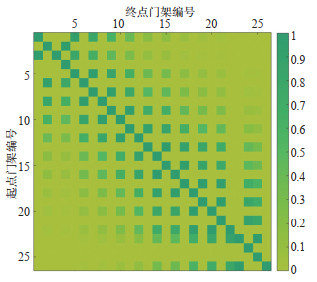
图 1 有向加权邻接矩阵连接权重热力图
Figure 1. Heatmap of connection weights in the directed weighted adjacency matrix

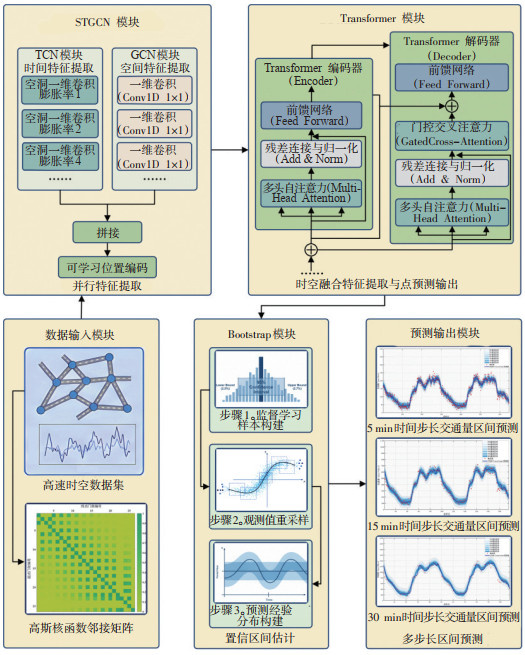
图 3 融合STGCN-Transformer和Bootstrap的高速公路短时交通量区间预测模型结构
Figure 3. Architecture of the short-term expressway traffic interval prediction model integrating STGCN-Transformer and Bootstrap

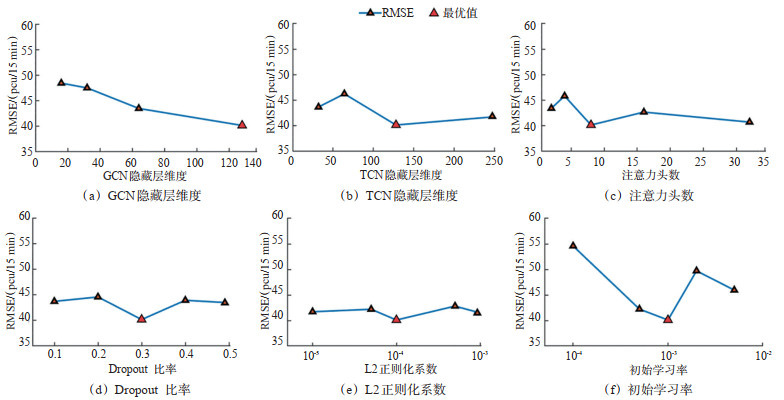
图 4 STGCN-Transformer参数敏感性分析图
Figure 4. Parameter sensitivity analysis of the STGCN-Transformer model

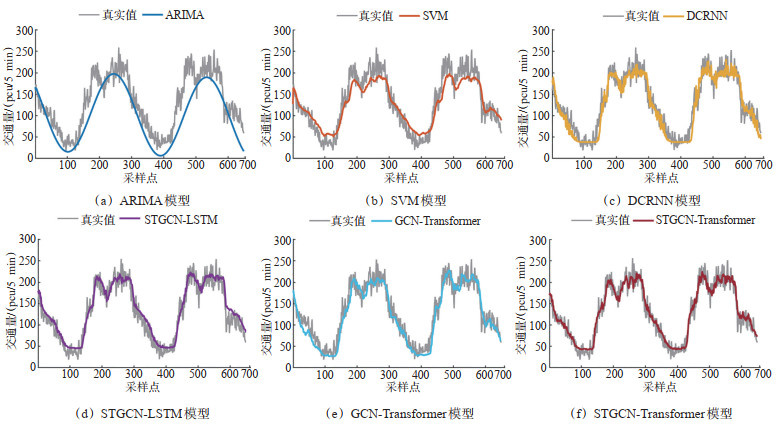
图 5 5min步长模型预测值与真实值对比曲线图
Figure 5. Comparison curves between predicted values and ground truth with a 5 min time step

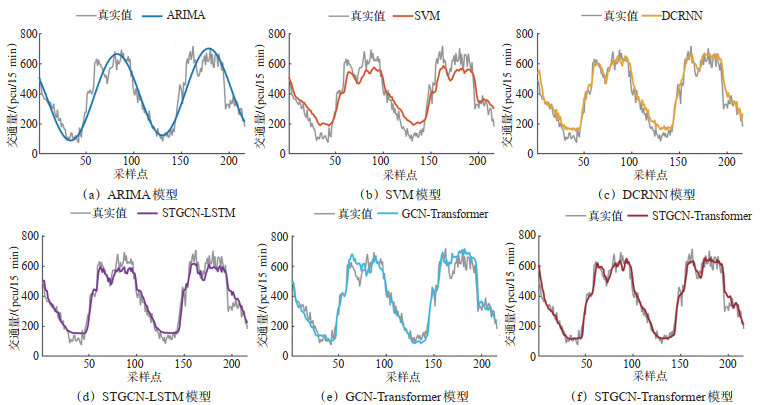
图 6 15 min步长模型预测值与真实值对比曲线图
Figure 6. Comparison curves between predicted values and ground truth with a 15 min time step

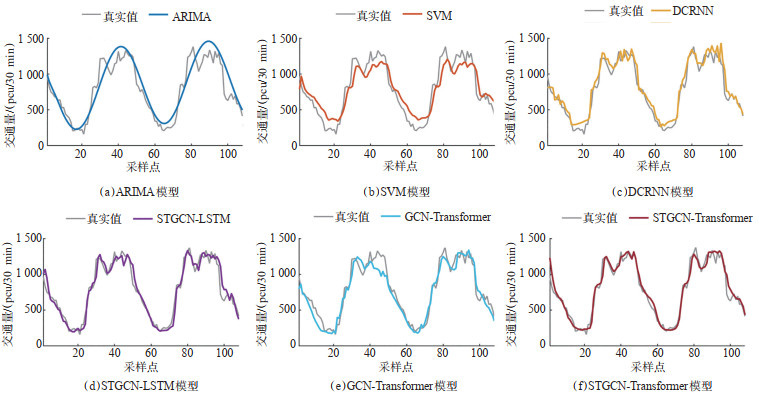
图 7 30min步长模型预测值与真实值对比曲线图
Figure 7. Comparison curves between predicted values and ground truth with a 30 min time step

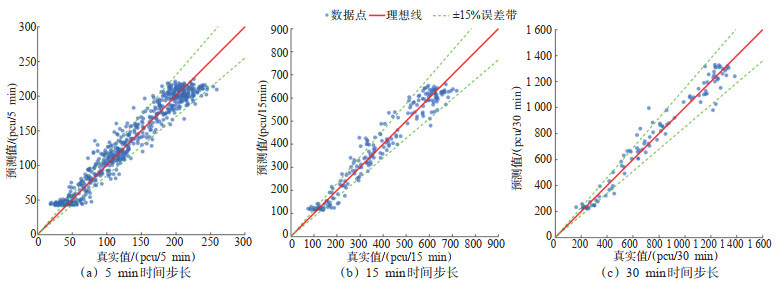
图 8 不同步长STGCN-Transformer模型预测值与真实值对比散点图
Figure 8. Scatter plots comparing predicted values and ground truth of the STGCN-Transformer model across different time steps

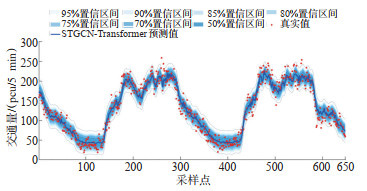
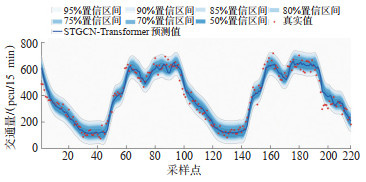
图 9 5 min步长STGCN-Transformer-Bootstrap区间预测结果
Figure 9. Interval prediction results of STGCN-Transformer-Bootstrap with a 5 min time step

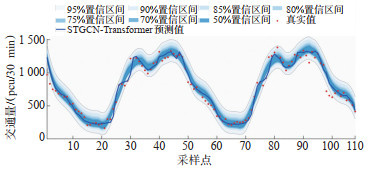
图 10 15min步长STGCN-Transformer-Bootstrap区间预测结果
Figure 10. Interval prediction results of STGCN-Transformer-Bootstrap with a 15 min time step

图 11 30min步长STGCN-Transformer-Bootstrap区间预测结果
Figure 11. Interval prediction results of STGCN-Transformer-Bootstrap with a 30 min time step
表 1 点预测模型性能指标表
Table 1. Performance metrics of point prediction models
门架号 模型 指标 5 min 15 min 30 min RMSE MAE MAPE/% $ R^{2} $ RMSE MAE MAPE/% $ R^{2} $ RMSE MAE MAPE/% $ R^{2} $ G001535 00600062 0010 ARIMA 39.01 31.94 30.43 0.62 69.46 51.69 13.84 0.86 140.70 114.88 16.25 0.85 SVM 24.19 19.66 21.71 0.86 76.60 65.07 25.92 0.84 144.33 121.72 23.30 0.85 DCRNN 18.82 14.69 14.34 0.91 52.20 42.00 17.18 0.92 96.11 77.36 14.07 0.94 STGCN-LSTM 17.53 14.17 15.78 0.94 50.81 40.77 14.48 0.94 89.48 63.74 9.61 0.95 GCN-Transformer 18.88 14.93 14.31 0.91 50.81 39.53 12.00 0.93 101.03 79.00 11.94 0.93 STGCN-Transformer 15.22 12.13 12.66 0.94 41.93 32.68 10.12 0.95 71.39 52.22 8.26 0.96 G001535 00600061 0010 ARIMA 29.46 22.67 18.93 0.72 70.08 51.14 13.61 0.82 147.92 108.41 15.05 0.79 SVM 22.92 18.25 16.82 0.84 70.76 60.14 21.64 0.82 125.86 108.47 19.00 0.86 DCRNN 20.76 16.76 14.80 0.87 48.38 39.98 15.89 0.92 67.49 51.24 7.32 0.96 STGCN-LSTM 17.08 13.66 13.54 0.91 40.26 31.49 10.06 0.95 66.72 52.27 7.88 0.97 GCN-Transformer 17.04 13.34 12.54 0.91 41.79 32.91 9.38 0.94 68.19 56.61 9.40 0.96 STGCN-Transformer 15.89 12.48 11.71 0.92 32.83 25.32 7.25 0.96 52.82 41.55 5.88 0.97  下载: 导出CSV
表 2 区间预测模型性能指标分析表
Table 2. Performance metric analysis of interval prediction models
门架号 模型 指标 5 min 15 min 30 min PICP/% MPIW CWC PICP/% MPIW CWC PICP/% MPIW CWC G001535006000620010 基本Bootstrap 94.91 59.45 121.71 94.44 173.59 402.76 95.37 341.19 341.19 BC法 94.75 58.95 125.64 94.91 172.79 353.77 95.37 354.58 354.58 BCa法 94.60 58.97 131.04 94.44 172.36 399.92 94.44 356.90 828.09 平滑法 95.06 62.13 62.13 95.83 182.96 182.96 96.30 360.29 360.29 百分位数法 95.06 59.39 59.39 95.83 174.46 174.46 96.30 337.73 337.73 G001535006000610010 基本Bootstrap 95.52 60.25 60.25 94.44 136.71 317.20 96.30 206.27 206.27 BC法 94.75 60.90 129.80 94.44 136.47 316.63 95.37 212.28 212.28 BCa法 95.06 60.90 60.90 95.37 137.36 137.36 94.44 214.58 497.87 平滑法 96.45 63.85 63.85 95.37 140.73 140.73 96.30 224.20 224.20 百分位数法 95.22 60.23 60.23 95.37 136.95 136.95 95.37 202.35 202.35
下载: 导出CSV
-
[1] YAN Y, NI L, SUN L, et al. Digital twin enabling technologies for advancing road engineering and lifecycle applications[J]. Engineering, 2025, 44(1): 184-206. [2] 裴玉龙, 何庆龄, 侯琳, 等. 基于文献计量分析的交通量预测研究综述[J]. 公路交通科技, 2023, 40(2): 171-181.PEI Y L, HE Q L, HOU L, et al. Review on traffic volume prediction research based on bibliometric analysis[J]. Journal of Highway and Transportation Research and Development, 2023, 40(2): 171-181. (in Chinese) [3] 王代君, 李明, 鹿守山. 基于Bayes-ARIMA的景区公路短时交通流量预测[J]. 公路, 2024, 69(4): 225-234.WANG D J, LI M, LU S S. Short-term traffic flow prediction of scenic highway based on Bayes-ARIMA[J]. Highway, 2024, 69(4): 225-234. (in Chinese) [4] 陈龙, 谷远利. 基于时空聚类与混合模型的高速公路短时流量预测[J]. 广州航海学院学报, 2025, 33(3): 44-51.CHEN L, GU Y L. Short-term highway traffic flow prediction based on spatiotemporal clustering and hybrid model[J]. Journal of Guangzhou Maritime University, 2025, 33(3): 44-51. (in Chinese) [5] HU X, XIAO Y, WANG T, et al. Traffic volume forecasting model of freeway toll stations during holidays-an SVM mod- el[J]. Promet-Traffic & Transportation, 2022, 34(3): 499-510. [6] 陈娇娜, 张翔, 张生瑞. 高速公路行程时间Bootstrap-KNN区间预测分析与实证[J]. 控制与决策, 2018, 33(11): 2080-2086.CHEN J N, ZHANG X, ZHANG S R. Analysis and empirical study of expressway travel time interval prediction based on Bootstrap-KNN[J]. Control and Decision, 2018, 33(11): 2080-2086. (in Chinese) [7] ZHAN A, DU F, CHEN Z, et al. A traffic flow forecasting method based on the GA-SVR[J]. Journal of High Speed Networks, 2022, 28(2): 97-106. doi: 10.3233/JHS-220682 [8] HUSSAIN B, AFZAL M K, AHMAD S, et al. Intelligent traffic flow prediction using optimized GRU model[J]. IEEE Access, 2021(9): 100736-100746. doi: 10.1109/ACCESS.2021.3097141 [9] 张开瑞, 陆由, 吕能超. 基于EEMD-PE-LSTM的高速公路路段交通状态预测方法[J]. 交通信息与安全, 2025, 43(1): 85-96. doi: 10.3963/j.jssn.1674-4861.2025.01.008ZHANG K R, LU Y, LYU N C. A traffic state prediction method for expressway sections based on EEMD-PE-LSTM[J]. Journal of Transport Information and Safety, 2025, 43(1): 85-96. (in Chinese) doi: 10.3963/j.jssn.1674-4861.2025.01.008 [10] SAEED A, LI C S, DANISH M, et al. Hybrid bidirectional LSTM model for short-term wind speed interval prediction[J]. IEEE Access, 2020(8): 182283-182294. doi: 10.1109/ACCESS.2020.3027977 [11] MOU L, ZHAN P, XIE H, et al. T-LSTM: a long short-term memory neural network enhanced by temporal information for traffic flow prediction[J]. IEEE Access, 2019(7): 98053-98060. doi: 10.1109/ACCESS.2019.2929692 [12] 唐进君, 段一鑫, 商淑杰, 等. 多特征融合时空图卷积的高速公路交通流量预测[J]. 公路交通科技, 2025, 42(6): 22-31.TANG J J, DUAN Y X, SHANG S J, et al. Expressway traffic flow prediction based on multi-feature fusion spatio-temporal graph convolution[J]. Journal of Highway and Transportation Research and Development, 2025, 42(6): 22-31. (in Chinese) [13] YU B, YIN H, ZHU Z. Spatio-temporal graph convolutional networks: a deep learning framework for traffic forecasting[C]. The 27th International Joint Conference on Artificial Intelligence, Stockholm, Sweden: International Joint Conferences on Artificial Intelligence Organization, 2018. [14] 孙大盟, 欧阳安杰, 何立明. 基于改进STGCN深度学习框架的交通速度预测[J]. 计算机技术与发展, 2024, 34(11): 133-139.SUN D M, OUYANG A J, HE L M. Traffic speed prediction based on improved STGCN deep learning framework[J]. Computer Technology and Development, 2024, 34(11): 133-139. (in Chinese) [15] WANG Y, CHEN P, CHU L. Network traffic prediction based on transformer and temporal convolutional network[J]. PLOS ONE, 2025, 20(4): e0320368. doi: 10.1371/journal.pone.0320368 [16] 张悦, 张磊, 刘佰龙, 等. 基于时空Transformer的多空间尺度交通预测模型[J]. 计算机工程与科学, 2024, 46(10): 1852-1863.ZHANG Y, ZHANG L, LIU B L, et al. A multi-spatial scale traffic prediction model based on spatio-temporal transformer[J]. Computer Engineering & Science, 2024, 46(10): 1852-1863. (in Chinese) [17] 吴靓. 基于GCN-Bi-GRU-Transformer的高速公路交通流多步预测与分析[J]. 福建交通科技, 2024(12): 165-170.WU L. Multi-step prediction and analysis of expressway traffic flow based on GCN-Bi-GRU-Transformer[J]. Fujian Transportation Science & Technology, 2024(12): 165-170. (in Chinese) [18] LI M, ZHU Z. Spatial-temporal fusion graph neural networks for traffic flow forecasting[C]. The AAAI Conference on Artificial Intelligence, Palo Alto, USA: AAAI Press, 2021. [19] LI L, XUE D, PAN C. Interval prediction of traffic flow based on bootstrap and deep learning[J]. IEEE Access, 2020(8): 153093-153104. [20] JIA X, JIAN S, TAN Y, et al. Gated cross-attention network for depth completion[C]. 2025 IEEE International Conference on Acoustics, Speech and Signal Processing (ICASSP), Hyderabad, India: IEEE, 2025. -

 点击查看大图
计量
- 文章访问数: 17
- HTML全文浏览量: 10
- PDF下载量: 0
- 被引次数: 0