



A Method for Measuring Bicycle-Sharing Tidal Flow Patterns from a Multi-level Perspective
-
摘要: 针对栅格等传统聚合单元在共享单车潮汐模式检测中易引发可塑面积单元问题(modifiable areal unit problem,MAUP),以及大规模路网下检测精度与计算效率难以兼顾等实际情况,研究了“管理子区-路段尺度”多层级视角下的两阶段潮汐测度方法。第一阶段,以路段替代栅格作为基本检测单元,从而规避聚合单元主观划分带来的MAUP干扰;第二阶段,引入Leiden社区发现算法将研究区域划分为若干内部联系紧密的管理子区,使路段尺度下的潮汐模式识别范围由全域收缩至管理子区内部,实现计算复杂度的数量级压缩。以厦门岛共享单车系统为例,对其06:00—10:00时段的潮汐模式进行检测,结果表明: ①在精度方面,两阶段法在“极高”与“较高”精度等级上的检出比例分别为74%、61%,而栅格法约为20%、12%;两阶段法与全域处理法相比计算效率提升66%;②83%的潮汐模式发生在早高峰(07:00—09:00),集中于就业区与住宅区附近,具有明显单向潮汐流特征;③检测出的潮汐模式呈现任意形状与多尺度分布,栅格法通常难以探测,且不同时段潮汐强度差异显著,存在分级调度的必要。本文方法在有效克服MAUP的同时,兼顾了潮汐模式检测效率与识别精度,可有效提升运维可操作性。Abstract: To address the modifiable areal unit problem (MAUP) caused by traditional aggregation units such as grids in shared bike tidal pattern detection, as well as the difficulty in balancing detection accuracy and computational efficiency in large-scale road networks, this paper proposes a two-stage tidal pattern measurement method from a multi-level perspective of "management subzone-road segment granularity." In the first stage, road segments are used as the basic detection unit instead of grids to avoid MAUP interference caused by subjective aggregation boundary delineation. In the second stage, the Leiden community detection algorithm is introduced to divide the study area into several management subzones with strong internal connections, shrinking the detection range of road-segment-scale tidal patterns from the entire region to within each subzone and achieving an order-of-magni tude reduction in computational complexity. Taking the shared bike system on Xiamen Island as a case study, the tidal patterns during the period from 06:00 to 10:00 are detected and analyzed. The results show that: in terms of accuracy, compared with grid-based methods, the two-stage method achieves significantly better accuracy, with the proportions of "extremely high" and "relatively high" accuracy reaching 74% and 61%, respectively, while the grid-based methods achieve only approximately 20% and 12%; in terms of computational efficiency, the two-stage method improves efficiency by 66% compared with direct processing of the entire region. A total of 83% of the tidal patterns occur during the morning peak (07:00—09:00), concentrated near employment and residential areas, respectively, exhibiting a clear unidirectional tidal flow pattern. The detected tidal patterns exhibit arbitrary shapes and multi-scale distributions that are difficult to capture with regular grid units, and tidal intensity varies significantly across time periods, indicating the necessity of graded dispatch strategies. In conclusion, the proposed method effectively overcomes the MAUP effect while balancing detection efficiency and identification accuracy, and can effectively enhance operational feasibility.
-

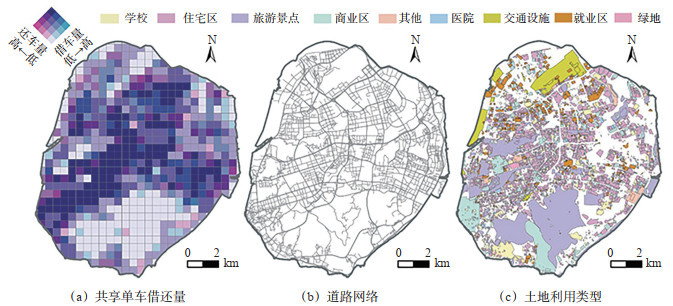
图 1 厦门岛共享单车用户订单、道路网络和土地利用空间分布
Figure 1. Spatial distribution of DBS user orders, road networks and land use on Xiamen island

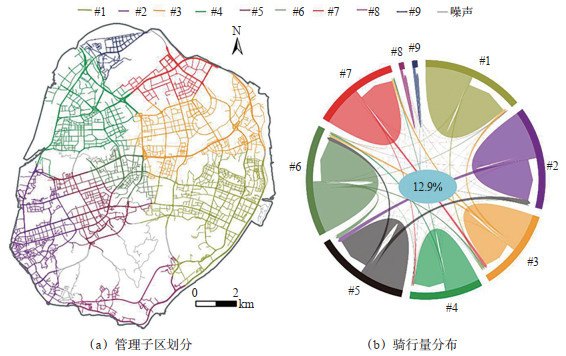
图 3 共享单车管理子区划分结果与订单量分布
Figure 3. Results of DBS management subzone division and distribution of order volume

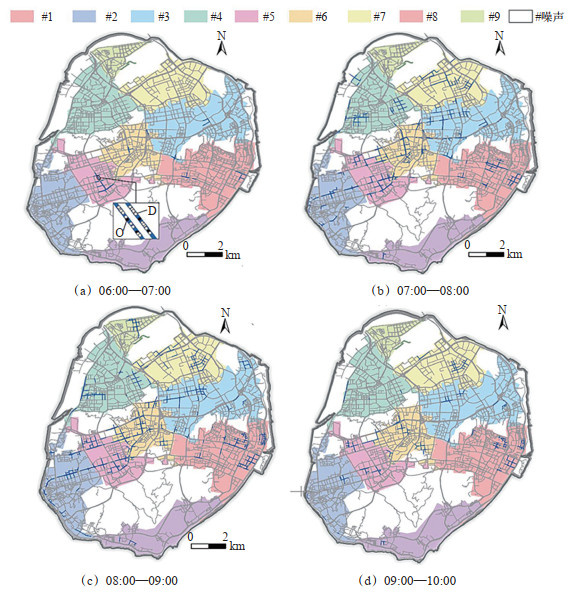
图 4 基于管理子区划分的12月22日共享单车"黑洞"潮汐模式时空分布
Figure 4. Spatiotemporal distribution of shared bike"black hole"tidal patterns on december 22 across management subzones

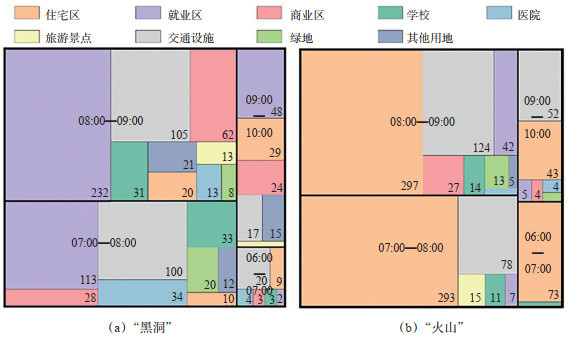
图 5 5 d内共享单车"黑洞"、"火山"在不同时段下的土地利用分布(右下角数值表示潮汐模式具体数量)
Figure 5. Land use distribution of DBS"black hole"and"volcano"across time periods over five days(Bottom-right values show tidal pattern quantities)

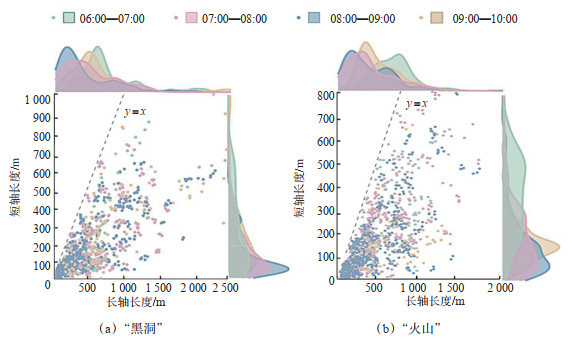
图 6 5 d内共享单车"黑洞"、"火山"在不同时段下的几何分布
Figure 6. Geometric distribution of DBS"black hole"and"volcano"across time periods over five days

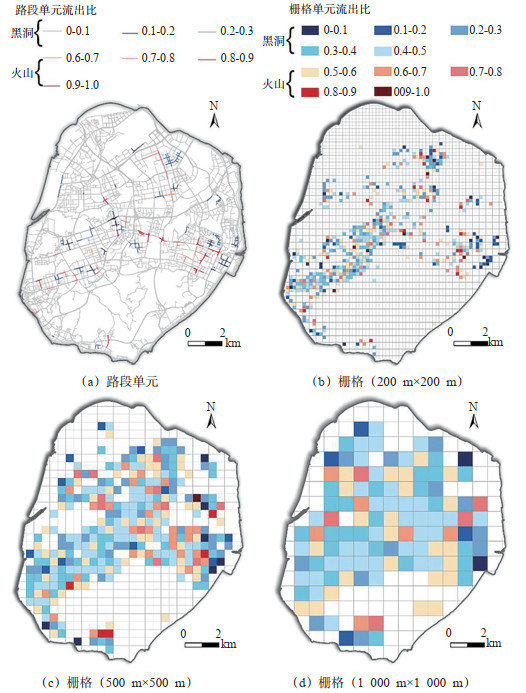
图 7 路段尺度与不同栅格尺度下共享单车12月22日早平峰时段(09:00-10:00)潮汐模式的空间分布
Figure 7. Spatial distribution of DBS tidal pattern on road segments and different grids during morning off-peak hour(09: 00-10: 00)
表 1 5 d内共享单车"黑洞"、"火山"潮汐模式在不同时段分布情况
Table 1. Distribution of DBS"black hole"and "volcano"tidal patterns across time periods over five days
时间段 "黑洞"数量/个(比例/%) "火山"数量/个(比例/%) 06:00-07:00 41(4) 77(7) 07:00-08:00 350(34) 404(36) 08:00-09:00 505(49) 526(47) 09:00-10:00 137(13) 111(10) 总计 1033(100) 1118(100)  下载: 导出CSV
表 2 5d内共享单车"黑洞"、"火山"潮汐强度在不同时段分布情况
Table 2. Tidal intensity of shared bike"black holes"and"volcanoes"across time periods over five days
时间段 共享单车"黑洞" 共享单车"火山" 潮汐强度/(veh/h) 数量/个(比例/%) 潮汐强度/(veh/h) 数量/个(比例/%) 06:00-07:00 轻度$ (\leqslant 92) $ 41 (100) 轻度$ (\leqslant 85) $ 77 (100) 中度(> 92~270) 0 (0) 中度(> 85~244) 0 (0) 重度(> 270) 0(0) 重度(> 244) 0 (0) 轻度$ (\leqslant 92) $ 311 (89) 轻度$ (\leqslant 85) $ 338 (84) 07:00-08:00 中度(> 92~270) 33(9) 中度(> 85~244) 62 (15) 重度(> 270) 6 (2) 重度(> 244) 4 (1) 轻度$ (\leqslant 92) $ 413(82) 轻度$ (\leqslant 85) $ 442 (84) 08:00-09:00 中度(> 92~270) 73 (14) 中度(> 85~244) 72 (14) 重度(> 270) 19(4) 重度(> 244) 12 (2) 轻度$ (\leqslant 92) $ 118(86) 轻度$ (\leqslant 85) $ 107 (96) 09:00-10:00 中度(> 92~270) 19 (14) 中度(> 85~244) 4 (4) 重度(> 270) 0(0) 重度(> 244) 0 (0)
下载: 导出CSV
表 3 5 d内共享单车早高峰时段(07:00—08:00)潮汐模式检测效率
Table 3. Detection efficiency of DBS tidal pattern during morning peak hour(07: 00-08: 00)over five days
管理子区编号 起讫点数量/个 路段数量/个 时间/min #1 4331 4869 8 #2 5553 3832 17 #3 4706 4354 13 #4 4560 3409 9 #5 4740 2105 6 #6 3714 1219 4 #7 3044 1455 8 #8 183 1233 1 #9 172 973 1 研究区域 31003 25171 201
下载: 导出CSV
表 4 5 d内共享单车潮汐模式检测精度
Table 4. Detection accuracy of DBS tidal pattern over five days
共享单车"黑洞"模式 共享单车"火山"模式 精度($ R_{I/T} $) 数量(比例/%) 精度($ R_{I/T} $) 数量(比例/%) 极高$ (0.9 \sim<1.0) $ 322(31) 极高(> 0~0.1) 299(27) 较高($ 0.8 \sim<0.9 $) 371(36) 较高(> 0.1~0.2) 484(43) 一般$ (0.7 \sim<0.8) $ 234(23) 一般(> 0.2~0.3) 258(23) 合格($ 0.6 \sim<0.7 $) 74(7) 合格(> 0.3~0.4) 54(5) 不合格(< 0.6) 32(3) 不合格(> 0.4) 23(2) 总计 1 033(100) 1118(100)
下载: 导出CSV
表 5 12月22日早平峰时段(09:00—10:00)潮汐模式精度对比
Table 5. Accuracy comparison of tidal patterns during the morning off-peak hours(09: 00-10: 00)on December 22
精度(RI/T) 共享单车"黑洞"数量(比例/%) 共享单车"火山"数量(比例/%) 两阶段法 200 m栅格 500 m栅格 1000 m栅格 两阶段法 200 m栅格 500 m栅格 1000 m栅格 极高 7(21) 22(7) 7(4) 2(2) 3(11) 5(3) 0(0) 0(0) 较高 18(53) 42(13) 11(6) 4(4) 14(50) 15(9) 5(5) 0(0) 一般 9(26) 84(26) 42(22) 12(13) 9(32) 20(12) 10(11) 5(14) 合格 0(0) 70(21) 54(28) 37(40) 2(7) 41(24) 26(28) 6(17) 不合格 0(0) 110(33) 77(40) 38(41) 0 88(52) 53(56) 24(69)
下载: 导出CSV
-
[1] 薛晴婉, 瞿麦青, 彭怀军, 等. 基于多目标蚁群算法的共享单车调度优化方法[J]. 交通信息与安全, 2024, 42(2): 124-135. doi: 10.3963/j.jssn.1674-4861.2024.02.013XUE Q W, QU M Q, PENG H J, et al. A shared bicycle scheduling optimization method based on multi-objective ant colony algorithm[J]. Journal of Transport Information and Safety, 2024, 42(2): 124-135. (in Chinese) doi: 10.3963/j.jssn.1674-4861.2024.02.013 [2] 柯日宏, 吴升, 柯玮文. 1种识别共享单车潮汐点的时空模型和基于KNN-Light GBM的租还需求预测方法[J]. 地球信息科学学报, 2023, 25(4): 741-753.KE R H, WU S, KE W W. A spatiotemporal model for identifying shared bicycle tidal points and a rental-demand prediction method based on KNN-Light GBM[J]. Journal of Geo-in-formation Science, 2023, 25(4): 741-753. (in Chinese) [3] LIU X, CHEN W, CHEN X, et al. Could free-floating bikeshare weed out station-based bikeshare? Analyzing the relationship between two bikeshare systems from bivariate flow clustering[J]. Journal of Transport Geography, 2024, 118: 103941. doi: 10.1016/j.jtrangeo.2024.103941 [4] 杨洋, 陈献天, 王健宇, 等. 面向夜间道路交通事故的VSSM-CNN检测网络构建[J]. 交通运输工程学报, 2026, 26(6): 137-152.YANG Y, CHEN X T, WANG J Y, et al. VSSM-CNN detection network for nighttime road traffic crashes[J]. Journal of Traffic and Transportation Engineering, 2026, 26(6): 137-152. (in Chinese) [5] HU B, ZHONG Z, ZHANG Y, et al. Understanding the influencing factors of bicycle-sharing demand based on residents' trips[J]. Physica A: Statistical Mechanics and its Applications, 2022, 586: 126472. doi: 10.1016/j.physa.2021.126472 [6] MENG F, ZHENG L, DING T, et al. Understanding dockless bike-sharing spatiotemporal travel patterns: evidence from ten cities in China[J]. Computers, Environment and Urban Systems, 2023, 104: 102006. doi: 10.1016/j.compenvurbsys.2023.102006 [7] 陈奕璠, 张步镐, 党振, 等. 建成环境对共享单车使用特征的非线性影响研究[J]. 交通运输系统工程与信息, 2024, 24(2): 217-224.CHEN Y F, ZHANG B G, DANG Z, et al. Nonlinear effects of built environment on shared bicycle usage characteristics[J]. Journal of Transportation Systems Engineering and Information Technology, 2024, 24(2): 217-224. (in Chinese) [8] GAO F, LI S, TAN Z, et al. Understanding the modifiable areal unit problem in dockless bike sharing usage and exploring the interactive effects of built environment factors[J]. International Journal of Geographical Information Science, 2021, 35(9): 1905-1925. doi: 10.1080/13658816.2020.1863410 [9] MA Y, ZHANG Z, CHEN S, et al. Investigating the impact of spatial-temporal grid size on the microscopic forecasting of the inflow and outflow gap in a free-floating bike-sharing system[J]. Journal of Transport Geography, 2021, 96: 103208. doi: 10.1016/j.jtrangeo.2021.103208 [10] ZHAO D, ONG G P. Geo-fenced parking spaces identification for free-floating bicycle sharing system[J]. Transportation Research Part A: Policy and Practice, 2021, 148: 49-63. doi: 10.1016/j.tra.2021.03.007 [11] 仝照民, 刘耀林, 张紫怡, 等. 骑行流密度聚类下的共享单车源汇空间识别[J]. 武汉大学学报(信息科学版), 2025, 50(1): 184-196. [12] 姜晓, 白璐斌, 楼夏寅, 等. 基于多尺度时空聚类的共享单车潮汐特征挖掘与需求预测研究[J]. 地球信息科学学报, 2022, 24(6): 1047-1060.JIANG X, BAI L B, LOU X Y, et al. Research on tidal characteristics mining and demand prediction of shared bicycles based on multi-scale spatio-temporal clustering[J]. Journal of Geo-information Science, 2022, 24(6): 1047-1060. (in Chinese) [13] ABOULELA M, CHANIOTAKIS E, ANTONIOU C. Understanding the landscape of shared-e-scooters in North Ameri- ca; spatiotemporal analysis and policy insights[J]. Transportation Research Part A: Policy and Practice, 2023, 169: 103602. doi: 10.1016/j.tra.2023.103602 [14] CAIGANG Z, SHAOYING L, ZHANGZHI T, et al. Nonlinear and threshold effects of traffic condition and built environment on dockless bike sharing at street level[J]. Journal of Transport Geography, 2022, 102: 103375. doi: 10.1016/j.jtrangeo.2022.103375 [15] LIU Q, WU Z, DENG M, et al. Network-constrained bivariate clustering method for detecting urban black holes and volcanoes[J]. International Journal of Geographical Information Science, 2020, 34(10): 1903-1929. [16] CHEN W, CHEN X, CHENG L, et al. Delineating borders of urban activity zones with free-floating bike sharing spatial interaction network[J]. Journal of Transport Geography, 2022, 104: 103442. doi: 10.1016/j.jtrangeo.2022.103442 [17] LIU Q, ZHU S, DENG M, et al. A spatial scan statistic to detect spatial communities of vehicle movements on urban road networks[J]. Geographical Analysis, 2022, 54(1): 124-148. [18] ZHANG X, SHEN Y, ZHAO J. The mobility pattern of dockless bike sharing: a four-month study in Singapore[J]. Transportation Research Part D: Transport and Environment, 2021, 98: 102961. doi: 10.1016/j.trd.2021.102961 [19] 梅婉婷, 张胜, 钟玲玲, 等. 基于边界节点的局部扩展社区发现算法[J]. 南昌航空大学学报(自然科学版), 2022, 36(2): 44-50, 57. [20] CHEN W, LIU X, CHEN X, et al. Deciphering flow clusters from large-scale free-floating bike sharing journey data: a two-stage flow clustering method[J]. Transportation, 2025, 52(1): 155-184. doi: 10.1007/s11116-023-10415-y [21] ZHANG Y, LIN D, MI Z. Electric fence planning for dockless bike-sharing services[J]. Journal of Cleaner Production, 2019, 206: 383-393. doi: 10.1016/j.jclepro.2018.09.215 [22] DIAO M, SONG K, SHI S, et al. The environmental benefits of dockless bike sharing systems for commuting trips[J]. Transportation Research Part D: Transport and Environment, 2023, 124: 103959. doi: 10.1016/j.trd.2023.103959 [23] 吴静娴, 唐桂孔, 李文翔. 建成环境对共享单车分时骑行量的非线性作用研究: 以上海市为例[J]. 交通运输系统工程与信息, 2024, 24(1): 290-298.WU J X, TANG G K, LI W X. Nonlinear effects of built environment on shared bicycle hourly ridership: a case study of Shanghai[J]. Journal of Transportation Systems Engineering and Information Technology, 2024, 24(1): 290-298. (in Chinese) [24] 刘霆威, 徐良杰, 袁凯, 等. 基于自然断点法的共享单车停放区定容方法[J]. 武汉理工大学学报(交通科学与工程版), 2023, 47(6): 992-997.LIU T W, XU L J, YUAN K, et al. A method for determining capacity of shared bike parking areas based on natural breaks[J]. Journal of Wuhan University of Technology (Transportation Science & Engineering), 2023, 47(6): 992-997. (in Chinese) [25] 马君泽, 郑长江, 吴非, 等. 面向地铁站点的共享单车接驳出行特征及影响因素分析[J]. 吉林大学学报(工学版), 2025, 55(8): 2639-2650. -

 点击查看大图
计量
- 文章访问数: 12
- HTML全文浏览量: 6
- PDF下载量: 1
- 被引次数: 0