



Optimization Method of Guide Signs for Ten-lane Freeway Off-ramps based on Driving Task Analysis
-
摘要: 双向10车道高速公路出口区域连续换道需求增加,指路标志布设与驾驶任务节奏适配不足,易造成驾驶负荷集中。基于驾驶任务分析构建指路标志优化方法,将车辆由主线驶离至匝道的连续驾驶过程划分为主线驾驶、首次分流、二次分流、减速调节和匝道调速5个功能区段,分解视觉扫描、车道控制、标志识别、换道和速度控制5类子任务并量化任务负荷;任务负荷分析显示,首次分流段与二次分流段负荷得分分别为40和43,是驶离过程中的主要负荷峰值区;建立“任务负荷-时间-距离”映射关系,将驾驶负荷转化为标志布设的空间需求,实现由驾驶行为解析向标志布设参数推导的转换,形成“认知前置、操作错峰”的6级指路标志布设方案。以实际高速公路改扩建工程为原型构建Unity驾驶模拟场景,组织32名被试完成5种指路标志方案共160组有效实验,融合驾驶人信息负荷与车辆控制负荷,采用熵权法确定权重并经尺度校准,构建驾驶人工作负荷综合评价模型。结果显示,优化方案E的DWL为0.331±0.096,较实际工程方案A(1.267±0.182)降低73.9%,且显著低于其他对比方案(p < 0.05),优化方案能够有效降低驾驶人综合工作负荷并改善车辆操控稳定性。依据驾驶任务负荷特征进行分区分析并优化标志空间布设,可增强指路信息与驾驶任务节奏的匹配性,定量优化超宽幅高速公路出口指路标志。Abstract: At exits of bidirectional 10-lane expressways, the increasing demand for continuous lane changes, coupled with insufficient adaptation between guide sign placement and driving task rhythm, tends to cause concentrated driving workload. This study proposes a guide sign optimization method based on driving task analysis. The continuous driving process from the mainline to the off-ramp is divided into five functional zones: mainline driving, first diversion, second diversion, deceleration adjustment, and ramp speed regulation. Five subtasks (visual scanning, lane control, sign identification, lane changing, and speed control) are decomposed and their workloads are quantified. Workload analysis reveals that the first and second diversion zones, with scores of 40 and 43 respectively, are the primary workload peaks during the exit process. Based on these findings, a "task workload-time-distance" mapping relationship is established to translate driving workload into spatial requirements for sign placement, enabling a transition from driving behavior analysis to the derivation of sign layout parameters. Accordingly, a six-level guide sign layout scheme featuring "cognitive advance and operational peak staggering" is proposed. A Unity driving simulation scenario was developed based on a real highway reconstruction and expansion project. Thirty-two drivers completed 160 valid trials across five guide sign schemes. By integrating drivers' information workload and vehicle control workload, and applying the entropy weight method for weight determination with subsequent scale calibration, a comprehensive Driver Workload (DWL) evaluation model was constructed. The results show that optimized Scheme E achieved a DWL of 0.331 ± 0.096, representing a 73.9% reduction compared to the actual engineering Scheme A (1.267±0.182), and was significantly lower than all other comparison schemes (p < 0.05), indicating that Scheme E effectively reduces overall driver workload and improves vehicle control stability. These findings demonstrate that zonal analysis based on driving task workload characteristics and optimization of sign spatial layout can enhance the matching between guide information and driving task rhythm, providing methodological support for the quantitative optimization of guide signs at exits of extra-wide expressways.
-
表 1 驾驶区段划分及速度特征
Table 1. Driving segment division and speed characteristics
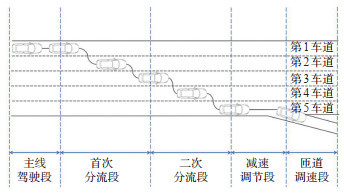
驾驶区段 驾驶核心目标 速度变化特征 主线驾驶段 保持车速与车道, 观察环境与初步指引 100~120 km/h, 匀速, 波动小 首次分流段 安全向右变道至第2车道, 为后续变道做准备 100~120 km/h, 变道时可能轻微减速 二次分流段 继续向右变道至最外侧车道, 完成进入匝道准备 匀减速, 逐步降至80~100 km/h 减速调节段 平稳降速至匝道安全范围, 安全切入匝道 匀减速, 逐步降至60~80 km/h 匝道调速段 根据市道线形精准控制车速, 保持稳定行驶 60 km/h以下, 适应几何设计与限速  下载: 导出CSV
表 2 驾驶子任务负荷赋值说明
Table 2. Driving subtask load assignment description
驾驶子任务 负荷分析说明 负荷值 视觉扫描 贯穿全程, 尤其在识别标志、换道等关键任务尤为重要, 需大范围分配注意力, 负荷较高 3 车道控制 基础性驾驶任务, 多数情况下持续进行车道保持;认知需求低, 操作自动化程度高 1 标志识别 对驾驶人至关重要, 尤其在复杂匝道场景中需快速准确解读关键决策点, 认知负荷极高 4 换道 高速分流段与匝道口执行, 时间紧迫、多任务并行, 需高效协调感知、决策与执行, 负荷极高 5 速度控制 贯穿全程, 对车辆稳定与安全至关重要。任务持续但自动化程度较高, 负荷中等 2
下载: 导出CSV
表 3 驾驶子任务专家评分统计结果
Table 3. Statistical results of expert ratings for driving subtasks
驾驶子任务 第1轮评分 第2轮评分 最终赋值 均值 标准差 均值 标准差 视觉扫描 2.8 0.84 3.0 0.71 3 车道控制 1.2 0.45 1.2 0.45 1 标志识别 4.0 0.71 3.8 0.45 4 换道 4.6 0.89 4.6 0.55 5 速度控制 2.2 0.84 2.4 0.49 2 注:均值与标准差均根据5位专家评分计算, 标准差采用样本标准差。
下载: 导出CSV
表 4 各区段任务分配及负荷得分表
Table 4. Task allocation and load score table for each segment
驾驶区段 视觉扫描 车道控制 标志识别 换道任务 速度控制 区段总负荷得分 主线驾驶段 $ 3 \times 3=9 $ $ 1 \times 1=1 $ $ 1 \times 4=4 $ $ 0 \times 5=0 $ $ 1 \times 2=2 $ 16 首次分流段 $ 6 \times 3=18 $ $ 2 \times 1=2 $ $ 2 \times 4=8 $ $ 2 \times 5=10 $ $ 1 \times 2=2 $ 40 二次分流段 $ 6 \times 3=18 $ $ 3 \times 1=3 $ $ 2 \times 4=8 $ $ 2 \times 5=10 $ $ 2 \times 2=4 $ 43 减速调节段 $ 3 \times 3=9 $ $ 1 \times 1=1 $ $ 1 \times 4=4 $ $ 0 \times 5=0 $ $ 4 \times 2=8 $ 22 市道调速段 $ 3 \times 3=9 $ $ 2 \times 1=2 $ $ 0 \times 4=0 $ $ 0 \times 5=0 $ $ 3 \times 2=6 $ 17
下载: 导出CSV
表 5 不同转换系数下的理论区段长度
Table 5. Theoretical segment lengths under different conversion coefficients
驾驶区段 任务得分 换算时间/s 速度/(m/s) $ k=0.7 $时长度/m $ k=0.8 $时长度/m $ k=1.0 $时长度/m 主线驾驶段 16 12.8 30.56 342 391 489 首次分流段 40 32.0 30.56 856 978 1222 二次分流段 43 34.4 25.00 753 860 1075 减速调节段 22 17.6 19.44 299 342 428 匝道调速段 17 13.6 13.89 165 189 236 合计 2415 2760 3450
下载: 导出CSV
表 6 指路标志设计方案
Table 6. Guide sign design scheme
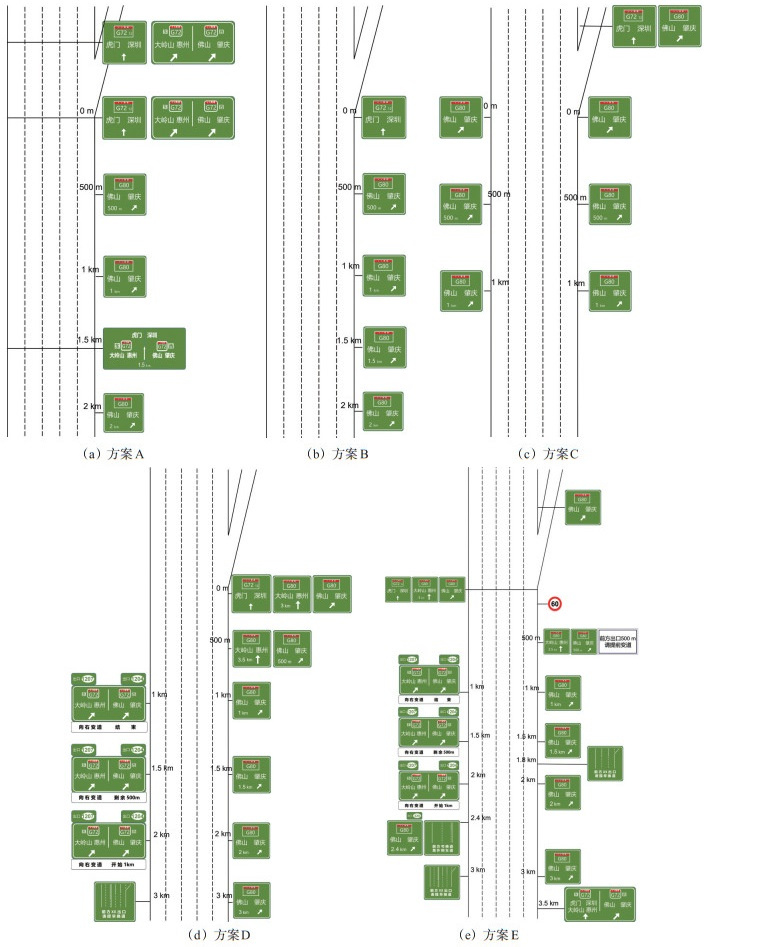
方案 来源依据 方案特征概述 A(实际工程方案) 水官高速布澜路出口方向 设置3个标志断面, 共8块主体板面, 采用左右侧配套布设 B(国标规范方案) GB 5768.2—2022《道路交通标志和标线》 设置5个标志断面, 共5块主体板面, 采用单侧连续预告 C(国内研究优化方案) 国内其他研究文献 设置6个标志断面, 共8块主体板面, 采用左右侧配套布设, 增设车道—去向组合信息 D(改扩建工程建议方案) 广深高速改扩建工程设计 设置6个标志断面, 共13块主体板面, 强化车道分布提示与路径预判 E(本文优化方案) 驾驶任务分析 设置9个指路及车道引导断面, 共18块主体板面, 依据驾驶任务阶段实施分级布设
下载: 导出CSV
表 7 DIL计算指标得分平均值
Table 7. Average score of DIL calculation indicators
方案 信息感知负荷 信息判断负荷 信息执行负荷 A 3.0 3.3 4.3 B 4.3 3.7 3.7 C 3.3 3.3 3.0 D 3.0 2.3 2.3 E 2.0 2.0 1.7
下载: 导出CSV
表 8 控制负荷子指标内容
Table 8. Control load sub-indicator content
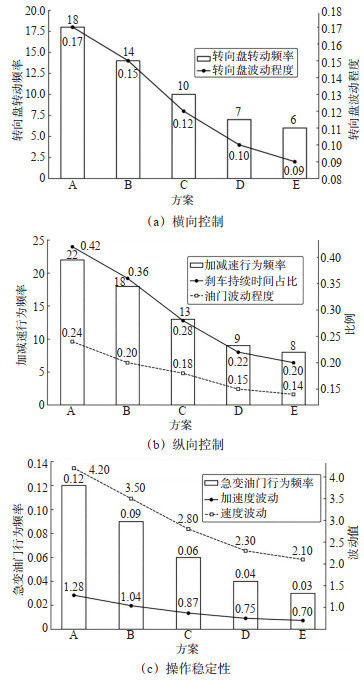
控制负荷子指标 计算指标 横向控制负荷 转向盘转动频率(steering变化大于0.03的次数/min) 转向盘波动程度(steering的标准差) 加减速行为频率$ (|a|>1.0 $的频次/min) 纵向控制负荷 刹车持续时间占比(brake小于0.95的帧占比) 油门波动程度(throttle的标准差) 操作稳定性控制负荷 加速度波动(acceleration的标准差) 速度波动(speed的标准差) 急变油门行为频率(throttle差分大于0.2的比例) 注:表中阈值主要用于剔除设备微小抖动与低幅随机波动, 识别具有实际操控意义的有效操作事件。阈值设置综合考虑了模拟器控制量输出范围、采样精度和预实验数据波动特征, 以及人工核查结果, 并在所有方案中保持一致。
下载: 导出CSV
表 9 驾驶负荷评价指标的信息熵及其权重
Table 9. Information entropy and weight of driving load evaluation indicators
指标名称 所属子指标 信息熵$ E_{j} $ 冗余度$ d_{j}=1-E_{j} $ 指标权重 信息感知负荷 DIL 0.8200 0.1800 0.0626 信息判断负荷 DIL 0.7830 0.2170 0.0755 信息执行负荷 DIL 0.7897 0.2103 0.0731 转向盘转动频率 VCL 0.7076 0.2924 0.1017 转向盘波动程度 VCL 0.7368 0.2632 0.0916 加减速行为频率 VCL 0.7045 0.2955 0.1028 刹车持续时间占比 VCL 0.7175 0.2825 0.0982 油门波动程度 VCL 0.7282 0.2718 0.0945 加速度波动 VCL 0.6993 0.3007 0.1046 速度波动 VCL 0.7147 0.2853 0.0992 急变油门行为频率 VCL 0.7235 0.2765 0.0962
下载: 导出CSV
表 10 各方案综合评价结果
Table 10. Comprehensive evaluation results of different schemes
方案 DIL VCL(归一) DWL A 3.53 0.7888 1.2669 B 3.90 0.5300 1.1174 C 3.23 0.2743 0.7897 D 2.53 0.0748 0.5030 E 1.90 0.0000 0.3314
下载: 导出CSV
表 11 各方案DWL及重复测量比较结果
Table 11. DWL and repeated-measures comparison results of different schemes
方案 DWL均值±标准差 95%置信区间 与方案E比较的校正后$ p $值 A 1.267±0.182 1.201~1.333 < 0.001 B 1.117±0.164 1.058~1.176 < 0.001 C $ 0.790 \pm 0.143 $ 0.738~0.841 < 0.001 D 0.503±0.118 0.460~0.546 0.002 E 0.331±0.096 0.297~0.366 -
下载: 导出CSV
-
[1] 胡鑫超, 戴喆, 奚坤. 内外分幅的整体复合式高速公路交通指路标志布设方法[J]. 交通信息与安全, 2024, 42(3): 62-73.HU X C, DAI Z, XI K. A layout method of guide signs for inner and outer lanes integrated composite expressway[J]. Journal of Transport Information and Safety, 2024, 42(3): 62-73. (in Chinese) [2] 冯移冬, 马国翔, 董文慧, 等. 基于驾驶模拟实验的立体复合高速公路出口指路标志布设[J]. 公路交通科技, 2023, 40(2): 206-213.FENG Y D, MA G X, DONG W H, et al. Layout of exit guide signs for 3D composite expressway based on driving simulation text[J]. Journal of Highway and Transportation Research and Development, 2023, 40(2): 206-213. (in Chinese) [3] 杨帆, 王建军, 马驰骋, 等. 绕城高速出入口指路标志信息量阈值研究[J]. 中国公路学报, 2021, 34(4): 251-260.YANG F, WANG J J, MA C C, et al. Information threshold for guide signs at entrances and exits of ring expressway [J]. China Journal of Highway and Transport, 2021, 34(4): 251-260. (in Chinese) [4] 赵妮娜, 赵晓华, 林展州, 等. 基于驾驶行为的高速公路出口标志形式研究[J]. 中国公路学报, 2020, 33(4): 137-145.ZHAO N N, ZHAO X H, LIN Z Z, et al. Exit gore sign forms for freeway based on driving behavior [J]. China Journal of Highway and Transport, 2020, 33(4): 137-145. (in Chinese) [5] APRONTI D T, SAHA P, MOOMEN M, et al. Truck safety evaluation on Wyoming mountain passes[J]. Accident Analysis & Prevention, 2019, 122: 342-349. [6] LEYN U, VORTISCH P. Calibrating VISSIM for the German highway capacity manual[J]. Transportation Research Record, 2015, 2483: 74-79. doi: 10.3141/2483-09 [7] XIANG W, HE Y, PENG Q, et al. Optimizing the guiding sign system to improve drivers' lane-changing behavior at freeway exit ramp[J]. Journal of Transportation Safety & Security, 2023, 15(10): 1029-1056. [8] HUANG L H, ZHAO X H, LYU S R, et al. Research on the optimization method of a complex diagrammatic sign on urban expressways based on the non-integer rank RSR method[J]. Accident Analysis & Prevention, 2023, 189: 107114. [9] 交通运输部公路科学研究院. 道路交通标志和标线第2部分: 道路交通标志: GB 5768.2—2022[S]. 北京: 中国标准出版社, 2022.Research Institute of Highway Science Ministry of Transport. Road traffic signs and markings—Part 2: Road traffic signs: GB 5768.2—2022[S]. Beijing: Standards Press of China, 2022. (in Chinese) [10] 赵妮娜, 刘会学, 葛书芳. 国内外高速公路枢纽互通指路标志设置形式研究[J]. 公路, 2017, 62(6): 175-181.ZHAO N N, LIU H X, GE S F. Research on guiding signs layout for expressway interchanges in China and overseas [J]. Highway, 2017, 62(6): 175-181. (in Chinese) [11] LONGO L, WICKENS C D, HANCOCK G, et al. Human mental workload: a survey and a novel inclusive definition[J]. Frontiers in Psychology, 2022, 13: 883321. doi: 10.3389/fpsyg.2022.883321 [12] 赵丁. 基于驾驶任务分析的10车道高速公路出口匝道指路标志布局优化[D]. 广州: 广州大学, 2025.ZHAO D. Layout optimization of exit ramp guide signs on ten-lane expressways based on driving task analysis[D]. Guangzhou: Guangzhou University, 2025. (in Chinese) [13] TAO D, TAN H, WANG H, et al. A systematic review of physiological measures of mental workload[J]. International Journal of Environmental Research and Public Health, 2019, 16(15): 2716. doi: 10.3390/ijerph16152716 [14] HAN L, DU Z G, WANG S S, et al. Analysis of traffic signs information volume affecting driver's visual characteristics and driving safety[J]. International Journal of Environmental Research and Public Health, 2022, 19(16): 10349. doi: 10.3390/ijerph191610349 [15] YANG Y, CHEN Y, WU C, et al. Effect of highway directional signs on driver mental workload and behavior using eye movement and brain wave[J]. Accident Analysis & Pre-vention, 2020, 146: 105705. [16] 何世永, 李晓虎, 刘琪, 等. 高速公路隧道群内隧道纵向间距对驾驶人生理负荷的影响规律研究[J]. 公路, 2023, 68(11): 192-199.HE S Y, LI X H, LIU Q, et al. Research on the influence of longitudinal spacing within tunnels group on drivers' physiological load [J]. Highway, 2023, 68(11): 192-199. (in Chinese) [17] 孟云伟, 王磊, 李智鹏, 等. 基于因子分析与熵权法的山区双车道公路驾驶视觉负荷研究[J]. 交通运输系统工程与信息, 2025, 25(4): 361-372.MENG Y W, WANG L, LI Z P, et al. Driver's visual load based on factor analysis and entropy weight methods for mountainous two-lane road [J]. Journal of Transportation Systems Engineering and Information Technology, 2025, 25(4): 361-372. (in Chinese) [18] CHEN Y T, GÉLINAS I, MAZER B. Development of a weighted scoring system for the electronic driving observation schedule[J]. MethodsX, 2020(7): 101099. doi: 10.1016/j.mex.2020.101099 [19] 陈岳峰, 陈礼彪, 黄键, 等. 考虑驾驶行为稳定性与交通流状态稳定性的路标效用评价模型[J]. 公路交通科技, 2019, 36(10): 137-143.CHEN Y F, CHEN L B, HUANG J, et al. A model for evaluating effect of guide sign considering stability of drving behavior and traffic flow state [J]. Journal of Highway and Transportation Research and Development, 2019, 36(10): 137-143. (in Chinese) [20] 卫雨桐, 周荣贵, 张巍汉, 等. 基于主客观赋权-TOPSIS法的县域指引信息重要度评估方法[J]. 公路交通科技, 2024, 41(9): 28-35.WEI Y T, ZHOU R G, ZHANG W H, et al. Assessment method for county-level guidance information importance based on subjective and objective empowerment-TOPSIS approach [J]. Journal of Highway and Transportation Research and Development, 2024, 41(9): 28-35. (in Chinese) [21] 袁滨, 贺润明, 杨射, 等. 条件生成对抗网络的变电站图像融合建模方法[J]. 中国测试, 2025, 51(12): 138-147.YUAN B, HE R M, YANG S, et al. Substation image fusion modeling method based on conditional generative adversarial network[J]. China Measurement & Test, 2025, 51(12): 138-147. (in Chinese) [22] RAN J, LI M L, RONG J, et al. Evaluation of adjustment effects of highway guide signs based on the TOPSIS method[J]. Applied Sciences, 2025, 15: 4949. doi: 10.3390/app15094949 [23] 刘秀, 李文洋. 基于熵权物元可拓模型的路堑边坡安全性评价[J]. 公路交通科技, 2022, 39(11): 49-55.LIU X, LI W Y. Evaluation on safety of cutting slope based on entropy weight matter-element extension model [J]. Journal of Highway and Transportation Research and Development, 2022, 39(11): 49-55. (in Chinese) [24] ROSZKOWSKA E, WACHOWICZ T. Impact of normalization on entropy-based weights in Hellwig's method: a case study on evaluating sustainable development in the education area[J]. Entropy, 2024, 26(5): 365. doi: 10.3390/e26050365 -

 点击查看大图
计量
- 文章访问数: 17
- HTML全文浏览量: 9
- PDF下载量: 0
- 被引次数: 0