



Functionality Resilience of Autonomous Vehicles: Case Studies of Lateral Control and Positioning
-
摘要: 针对自动驾驶车辆在复杂动态环境中因内部子系统耦合、外部环境变化和多交通参与者交互等不确定性而面临关键功能退化、运行安全难以保障的问题,提出以功能为中心的韧性框架及其表征、量化和增强方法。将功能韧性形式化为由不利事件$A$、功能$F$和不确定性$U$组成的三元组($A, F, U$);基于性能曲线$Q(t)$的几何特性,从全局和局部2个维度评估功能韧性,全局维度以韧性损失$R_{L}$量化不利事件作用期间的功能损失,局部维度以性能曲线的局部几何特征刻画系统的吸收与恢复特性;归纳出以降低认知不确定性、优化功能性水平和引入性能反馈为核心的功能韧性增强原则。车辆横向控制案例针对纯跟踪控制器在急弯工况下的功能退化问题,设计融合实时车速与路径曲率的自适应预瞄距离计算方法,并引入横向误差的比例-积分-滑动平均微分反馈构成闭环校正;实车试验与仿真测试表明,所提策略在2个连续急弯处的韧性损失$R_{L}$分别由63.93降至49.50、由61.50降至45.58,性能下降$L_{1}$的绝对值分别由6.73减小至5.15、由5.83减小至3.94,恢复速度$k_{2}$分别由0.530提升至0.683、由0.565提升至0.864。车辆定位案例构建位置"预测-校正"网络,以全球导航卫星系统(global navigation satellite system,GNSS)定位误差为监督信息训练校正网络,提升GNSS信号中断时组合导航系统的定位功能韧性;3处GNSS信号中断场景下,预测-校正策略的定位功能韧性均优于航迹推算与"$p-\Delta p$"架构,第2处中断场景的韧性损失$R_{L}$由航迹推算的420.13降至141.41。结果表明,($A, F, U$)框架能够有效表征、量化和增强自动驾驶车辆的功能韧性,降低认知不确定性与优化功能性水平是提升功能韧性的有效途径。Abstract: Autonomous vehicles (AVs) face functionality degradation and safety risks in complex dynamic environments. Such risks arise from uncertainties, including the coupling of internal subsystems, changes in the external environment, and interactions among multiple traffic participants. To address this problem, a functionality-centered resilience framework together with its characterization, quantification, and enhancement methods is proposed. Functionality resilience is formalized as a triplet (A, F, U) consisting of an adverse event (A), a functionality (F), and uncertainty (U). Based on the geometric characteristics of the performance curve Q(t), functionality resilience is evaluated from both global and local dimensions. The global resilience loss RL quantifies the functionality loss during adverse events, while the local geometric features of the performance curve characterize the absorption and recovery behavior of the system. Resilience enhancement principles centered on reducing epistemic uncertainty, optimizing the functionality level, and introducing performance feedback are summarized. In the vehicle lateral control case, the functionality degradation of a pure pursuit controller in sharp-curve scenarios is addressed. An adaptive look-ahead distance method that fuses real-time vehicle speed and path curvature is designed, and a closed-loop correction consisting of proportional-integral-moving-average-derivative feedback of the lateral error is introduced. Vehicle tests and simulation experiments show that, for the proposed strategy, the resilience loss RL at two successive sharp curves decreases from 63.93 to 49.50 and from 61.50 to 45.58. The absolute value of the performance drop L1 decreases from 6.73 to 5.15 and from 5.83 to 3.94. The recovery speed k2 increases from 0.530 to 0.683 and from 0.565 to 0.864. In the vehicle positioning case, a position"prediction-correction"network is developed. Global navigation satellite system (GNSS) positioning errors are used as supervisory information to train the correction network, thereby improving the positioning functionality resilience of the integrated navigation system during GNSS outages. Under three GNSS outage scenarios, the positioning functionality resilience of the prediction-correction strategy is superior to that of dead reckoning and the " $p-\Delta p$ " architecture. The resilience loss RL at the second outage decreases from 420.13 for dead reckoning to 141.41. The results indicate that the (A, F, U) framework can effectively characterize, quantify, and enhance the functionality resilience of AVs. Reducing epistemic uncertainty and optimizing the functionality level are effective ways to improve functionality resilience.
-

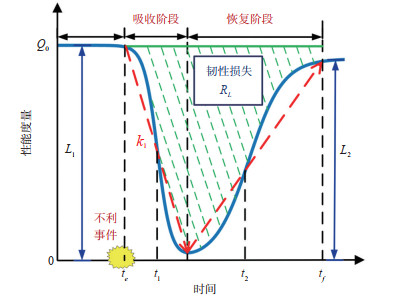
图 1 性能曲线及全局、局部视角下的功能韧性评估
Figure 1. A performance curve and resilience evaluation from both global and local dimensions

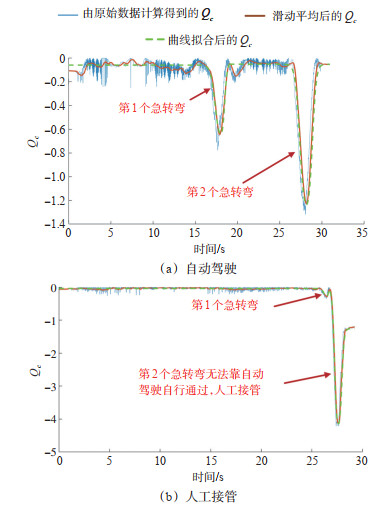
图 3 不同情况下纯跟踪控制器通过急弯时的性能曲线
Figure 3. Performance curves of the pure-pursuit controller when passing sharp curves under different circumstance

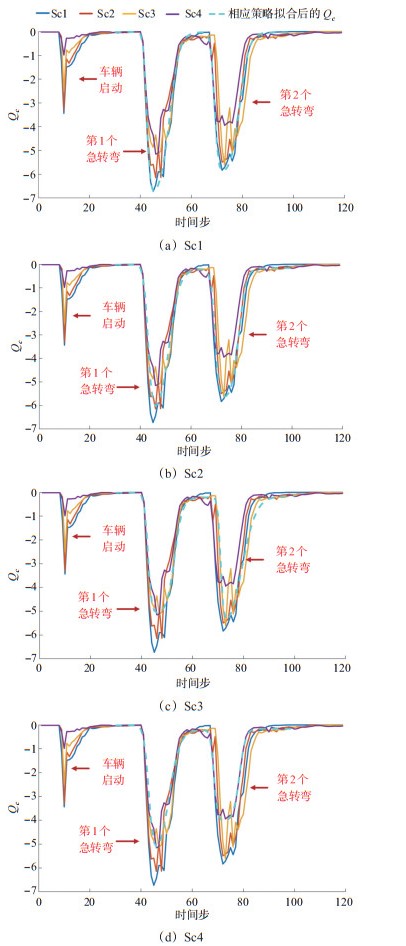
图 5 几种横向控制策略的韧性评估对比
Figure 5. Comparison of the resilience evaluation for several lateral control strategies

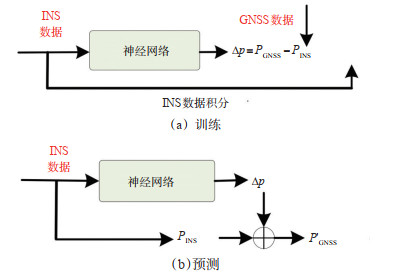
图 6 补偿INS漂移的“位置-位置偏差(“$p-\Delta p$") 架构
Figure 6. "Position-Position Deviation" ("$p-\Delta p$") architecture for INS drift compensation

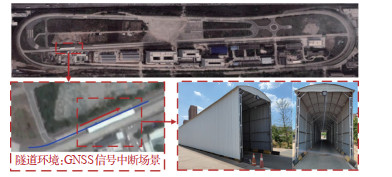
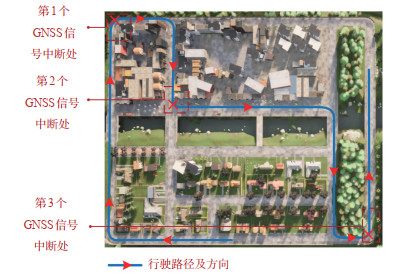
图 8 模拟GNSS信号中断场景的隧道(长度约50 m)测试场地
Figure 8. The test field with a tunnel (with a length of about 50 m) to simulate the GNSS outage scenario

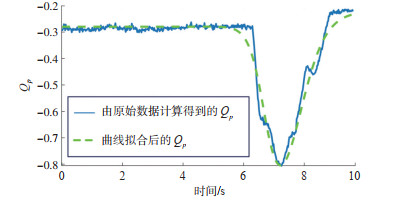
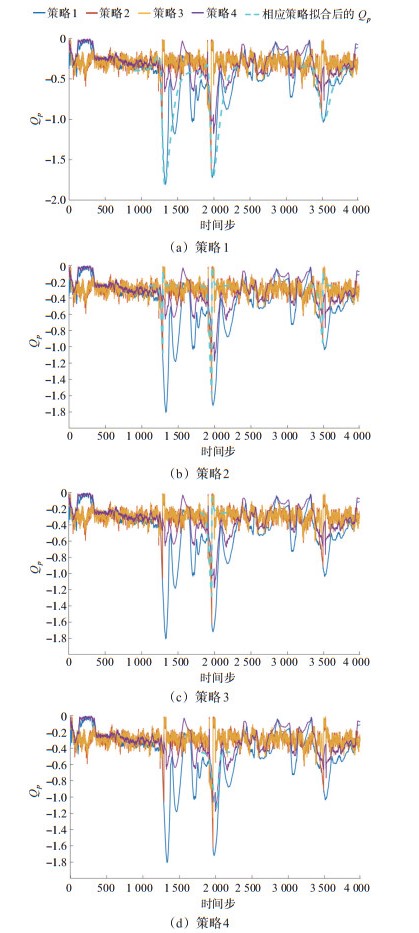
图 9 GNSS信号中断期间组合导航系统的性能曲线
Figure 9. Performance curve of an integrated navigation system during GNSS outages

图 11 不同定位策略韧性比较
Figure 11. Comparison of the resilience evaluation for different positioning strategies
表 1 韧性与含义相近概念的比较 [5]
Table 1. Comparison of resilience with related concepts
概念 含义 韧性(resilience) 系统在受到外界扰动和不利影响后, 具备抵抗、吸收干扰, 并在特定时间内恢复到预期状态或适应新环境的能力 鲁棒性(robustness) 系统在面对环境压力、扰动或参数变化时, 维持初始功能不发生损失的能力 可靠性(reliability) 系统在规定的条件下和规定的时间内, 完成预定功能的能力。主要关注特定不利事件发生后的失效概率 适应性(adaptability) 系统调整自身状态或控制策略, 以在新环境或变化的环境中继续执行预定功能的能力 恢复性(recoverability) 系统从故障或异常状态恢复到正常或预期状态的能力 安全裕度(safety margin) 系统在运行过程中, 实际状态与临界安全边界(如物理极限、性能下限)之间的允许缓冲空间  下载: 导出CSV
表 2 横向控制案例中$(A, F, U)$实例化及相应的韧性增强策略
Table 2. Instantiation of the $(A, F, U)$ framework for the lateral control case and corresponding resilience enhancement strategies
框架要素 在本案例中的具体内涵 韧性增强策略的应对机制 不利事件A 急弯: 路径曲率突然增大, 导致ε≠i跟踪控制器的横向跟踪性能显著下降 自适应预瞄距离: 使预瞄距离ld随路径曲率增大而自适应减小, 提升控制器对急弯事件的响应能力 系统功能F 横向路径跟踪功能: 其水平由跟踪精度(横向误差ε)与平稳性(误差变化Δε)共同衡量 横向误差反馈闭环: 引入横向误差ε及其变化率的比例、积分和平滑微分反馈直接作用于转向角, 以优化跟踪性能F 不确定性U 认知不确定性: 包括车辆动态响应特性等车辆状态信息、道路曲率信息等驾驶环境信息的不确定性 上下文信息融合: 将实时车速与估计路径曲率融入ld的计算, 降低对道路环境的认知不确定性U; 引入横向误差ε及其变化率作为反馈, 减少车辆状态的认知不确定性
下载: 导出CSV
表 3 第1个急弯处不同策略的韧性指标
Table 3. Indicators of resilience evaluation for different strategies at the first turning
策略 韧性损失$\left(R_{L}\right)$ 性能下降($L_{1}$) 恢复速度$\left(k_{2}\right)$ Sc1 63.93 -6.73 0.530 Sc2 59.01 -6.14 0.503 Sc3 56.85 -5.16 0.658 Sc4 49.50 -5.15 0.683
下载: 导出CSV
表 4 第2个急弯处不同策略的韧性指标
Table 4. Indicators of resilience evaluation for different strategies at the second turning
策略 韧性损失$\left(R_{L}\right)$ 性能下降($L_{1}$) 恢复速度$\left(k_{2}\right)$ Sc1 61.50 -5.83 0.565 Sc2 60.68 -5.49 0.514 Sc3 57.39 -5.62 0.744 Sc4 45.58 -3.94 0.864
下载: 导出CSV
表 5 定位案例中(A,F,U)实例化及相应的韧性增强策略
Table 5. Instantiation of the (A, F, U) framework for positioning case and corresponding resilience enhancement strategies
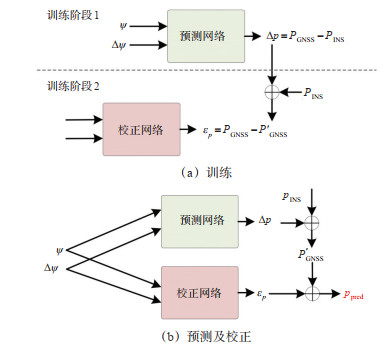
框架要素 在本案例中的具体内涵 韧性增强策略的应对机制 不利事件A GNSS中断: 在隧道、城市、峡谷等场景中, 绝对位置信息来源暂时失效 训练神经网络学习GNSS与INS的偏差模式, 应对GNSS信号中断 系统功能F 高精度、连续、稳定的车辆定位 预测-校正架构: 通过两级网络结构提供位置估计, 并在信号恢复后快速收敛, 旨在维持定位功能F 不确定性U 认知不确定性: INS的累积误差 误差模式学习: 校正网络学习并补偿预测网络的残差, 降低预测模型的认知不确定性
下载: 导出CSV
表 6 第1个GNSS中断处不同策略的韧性指标
Table 6. Indicators of resilience evaluation for different positioning strategies at the first place of GNSS outage
策略 韧性损失(RL) 性能下降(L1) 恢复速度(k2) 策略1 546.68 -1.81 0.016 策略2 117.54 -1.06 6.096 策略3 无明显吸收与恢复特性 策略4 无明显吸收与恢复特性
下载: 导出CSV
表 7 第2个GNSS中断处不同策略的韧性指标
Table 7. Indicators of resilience evaluation for different positioning strategies at the second place of GNSS outage
策略 韧性损失(RL) 性能下降(L1) 恢复速度(k2) 策略1 420.13 -1.70 0.015 策略2 145.35 -1.62 3.060 策略3 141.41 -1.25 4.309 策略4 244.89 -1.16 0.067
下载: 导出CSV
表 8 第3个GNSS中断处不同策略的韧性指标
Table 8. Indicators of resilience evaluation for different positioning strategies at the third place of GNSS outage
策略 韧性损失(RL) 性能下降(L1) 恢复速度(k2) 策略1 374.87 -1.03 0.016 策略2 125.30 -0.90 2.465 策略3 无明显吸收与恢复特性 策略4 无明显吸收与恢复特性
下载: 导出CSV
-
[1] ZHAO X M, FANG Y K, MIN H G, et al. Potential sources of sensor data anomalies for autonomous vehicles: an overview from road vehicle safety perspective[J]. Expert Systems with Applications, 2024, 236: 121358. doi: 10.1016/j.eswa.2023.121358 [2] WANG H, SHAO W, SUN C, et al. A survey on an emerging safety challenge for autonomous vehicles: safety of the intended functionality[J]. Engineering, 2024, 33: 17-34. doi: 10.1016/j.eng.2023.10.011 [3] 李玉峰, 郑向雨, 邱菡, 等. 内生安全赋能智能网联汽车韧性技术研究[J]. 中国科学: 信息科学, 2025, 55(8): 1822-1848.LI Y F, ZHENG X Y, QIU H, et al. Research on resilience technology for intelligent connected vehicle empowered by endogenous security and safety[J]. Scientia Sinica Informationis, 2025, 55(8): 1822-1848. (in Chinese) [4] ARTIME O, GRASSIA M, DE DOMENICO M, et al. Robustness and resilience of complex networks[J]. Nature Reviews Physics, 2024, 6(2): 114-131. doi: 10.1038/s42254-023-00676-y [5] 吴超. 55类重要领域韧性概念的综述[J]. 安全, 2026, 47 (5): 84-91.WU C. Review on the resilience concepts in 55 important fields[J]. Safety & Security, 2026, 47(5): 84-91. (in Chinese) [6] 韩磊, 杜志刚, 潘远轩, 等. 基于文献计量分析的公路隧道交通安全国际研究进展[J]. 交通信息与安全, 2024, 42(6): 1-13. doi: 10.3963/j.jssn.1674-4861.2024.06.001HAN L, DU Z G, PAN Y X, et al. International research progress on highway tunnel traffic safety based on bibliometric analysis[J]. Journal of Transport Information and Safety, 2024, 42(6): 1-13. (in Chinese) doi: 10.3963/j.jssn.1674-4861.2024.06.001 [7] DUI H, ZHANG H, DONG X, et al. Cascading failure and resilience optimization of unmanned vehicle distribution networks in IoT[J]. Reliability Engineering & System Safety, 2024, 246: 110071. [8] WU C, DENG H, WU H, et al. Enhancing resilience of unmanned autonomous swarms through game theory-based cooperative reconfiguration[J]. Reliability Engineering & System Safety, 2025, 260: 110951. [9] 卫亚欣, 李堃, 慕晨, 等. 城市韧性交通系统综述: 评估方法与优化提升[J]. 交通运输工程学报, 2026, 26(4): 230-258.WEI Y X, LI K, MU C, et al. Review of urban resilient transportation systems: assessment methods and optimization improvements[J]. Journal of Traffic and Transportation Engineering, 2026, 26(4): 230-258. (in Chinese) [10] PATIL P, ROJAS J F, KADAV P, et al. Assessing Resilience in lane detection methods: infrastructure-based sensors and traditional approaches for autonomous vehicles[C]. WCX SAE World Congress Experience, Detroit, USA: SAE Technical Paper, 2024. [11] LOGAN T M, AVEN T, GUIKEMA S D, et al. Risk science offers an integrated approach to resilience[J]. Nature Sustainability, 2022, 5(9): 741-748. doi: 10.1038/s41893-022-00893-w [12] AVEN T. Risk science or risk sciences: a perspective on the foundation of the science(s)of risk[J]. Risk Sciences, 2026, 2: 100056. doi: 10.1016/j.risk.2026.100056 [13] AVEN T. On some foundational issues concerning the relationship between risk and resilience[J]. Risk Analysis, 2022, 42(9): 2062-2074. doi: 10.1111/risa.13848 [14] YANG M, SUN H, GENG S. On the quantitative resilience assessment of complex engineered systems[J]. Process Safety and Environmental Protection, 2023, 174: 941-950. doi: 10.1016/j.psep.2023.05.019 [15] DEMMER T, KAHLEN J, LICHTE D, et al. Towards the prediction of resilience: an equation-based resilience representation[C]. 32nd European Safety and Reliability Conference(ESREL), Dublin, Ireland: European Safety and Reliability Association(ESRA), 2022. [16] FANG Y, MIN H, WU X, et al. Resilience-oriented oscillation dampening for connected autonomous vehicle platoons[J]. IEEE Transactions on Vehicular Technology, 2024, 73(11): 16024-16040. doi: 10.1109/TVT.2024.3422239 [17] 王志红, 曾嘉荣, 胡杰, 等. 基于P-PP的轻型商用车路径跟踪控制[J]. 汽车工程, 2025, 47(4): 669-679.WANG Z H, ZENG J R, HU J, et al. Path tracking control of light commercial vehicles based on P-PP[J]. Automotive Engineering, 2025, 47(4): 669-679. (in Chinese) [18] KIM S, LEE J, HAN K, et al. Vehicle path tracking control using pure pursuit with MPC-based look-ahead distance optimization[J]. IEEE Transactions on Vehicular Technology, 2024, 73(1): 53-66. doi: 10.1109/TVT.2023.3304427 [19] GAO Y, LI W, HU Y. Trajectory planning for autonomous driving featuring time-varying road curvature and adhesion constraints[J]. IEEE Transactions on Intelligent Transportation Systems, 2024, 25(11): 16259-16276. doi: 10.1109/TITS.2024.3416289 [20] 白金乐, 权悦, 胡俊泽. 融合改进纯跟踪与模糊PID的履带机器人轨迹跟踪控制[J]. 现代制造工程, 2026(6): 1-10.BAI J L, QUAN Y, HU J Z. Trajectory tracking control for tracked robots combining improved pure pursuit algorithm with fuzzy PID[J]. Modern Manufacturing Engineering, 2026 (6): 1-10. (in Chinese) [21] FANG Y, TEIXEIRA R, MIN H, et al. A safety enhancing framework for autonomous vehicles with a resilience rationale[C]. 7th International Conference on Transportation Information and Safety(ICTIS), Xi'an, China: China Communication and Transportation Association(CCTA), 2023. [22] PASIOS S, NIKOLAIDIS N. CARLA2Real: a tool for reducing the sim2real appearance gap in CARLA simulator[J]. IEEE Transactions on Intelligent Transportation Systems, 2025, 26(11): 18747-18761. doi: 10.1109/TITS.2025.3597010 [23] CHEN Y P, SHAN Y X, CHEN L, et al. Optimization of pure pursuit controller based on PID controller and low-pass filter[C]. 21st International Conference on Intelligent Transportation Systems(ITSC), Maui, USA: IEEE, 2018. [24] 胥川, 胡家琳, 宫丽婷, 等. 考虑交通安全的车载导航技术研究进展[J]. 交通信息与安全, 2025, 43(6): 1-10. doi: 10.3963/j.jssn.1674-4861.2025.06.001XU C, HU J L, GONG L T, et al. In-vehicle navigation technology considering traffic safety: a systematic literature review[J]. Journal of Transport Information and Safety, 2025, 43(6): 1-10. (in Chinese) doi: 10.3963/j.jssn.1674-4861.2025.06.001 [25] AL BITAR N, GAVRILOV A, KHALAF W. Artificial intelligence based methods for accuracy improvement of integrated navigation systems during GNSS signal outages: an analytical overview[J]. Gyroscopy and Navigation, 2020, 11: 41-58. doi: 10.1134/S2075108720010022 [26] FANG Y K, MIN H G, WU X, et al. Toward interpretability in fault diagnosis for autonomous vehicles: interpretation of sensor data anomalies[J]. IEEE Sensors Journal, 2023, 23 (5): 5014-5027. doi: 10.1109/JSEN.2023.3236838 [27] MENGHANI G. Efficient deep learning: a survey on making deep learning models smaller, faster, and better[J]. ACM Computing Surveys, 2023, 55(12): 1-37. -

 点击查看大图
计量
- 文章访问数: 15
- HTML全文浏览量: 9
- PDF下载量: 0
- 被引次数: 0