



A Safety Risk Assessment Method of Road Vertical Alignment Design for Intelligent Vehicles
-
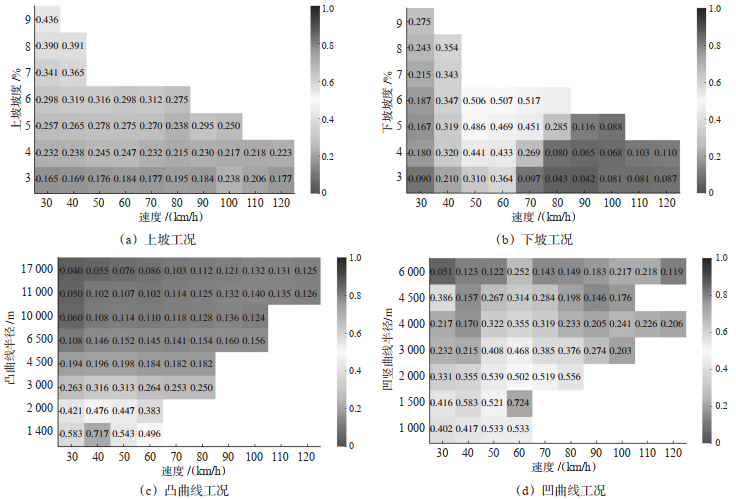
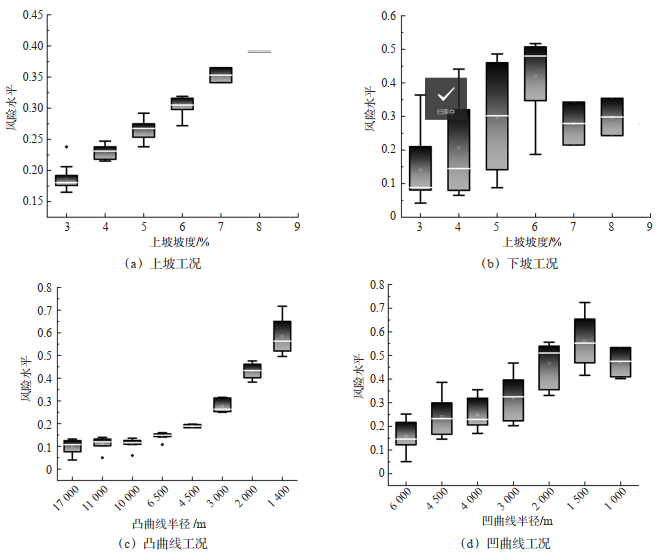
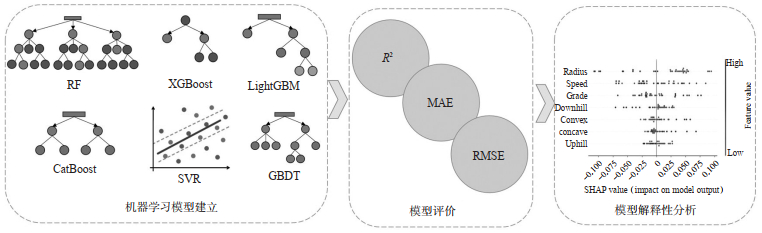
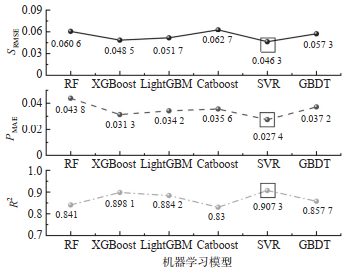
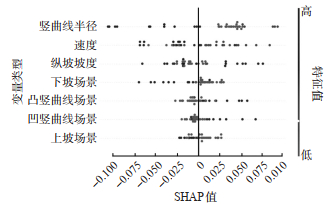
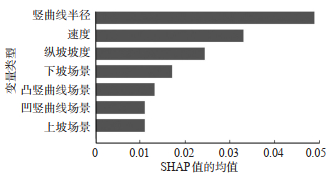
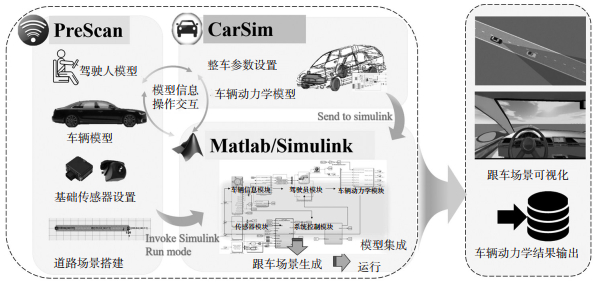
摘要: 针对以自然驾驶人运行特性为依据制定的道路几何设计标准能否适应智能车辆自动控制需求这一问题,结合平面与纵断面线形对车辆动力学的影响差异,从车辆动力学响应角度开展智能车辆对现役道路纵断面几何线形的适应性分析。基于CarSim、PreScan和Simulink多平台联合仿真实验技术,构建涵盖车速30~ 120 km/h、上坡3%~9%、下坡-3%~-9%,以及凸形、凹形竖曲线一般最小与极限最小半径组合的跟驰仿真工况,采集184组不同纵断面工况下的车辆动力学响应有效数据;提取6项纵向行驶统计特征,采用主成分分析提取前3个主成分(累积贡献率92.443%)筛选关键风险特征,结合熵权-TOPSIS法建立纵向行车风险综合评价模型;进一步以纵断面几何参数与运行速度为输入,采用交叉验证与贝叶斯优化优化支持向量回归(support vector regression,SVR)模型,构建智能车辆风险预测模型,并结合SHAP(Shapley additive explanations)方法开展特征可解释性分析。结果表明:跟车距离、相对速度和纵向加速度为反映纵向行车风险水平的关键因素,其中相对速度标准差在熵权评价中权重最高(49.540%);竖曲线半径与运行速度是影响风险水平的主导因素,纵断面几何线形与速度具有显著联合作用;中低车速条件下频繁加减速更易引发纵向控制不稳定,当上坡坡度大于8%、下坡坡度为4%~6%、凸竖曲线半径小于3 000 m,以及凹竖曲线半径小于4 000 m时,智能车辆运行风险明显增加;消融实验显示,剔除纵断面几何特征后模型决定系数R2由0.907降至0.131,表明几何特征对风险预测具有关键贡献;所构建SVR模型测试集决定系数R2为0.907 3,均方根误差(SRMSE)与平均绝对误差(PMAE)分别为0.046 3、0.027 4。研究结果可为现役道路纵断面线形的安全校核与设计参数优化提供依据。Abstract: Geometric design criteria developed for human drivers are examined for their adaptability to the automatic control of intelligent vehicles. Horizontal and vertical alignments differ in their influence on vehicle dynamics. Co-simulation experiments are built on a CarSim-PreScan-Simulink platform. Scenarios cover car-following runs at 30-120 km/h, uphill grades of 3%-9%, and downhill grades of-3% to-9%. Convex or concave vertical curves at minimum radii are also included. A total of 184 valid cases of vehicle dynamic responses are collected. Six longitudinal statistical features are extracted from these cases. Principal component analysis retains the first three components (cumulative contribution rate 92.443%) as key risk features. An entropy-weight TOPSIS model is established for longitudinal driving risk evaluation. Vertical geometric parameters and operating speed are used as model inputs. A support vector regression (SVR) model is optimized by cross-validation and Bayesian optimization. SHAP analysis is applied to interpret the importance of model features. Results identify following distance, relative speed, and longitudinal acceleration as key risk factors. The standard deviation of relative speed receives the highest entropy weight (49.540%). Vertical curve radius and operating speed are the dominant influencing factors. Vertical geometry and speed show joint effects on the risk level. Frequent acceleration and deceleration at low and medium speeds impair longitudinal control stability. Risk rises markedly for uphill grades above 8% and downhill grades of 4% to 6%. Risk also rises when convex radii fall below 3 000 m or concave radii below 4 000 m. An ablation result shows that removing vertical geometric features lowers R2 from 0.907 to 0.131. This indicates the contribution of geometric features to risk prediction. On the test set, the SVR model reaches a coefficient of determination (R2) of 0.907 3. Its root mean square error and mean absolute error are 0.046 3 and 0.027 4, respectively. The results support safety verification and parameter optimization of in-service vertical alignment.
-
Key words:
- traffic safety /
- intelligent vehicles /
- road vertical alignment /
- safety evaluation /
- virtual simulation
-

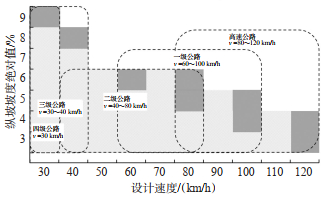
图 2 不同等级公路设计速度—纵坡适用范围
Figure 2. Applicable ranges of design speed and longitudinal grade for different highway classes

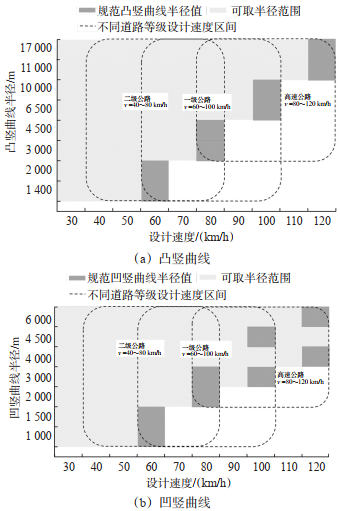
图 3 不同等级公路设计速度—竖曲线适用范围
Figure 3. Applicable ranges of design speed and vertical curve radius for different highway classes

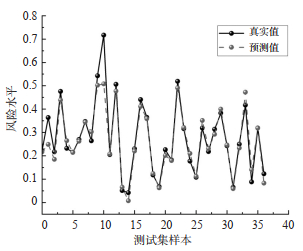
图 10 基于SVR的风险水平真实值与预测值对比
Figure 10. Actual vs. predicted risk levels using SVR (test set)
表 1 车辆动力学系统参数
Table 1. Parameters of vehicle dynamics system
系统模块 指标 单位 参数值 整车质量 kg 2 020 轮距 mm 1 675 整车参数 轴距 mm 2 940 转动惯量Ixx (kg·m2) 1 023.8 转动惯量Iyy (kg·m2) 3 567.2 转动惯量Izz (kg·m2) 4 095.0 前轮最大制动力 (N·m/MPa) 400 制动与轮胎 后轮最大制动力 (N·m/MPa) 150 有效滚动半径 mm 353 轮胎垂直刚度 N/mm 278 动力与传动系统 发动机最大功率 kW 300 驱动形式 - 四轮驱动 变速箱类型 - 8挡自动变速 空气动力学 迎风面积A m2 3.0 空气阻力系数Cd - 0.3  下载: 导出CSV
表 2 纵坡仿真实验方案
Table 2. Design of longitudinal grade scenario simulation experiments
纵坡坡度/% 设计速度/(km/h) ±3 [30, 120] ±4 [30, 120] ±5 [30, 100] ±6 [30, 80] ±7 [30, 40] ±8 [30, 40] ±9 30
下载: 导出CSV
表 3 竖曲线仿真实验方案
Table 3. Design of vertical curve scenario simulation experiments
曲线类型 半径R/m 设计速度/(km/h) 极限最小半径 一般最小半径 1 400 2 000 [30, 60] 凸形竖曲线 3 000 4 500 [30, 80] 6 500 10 000 [30, 100] 11 000 17 000 [30, 120] 1 000 1 500 [30, 60] 凹形竖曲线 2 000 3 000 [30, 80] 3 000 4 500 [30, 100] 4 000 6 000 [30, 120]
下载: 导出CSV
表 4 统计特征指标
Table 4. Statistical characteristics of vehicle dynamics
序号 指标描述 指标符号 1 速度标准差 $\sigma_v$ 2 纵向加速度极值 $\max \left|a_x\right|$ 3 纵向加速度标准差 $\sigma_{a x}$ 4 相对速度极值 $\max |\Delta v|$ 5 相对速度标准差 $\sigma_{\Delta v}$ 6 跟车距离标准差 $\sigma_{\Delta d}$
下载: 导出CSV
表 5 主成分分析方差贡献率
Table 5. Variance contribution rate in principal component analysis
成分 合计 初始特征值 提取主成分 方差贡献率λ/% 累计贡献率∂/% 合计 方差贡献率λ/% 累计贡献率∂/% 1 4.243 70.709 70.709 4.243 70.709 70.709 2 0.820 13.659 84.368 0.820 13.659 84.368 3 0.485 8.075 92.443 0.485 8.075 92.443 4 0.296 4.941 97.384 5 0.107 1.780 99.164 6 0.050 0.836 100.000
下载: 导出CSV
表 6 成分矩阵
Table 6. Component matrix
原始变量 编号 在主成分中的系数l 系数绝对值之和L 成分1 成分2 成分3 $\sigma_v$ x1 0.427 -0.307 0.081 0.815 $\max \left|a_x\right|$ x2 0.407 -0.356 -0.464 1.227 $\sigma_{a x}$ x3 0.447 -0.190 -0.343 0.980 $\max |\Delta v|$ x4 0.427 0.137 0.464 1.027 $\sigma_{\Delta v}$ x5 0.437 0.155 0.521 1.113 $\sigma_{\Delta d}$ x6 0.281 0.837 -0.417 1.535
下载: 导出CSV
表 7 评价指标权重
Table 7. Indicator weights based on entropy method
指标名称 信息熵值ej 权重系数Wj/% $\max \left|a_x\right|$ 0.963 23.259 $ \sigma_{\Delta v}$ 0.921 49.540 $\sigma_{\Delta d}$ 0.957 27.202
下载: 导出CSV
表 8 正、负理想解取值
Table 8. Positive and negative ideal solution values
指标 正理想解Ei+ 负理想解Ei- $\max \left|a_x\right|$ 0.415 0.011 $\sigma \Delta v$ 0.228 0.005 $\sigma \Delta d$ 0.482 0.013
下载: 导出CSV
表 9 模型输入特征提取
Table 9. Model input feature extraction
组成 特征 车辆 运行速度 上坡(0:否;1:是) 下坡(0:否;1:是) 纵断面几何线形 纵坡坡度 凹竖曲线(0:否;1:是) 凸竖曲线(0:否;1:是) 竖曲线半径
下载: 导出CSV
表 10 消融实验数据结果
Table 10. Results of ablation study
实验组 运行速度特征 纵断面几何特征 纵断面线形类别特征 R2 PMAE SRMSE 1 √ √ √ 0.907 0.027 0.046 2 √ - - 0.131 0.109 0.142 3 - √ √ 0.546 0.073 0.102 4 √ √ - 0.595 0.074 0.097
下载: 导出CSV
-
[1] ZHANG Z, LIU H, LEI M, et al. Review on the impacts of cooperative automated driving on transportation and environment[J]. Transportation Research Part D: Transport and Environment, 2023, 115: 103607. doi: 10.1016/j.trd.2023.103607 [2] 王雪松, 覃定明, 叶欣辰, 等. 面向自动驾驶的道路适驾性研究进展[J]. 中国公路学报, 2024, 37(1): 175-193.WANG X S, QIN D M, YE X C, et al. Research progress on road drivability for autonomous vehicles[J]. China Journal of Highway and Transport, 2024, 37(1): 175-193. (in Chinese) [3] 于斌, 王书易, 马羊, 等. 面向智能车辆的现役道路设施行驶适应性研究综述[J]. 中国公路学报, 2022, 35(10): 205-225.YU B, WANG S Y, MA Y, et al. A review of operational compatibility between in-service road infrastructure and intelligent vehicles[J]. China Journal of Highway and Transport, 2022, 35(10): 205-225. (in Chinese) [4] HOSSAIN M M, LIMA M R A, ZHOU H. Potential impacts of connected and autonomous vehicles on controlling criteria for road geometric design: a review[J]. Transportation Research Record, 2024, 2678(11): 1128-1139. doi: 10.1177/03611981241242764 [5] WOO S, WOO B, CHANG Y, et al. Road design on human driver accidents versus automated vehicle failures: comparison with real-world field data[J]. IEEE Access, 2024, 12: 159545-159560. doi: 10.1109/ACCESS.2024.3487353 [6] YAN J, ZENG S, TIAN B, et al. Relationship between highway geometric characteristics and accident risk: a multilayer perceptron model(MLP)approach[J]. Sustainability, 2023, 15 (3): 1893. doi: 10.3390/su15031893 [7] TENGILIMOGLU O, CARSTEN O, WADUD Z, et al. Implications of automated vehicles for physical road environment: a comprehensive review[J]. Transportation Research Part E: Logistics and Transportation Review, 2023, 169: 102989. doi: 10.1016/j.tre.2022.102989 [8] EASA S M, WANG S Y, MA Y, et al. How do vehicle automated features help or hurt driving performance?[J]. Ergonomics International Journal, 2023, 7(1): 1-9. [9] WANG S Y, MA Y, EASA S M, et al. Sight distance of automated vehicles considering highway vertical alignments and its implications for speed limits[J]. IEEE Intelligent Transportation Systems Magazine, 2024, 16(4): 45-61. doi: 10.1109/MITS.2023.3334769 [10] 程国柱, 张禧龙, 徐亮. 全自动驾驶环境下高速公路纵断面线形参数设计[J]. 哈尔滨工业大学学报, 2025, 57(11): 105-114.CHENG G Z, ZHANG X L, XU L. Design of highway longitudinal profile parameters in fully autonomous driving environments[J]. Journal of Harbin Institute of Technology, 2025, 57(11): 105-114. (in Chinese) [11] WELDE Y, QIAO F. Effects of autonomous and automated vehicles on stopping sight distance and vertical curves in geometric design[C]. Resilience and Sustainable Transportation Systems Conference, Tempe, AZ: Arizona State University, 2020. [12] ZHAO Y, YING X, LI J, et al. Research on geometric design standards for freeways under a fully autonomous driving environment[J]. Applied Sciences, 2022, 12(14): 7109. doi: 10.3390/app12147109 [13] YE X, WANG X, LIU S, et al. Feasibility study of highway alignment design controls for autonomous vehicles[J]. Accident Analysis & Prevention, 2021, 159: 106252. [14] CAI M, ZHOU W, WANG S, et al. Road geometry feasibility for automated vehicles with ACC systems: vehicle dynamics on curved roads[J]. Journal of Transportation Engineering, Part A: Systems, 2024, 150(10): 04024056. doi: 10.1061/JTEPBS.TEENG-8240 [15] WANG S, LAI Y, QIU X, et al. Implications of as-built highway horizontal curves on vehicle dynamics/kinematics characteristics under adaptive cruise control[J]. IET Intelligent Transport Systems, 2025, 19(1): e12604. doi: 10.1049/itr2.12604 [16] WANG X, WEI X, WANG X. Investigating micro-driving behavior of combined horizontal and vertical curves using an RF model and SHAP analysis[J]. Applied Sciences, 2024, 14 (6): 2369. doi: 10.3390/app14062369 [17] WANG S, ZHANG J, MA Y, et al. Sight distance analysis of vehicles with driving automation on horizontal curves of as-built highway tunnels[J]. Tunnelling and Underground Space Technology, 2025, 163: 106719. doi: 10.1016/j.tust.2025.106719 [18] CAI M, MAO C, ZHOU W, et al. Neural Network-Driven reliability analysis in safety evaluation of LIDAR-based automated vehicles: considering highway vertical alignments and adverse weather conditions[J]. Electronics, 2024, 13(5): 881. doi: 10.3390/electronics13050881 [19] CHAURASIA V, TIWARI A N, TRIPATHI S M. Coordinated control of autonomous electric vehicles with lateral and longitudinal control using a hybrid approach[J]. Journal of Field Robotics, 2025, 42(7): 3380-3398. doi: 10.1002/rob.22584 [20] ZHANG Z, YU X, ZHU L, et al. Adaptability analysis of autonomous vehicles on small-radius circular curves based on co-simulation[J]. Smart Construction, 2025, 2(3): 1-20. [21] 中华人民共和国交通运输部. 公路路线设计规范: JTG D20-2017[S]. 北京: 人民交通出版社股份有限公司, 2017.Ministry of transport of the People's Republic of China. Design specification for highway alignment: JTG D20-2017[S]. Beijing: China Communications Publishing Group Co., Ltd., 2017. [22] 敖宏伟, 陈学文, 荣同康. 安全距离-时间模型的汽车紧急制动分层控制策略研究[J]. 重庆理工大学学报(自然科学), 2022, 36(1): 31-38.AO H W, CHEN X W, RONG T K. A hierarchical control strategy for vehicle emergency braking based on a safety distance-time model[J]. Journal of Chongqing University of Technology(Natural Science), 2022, 36(1): 31-38. (in Chinese) [23] COPPOLA A, D'ANIELLO C, PARIOTA L, et al. Assessing safety functionalities in the design and validation of driving automation[J]. Transportation Research Part C: Emerging Technologies, 2023, 154: 104243. doi: 10.1016/j.trc.2023.104243 [24] 柳本民, 廖岩枫, 涂辉招, 等. 基于模拟实验的低等级公路车辆过弯风险预测模型[J]. 同济大学学报(自然科学版), 2021, 49(4): 499-505.LIU B M, LIAO Y F, TU H Z, et al. A risk prediction model for vehicles negotiating curves on low-grade highways based on simulation experiments[J]. Journal of Tongji University (Natural Science), 2021, 49(4): 499-505. (in Chinese) [25] ALI G, MCLAUGHLIN S, AHMADIAN M. Quantifying the effect of roadway, driver, vehicle, and location characteristics on the frequency of longitudinal and lateral accelerations[J]. Accident Analysis & Prevention, 2021, 161: 106356. [26] WU B, YAN Y, NI D, et al. A longitudinal car-following risk assessment model based on risk field theory for autonomous vehicles[J]. International Journal of Transportation Science and Technology, 2021, 10(1): 60-68. doi: 10.1016/j.ijtst.2020.05.005 [27] TAN H, LU G, WANG Z, et al. A unified risk field-based driving behavior model for car-following and lane-changing behaviors simulation[J]. Simulation Modelling Practice and Theory, 2024, 136: 102991. doi: 10.1016/j.simpat.2024.102991 [28] ZHOU H, MA C, MA K, et al. Quantile-based scenario generation for automated vehicle safety evaluation[J]. Accident Analysis & Prevention, 2025, 218: 108043. [29] 汪勇杰, 徐玥莹, 苏倩, 等. 基于贝叶斯推理与XGBoost的城市交叉口车道风险综合评价模型[J]. 交通信息与安全, 2024, 42(4): 12-20. doi: 10.3963/j.jssn.1674-4861.2024.04.002WANG Y J, XU Y Y, SU Q, et al. A comprehensive evaluation model of lane risk at urban intersections based on Bayesian inference and XGBoost[J]. Journal of Transport Information and Safety, 2024, 42(4): 12-20. (in Chinese) doi: 10.3963/j.jssn.1674-4861.2024.04.002 [30] LI Z, CAI M, GU T, et al. Feasibility of road longitudinal profiles for automated vehicles based on vehicle dynamics[C]. International Conference on Smart Transportation Interdisciplinary Studies, Nanjing, China: SAE International, 2025. -

 点击查看大图
计量
- 文章访问数: 8
- HTML全文浏览量: 5
- PDF下载量: 0
- 被引次数: 0