



Identification Method for Assisted-Driving Collision-Avoidance Intervention Modes Based on Physiological-Behavioral Fusion
-
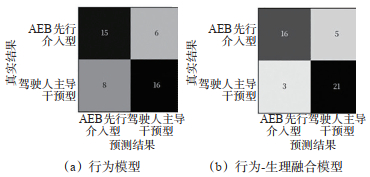
摘要: 为探究自动紧急制动系统(automatic emergency braking,AEB)介入条件下驾驶人生理响应、操纵行为与人机介入时序之间的关联特征,基于驾驶模拟平台,设计雨天固定物碰撞、晴天追尾和夜间固定物碰撞3类典型事故场景,采集驾驶人在稳定跟驰、风险感知与减速避撞阶段的驾驶操纵行为与生理信号数据。根据驾驶人综合反应时刻与AEB触发时刻的先后关系,将样本划分为“驾驶人主导干预型”与“AEB先行介入型”,在控制被试个体差异与场景类型影响的基础上,对比分析2类样本在生理状态、早期反应行为和执行控制行为上的差异。在此基础上,构建随机森林驾驶干预模式识别模型,对比行为特征模型与行为生理融合特征模型的判别性能。结果表明:2类干预模式的差异并非仅体现在AEB触发后的车辆控制结果中,而是在风险暴露前已表现出生理与行为响应的阶段性分化。在稳定跟驰阶段,“驾驶人主导干预型”平均心率更高,说明驾驶人在明显操纵行为出现前已具有更高的生理唤醒水平与风险准备状态;在稳定跟驰向风险感知过渡阶段,“AEB先行介入型”肌电变化强度更高,反映其在风险刺激暴露后的肌肉激活变化更明显。在驾驶行为层面,“AEB先行介入型”表现出更高的早期制动波动性与减速避撞阶段纵向制动强度,而“驾驶人主导干预型”表现出更高的AEB最大制动输出与横向偏移波动,说明2类模式对应不同的人机控制叠加特征。干预模式识别结果表明:引入生理特征后,模型准确率由0.689提高至0.822,召回率由0.667提高至0.875,表明生理信号能够为驾驶人主动介入模式识别提供补充判别信息,有助于降低“驾驶人主导干预型”样本的漏判风险。特征重要性分析表明:S1→S2阶段肌电变化强度与S1阶段平均心率在融合模型中具有一定贡献,可作为干预模式识别的辅助判别依据。Abstract: To investigate the associations among driver physiological responses, control behavior, and human-machine intervention timing under automatic emergency braking (AEB) intervention, a driving-simulator experiment was conducted. Three typical crash scenarios were designed, including a rainy fixed-object collision scenario, a clear-weather rear-end collision scenario, and a nighttime fixed-object collision scenario. Driver control behavior and physiological signals were collected during the stable car-following, risk perception, and deceleration avoidance stages. Based on the temporal relationship between the driver's comprehensive reaction time and AEB triggering time, samples are classified into two intervention modes: "driver-led intervention" and "AEB-first intervention". After individual differences among participants and scenario-type effects are controlled, differences between the two modes in physiological state, early response behavior, and control execution behavior are analyzed. A random forest model is developed to identify the driver intervention mode. The discriminative performance of the behavior-only feature model and the behavior-physiology fusion feature model is compared. The results show that differences between the two intervention modes are not limited to vehicle control outcomes after AEB activation. Stage-specific physiological and behavioral response differences already appear before risk exposure. During the stable car-following stage, the driver-led intervention mode shows a higher average heart rate. This indicates a higher level of physiological arousal and risk readiness before obvious control actions occur. During the transition from stable car-following to risk perception, the AEB-first intervention mode shows larger electromyographic activity changes. This reflects more pronounced muscle activation after risk stimulus exposure. In terms of driving behavior, the AEB-first intervention mode exhibits higher early braking variability and stronger longitudinal braking intensity during the deceleration avoidance stage. The driver-led intervention mode shows higher maximum AEB braking output and greater lateral deviation variability. These patterns indicate different human-machine control overlap characteristics between the two modes. In the intervention mode recognition results, the introduction of physiological features improves model accuracy from 0.689 to 0.822 and recall from 0.667 to 0.875. Physiological signals thus provide complementary discriminative information for recognizing driver-led intervention and help reduce the missed-detection risk of such samples. Feature importance analysis further indicates that S1-to-S2 electromyographic change intensity and S1 average heart rate contribute to the fusion model and can serve as auxiliary discriminative indicators for intervention pattern recognition.
-

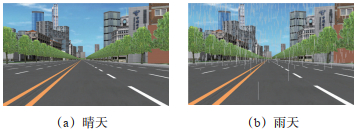
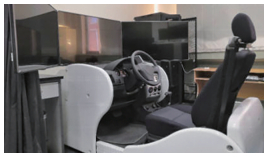
图 4 不同天气环境下模拟界面
Figure 4. Driving simulator interface under different weather conditions

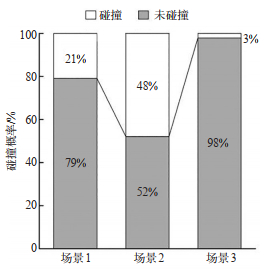
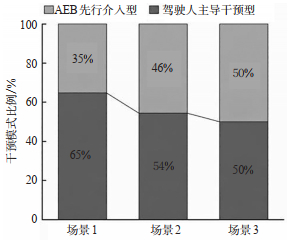
图 7 不同场景下干预模式比例分布
Figure 7. Distribution of intervention modes across different scenarios

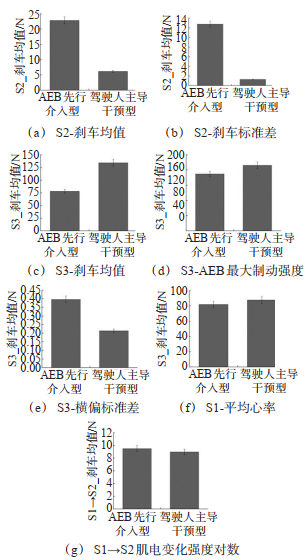
图 8 差异性指标分布图
Figure 8. Distribution of indicators with differences between intervention modes

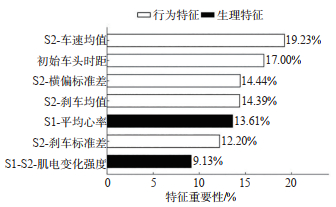
图 12 行为-生理融合随机森林模型特征重要性排序
Figure 12. Feature importance ranking of the behavior-physiology fusion random forest model
表 1 变量定义及符号描述
Table 1. Variable definitions and symbolic descriptions
类别 阶段 指标名称 指标描述 符号/单位 驾驶行为 S1 初始车头时距(initial time headway) 前车切出瞬间主车与前车之间的纵向车头时距 THW/s 车速均值(mean speed) 前车切出至驾驶人首次反应期间主车车速的平均值 AVEL_S2/(m/s) S2 刹车均值(mean braking intensity) 前车切出至驾驶人首次反应期间主车制动强度的平均值 AVEB_S2/N 刹车标准差(braking variability) 前车切出至驾驶人首次反应期间主车制动强度的标准差 SDEB_S2/N 横偏标准差(lateral deviation variability) 前车切出至驾驶人首次反应期间主车相对车道中心线横向偏移的标准差 SDLP_S2/m 刹车均值(mean braking intensity) 减速避撞阶段主车制动操作的平均值 AVEB_S3/N S3 AEB最大制动强度(maximum AEB braking intensity) 自动紧急制动系统介入过程中输出的最大制动力 MaxAEB/N 横偏标准差(lateral deviation variability) 减速避撞阶段主车相对车道中心线横向偏移的标准差 SDLP_S3/m 生理信号 S1 平均心率(average heart rate) 风险暴露前稳定跟驰阶段驾驶人心率平均值 HR_AV/bpm S1→S2 肌电变化强度(对数)(log-transformed EMG increment) 风险暴露前后驾驶人肌电信号积分变化幅度的对数变换值 log1p(ΔEMG)  下载: 导出CSV
表 2 基于线性混合效应模型的驾驶人生理与行为指标差异分析结果
Table 2. Differences in physiological and driving behavior indicators based on linear mixed-effects models
类别 阶段 指标 AEB先行介入型 驾驶人主导干预型 F值 p值 驾驶行为 S1 初始车头时距 1.970 1.899 0.369 0.543 车速均值 14.725 15.015 0.654 0.419 S2 刹车均值 22.844 6.155 3.746 0.053 刹车标准差 12.762 1.273 16.225 <0.001 横偏标准差 0.012 0.008 1.448 0.229 刹车均值 134.160 78.034 15.515 <0.001 S3 AEB最大制动强度 149.581 172.250 4.738 0.029 横偏标准差 0.214 0.396 9.896 0.002 生理状态 S1 平均心率 81.885 87.750 8.460 0.004 S1→S2 肌电变化强度(对数) 9.483 8.962 4.716 0.030 注:表中2类干预模式对应数值为描述性均值;F值和p值为线性混合效应模型中驾驶干预模式固定效应的检验结果。模型中驾驶干预模式和场景类型为固定效应,被试编号为随机截距项。
下载: 导出CSV
表 3 模型输入输出
Table 3. Model inputs and outputs
模型 输入 输出 行为特征 S1-初始车头时距、S2-车速均值、S2-刹车均值、S2-刹车标准差、S2-横偏标准差 0:AEB先行介入型 行为-生理融合 S1-初始车头时距、S2-车速均值、S2-刹车均值、S2-刹车标准差、S2-横偏标准差、S1-平均心率、S1→S2-肌电变化强度(对数) 1:驾驶人主导干预型
下载: 导出CSV
表 4 模型超参数设置
Table 4. Model hyperparameter settings
参数 设置 决策树数量 300 最大树深度 6 类别权重 Balanced 种子 4
下载: 导出CSV
表 5 模型性能指标对比
Table 5. Comparison of model performance metrics
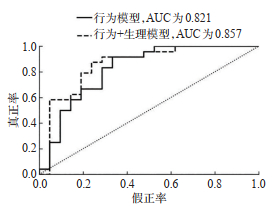
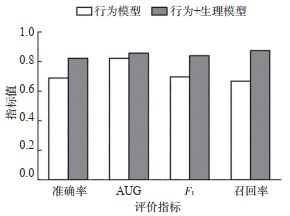
指标 行为模型 行为-生理融合模型 AUC 0.821 0.857 准确率 0.689 0.822 F1分数 0.696 0.840 召回率 0.667 0.875
下载: 导出CSV
表 6 Bootstrap置信区间与模型性能差异检验结果
Table 6. Bootstrap confidence intervals and model performance difference test results
指标 行为模型 行为-生理融合模型 差值 Bootstrap p值 AUC 0.821 [0.679, 0.938] 0.857 [0.728, 0.960] +0.036 [-0.032, +0.110] 0.325 准确率 0.689 [0.533, 0.822] 0.822 [0.711, 0.933] +0.133 [+0.022, +0.244] 0.031 F1分数 0.696 [0.513, 0.830] 0.840 [0.714, 0.933] +0.144 [+0.034, +0.282] 0.008 召回率 0.667 [0.462, 0.852] 0.875 [0.727, 1.000] +0.208 [+0.050, +0.385] 0.010 注:方括号内为Bootstrap 95%置信区间;差值为行为-生理融合模型指标值减去行为特征模型指标值;p值由配对Bootstrap检验得到。
下载: 导出CSV
-
[1] World Health Organization. Global status report on road safety 2023: country and territory profiles[R]. Geneva, Switzerland: World Health Organization, 2024. [2] NING H J, YU Y Y, BAI L. Survival analysis of the unsafe behaviors leading to urban expressway crashes[J]. PLOS ONE, 2022, 17(8): e0267559. doi: 10.1371/journal.pone.0267559 [3] LI G, LIAO Y, GUO Q, et al. Traffic crash characteristics in Shenzhen, China from 2014 to 2016[J]. International Journal of Environmental Research and Public Health, 2021, 18(3): 1176. doi: 10.3390/ijerph18031176 [4] YANG L, YANG Y, WU G, et al. A systematic review of autonomous emergency braking system: impact factor, technology, and performance evaluation[J]. Journal of Advanced Transportation, 2022(1): 1188089. [5] CICCHINO J B. Effectiveness of forward collision warning and autonomous emergency braking systems in reducing front-to-rear crash rates[J]. Accident Analysis & Prevention, 2017, 99: 142-152. [6] 孙明宇, 刘鹏, 刘灿灿, 等. 基于2021年版C-NCAP评价结果的汽车安全技术分析[J]. 时代汽车, 2025(19): 140-143.SUN M Y, LIU P, LIU C C, et al. Analysis of automotive safety technologies based on the 2021 edition C-NCAP evaluation results[J]. Auto Times, 2025(19): 140-143. (in Chinese) [7] LU Y, QIN X, SUN Y, et al. Assessing the effect of the AEB-P system with adaptive control strategy from the perspective of pedestrian head injury risk[J]. Transportation Safety and Environment, 2025, 7(1): tdaf002. doi: 10.1093/tse/tdaf002 [8] PEREZ-RAPELA D, RIEXINGER L E, KIDD D G, et al. P-AEB performance and limiting factors for superior-rated P-AEB systems based on simulations of real-world pedestrian crashes: a simulation study on the VIPA database[J]. Accident Analysis & Prevention, 2026, 229: 108368. [9] 王彦峰, 陈浩林, 赵晓华, 等. 驾驶次任务沉浸等级对接管行为的影响分析[J]. 交通信息与安全, 2022, 40(1): 135-143. doi: 10.3963/j.jssn.1674-4861.2022.01.016WANG Y F, CHEN H L, ZHAO X H, et al. A study on the impact of immersion levels of non-driving-related tasks on takeover behavior[J]. Journal of Transport Information and Safety, 2022, 40(1): 135-143. (in Chinese) doi: 10.3963/j.jssn.1674-4861.2022.01.016 [10] HUANG J, HUANG X. An integrated active-passive safety strategy for automobiles based on driver state recognition and injury risk prediction[J]. Accident Analysis & Prevention, 2025, 223: 108271. [11] WU K F, AGUERO-VALVERDE J, JOVANIS P P. Using naturalistic driving data to explore the association between traffic safety-related events and crash risk at driver level[J]. Accident Analysis & Prevention, 2014, 72: 210-218. [12] LI Y, ZHAO L, GAO K, et al. Revealing driver psychophysiological response to emergency braking in distracted driving based on field experiments[J]. Journal of Intelligent and Connected Vehicles, 2022, 5(3): 270-282. doi: 10.1108/JICV-06-2022-0024 [13] ALREFAIE M T, SUMMERSKILL S, JACKON T W. In a heart beat: using driver's physiological changes to determine the quality of a takeover in highly automated vehicles[J]. Accident Analysis & Prevention, 2019, 131: 180-190. [14] LEE C, SHIN M, ENIYANDUNMO D, et al. Predicting driver's mental workload using physiological signals: a functional data analysis approach[J]. Applied Ergonomics, 2024, 118: 104274. doi: 10.1016/j.apergo.2024.104274 [15] WEI W, FU X, ZHONG S, et al. Driver's mental workload classification using physiological, traffic flow and environmental factors[J]. Transportation Research Part F: Traffic Psychology and Behaviour, 2023, 94: 151-169. doi: 10.1016/j.trf.2023.02.004 [16] ERIKSSON A, STANTON N A. Takeover time in highly automated vehicles: noncritical transitions to and from manual control[J]. Human Factors, 2017, 59(4): 689-705. doi: 10.1177/0018720816685832 [17] EL HAOUIJ N, POGGI J M, GHOZI R, et al. Random forest-based approach for physiological functional variable selection for driver's stress level classification[J]. Statistical Methods & Applications, 2019, 28(1): 157-185. [18] CHEN L, FANG J, LI J, et al. Research on the effectiveness of driving simulation systems in risky traffic environments[J]. Systems, 2025, 13(5): 329. doi: 10.3390/systems13050329 [19] BIAU G, SCORNET E. A random forest guided tour[J]. TEST, 2016, 25(2): 197-227. doi: 10.1007/s11749-016-0481-7 [20] DU N, YANG X J, ZHOU F. Psychophysiological responses to takeover requests in conditionally automated driving[J]. Accident Analysis & Prevention, 2020, 148: 105804. -

 点击查看大图
计量
- 文章访问数: 9
- HTML全文浏览量: 6
- PDF下载量: 0
- 被引次数: 0