



Automated Extraction Method of Driving Video Data for L2-Level Intelligent Vehicle Accident Analysis
-
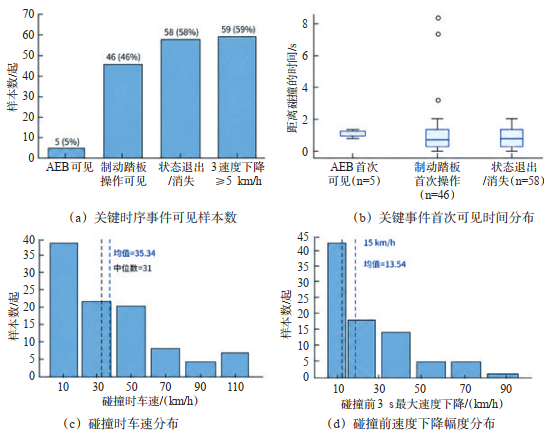
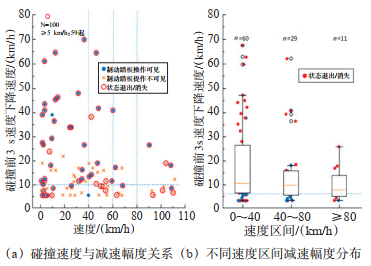
摘要: 针对智能驾驶事故分析中车端运行数据日志获取受限、行车视频信息非结构化,导致碰撞前车辆运行状态、驾驶人操作和道路场景信息难以统一提取与联合分析的问题,研究了面向智能行车记录仪视频的结构化数据提取与分布分析方法。选取同时包含前向道路场景与车机状态栏信息的行车记录仪事故视频作为研究对象,围绕专家校准的碰撞时刻建立观测窗口,将事故视频按10 Hz频率重采样形成帧级序列;在行车记录仪视频的感兴趣区域内,利用约束式光学字符识别(optical character recognition,OCR)与YOLOv8s小目标检测模型(you only look once version 8 small,YOLOv8s)提取速度、辅助驾驶状态标识、踏板图标和自动紧急制动(automatic emergency braking,AEB)提示等外部可见状态显示字段时序数据;在道路场景层面,构建了含有事故类型、道路环境、碰撞对象和对象行为等场景语义的提示词,将提示词与事故视频输入Gemini 2.5 Pro进行场景语义数据提取;最后经人工校准/复核形成以碰撞时刻为锚点的联合事故档案。识别精度验证表明:速度OCR、制动踏板、加速踏板和辅助驾驶状态识别准确率分别为78.2%、85.0%、84.7%和81.3%,速度OCR的平均绝对误差(mean absolute error,MAE)与均方根误差(root mean square error,RMSE)分别为1.71、6.42 km/h;场景语义验证表明:模型+专家反馈流程能够生成可复核的结构化场景字段,小规模工时对照显示人机协同流程相较纯人工整理可降低时间成本,最终统计仍以人工校准/复核后的字段为准。基于100起事故样本的分布分析显示,AEB提示仅在少数样本中可见;制动踏板操作可见样本为46起;辅助驾驶状态标识退出或消失样本为58起;碰撞前3 s速度下降不小于5 km/h的样本为59起。结果表明:外部可观测的视频界面字段与现有事件数据记录器(event data recorder,EDR)/控制器局域网(controller area network,CAN)日志在覆盖面上互补,特别是在状态显示变化和碰撞前速度过程方面能够提供独立的外部证据。受样本品牌单一与字段可见性限制,方法结论暂不外推至多品牌车机界面与无状态栏视频场景。Abstract: In intelligent driving accident analysis, access to onboard operational data logs is restricted. Driving videos remain unstructured. Pre-collision vehicle operating states, driver actions, and road-scene information are difficult to extract and analyze jointly. To address this issue, a structured data extraction and distribution analysis method for intelligent driving recorder videos is proposed. Accident videos containing both forward road scenes and in-vehicle interface status bars are selected. An observation window is established around the expert-calibrated collision time, and each video is resampled at 10 Hz to generate frame-level sequences. Within predefined regions of interest, constrained optical character recognition (OCR) and a YOLOv8s small-object detection model are employed to extract time-series data. These data cover externally visible status-display fields, including vehicle speed, driving automation status indicators, pedal icons, and automatic emergency braking (AEB) alerts. At the road-scene level, prompts covering accident type, road environment, collision object, and object behavior are constructed. These prompts, together with the accident videos, are input into Gemini 2.5 Pro to extract structured scene-semantic data. After manual calibration and review, a joint accident profile anchored to the collision time is established. Recognition accuracy validation indicates that the accuracies for speed OCR, brake-pedal status, accelerator-pedal status, and driving automation status are 78.2%, 85.0%, 84.7%, and 81.3%, respectively. The mean absolute error (MAE) and root mean square error (RMSE) of speed OCR are 1.71 km/h and 6.42 km/h, respectively. Scene-semantic validation shows that the model-plus-expert-feedback workflow generates reviewable structured scene fields. A small-scale comparison of labor time indicates that the human-AI collaborative workflow reduces processing time relative to fully manual data organization. The final statistical analysis remains based on manually calibrated and reviewed fields. Distribution analysis of 100 accident cases indicates that AEB alerts are visible in only a small proportion of the samples. Brake-pedal operation is observable in 46 cases. Driving automation status indicators disappear or indicate disengagement in 58 cases. Vehicle speed decreases by at least 5 km/h during the 3 s preceding the collision in 59 cases. The results demonstrate that externally observable video-interface fields complement existing event data recorder (EDR) and controller area network (CAN) logs in terms of information coverage. These fields provide independent external evidence of status-display changes and pre-collision vehicle-speed evolution. Owing to the single-brand sample and field visibility constraints, the conclusions are not extrapolated to multi-brand head-up interfaces or videos without status bars.
-

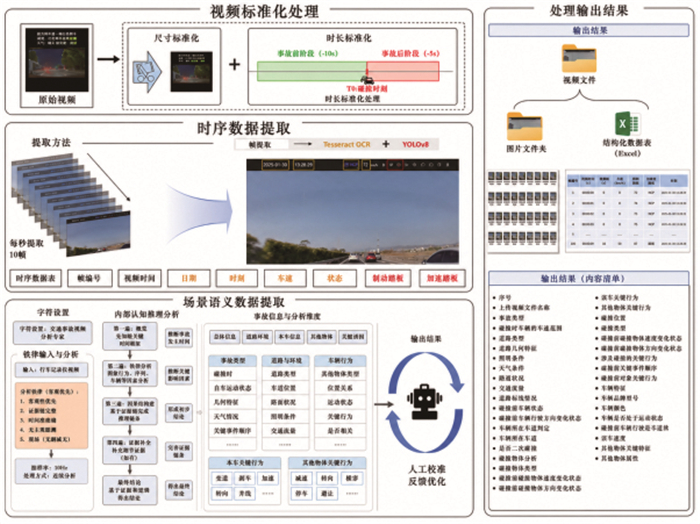
图 2 视频数据提取与事故档案构建流程
Figure 2. Video data extraction and crash-record construction process
表 1 车辆状态时序字段定义
Table 1. Definition of temporal vehicle-state fields
字段 单位或类型 定义与用途 Frame 整数 视频帧索引 Video Time mm: ss.s 视频播放时间 Speed km/h 车机界面速度读数 Status 类别 辅助驾驶可见状态 Brake On/Off 制动踏板图标状态 Accelerator On/Off 加速踏板图标状态 AEB On/Off 自动紧急制动提示状态 Crash Time mm: ss.s 专家校验碰撞时刻  下载: 导出CSV
表 2 离散场景核心字段定义
Table 2. Definition of core discrete scene fields
字段组 字段名称 取值或说明 事故形态 事故类型 追尾、侧面、固定物、障碍物、 碰撞对象 弱势交通参与者(vulnerable road user,VRU)等 道路环境 道路类型 高速、快速路、一般道路、匝道等 几何、标线 直线、曲线、四车道等 运行背景 光照、天气 光照良好、夜间、逆光、晴天、雨天等 路面 干燥、潮湿等 交通密度 稀疏、拥堵等 本车状态 运动、方向 匀速、加速、减速、直行、变道等 碰撞位置 前方/侧方碰撞等 速度变化 静止、匀速、减速等 对象行为 方向变化 切入、转弯 关键行为 横穿、作业等
下载: 导出CSV
表 3 识别精度验证结果
Table 3. Validation results of field extraction accuracy
对象 人工校验样本真值总数 验证结果 速度OCR 4 141 识别正确数量为3 240;准确率为78.2%;MAE为1.71 km/h;RMSE为6.42 km/h 制动踏板 4 141 准确率为85.0% 加速踏板 4 141 准确率为84.7% 辅助驾驶状态 4 141 识别正确数量为3 368;准确率为81.3%
下载: 导出CSV
表 4 场景语义提取的人机协同流程验证
Table 4. Human-machine workflow validation for scene-semantic extraction
对比项目 纯人工流程 模型+专家反馈流程 验证样本 27起人工标定 同批27起模型输出后复核 字段一致率 参考标签口径 17字段66.2%;核心9字段59.3% 关键行为字段 人工逐项确认 对象速度74.1%;对象方向70.4% 平均整理用时 31.6 min/起 18.9 min/起 流程价值 准确性基准 节约12.7 min/起(40.2%)
下载: 导出CSV
表 5 速度下降阈值敏感性分析
Table 5. Sensitivity analysis of speed-decrease thresholds
分析窗口 窗口内速度下降3 km/h以上数量 窗口内速度下降5 km/h以上数量 窗口内速度下降8 km/h以上数量 窗口内速度下降10 km/h以上数量 碰撞前2 s 72 58 40 34 碰撞前3 s 73 59 44 40 碰撞前5 s 75 61 45 43
下载: 导出CSV
表 6 典型样本场景语义字段
Table 6. Scene semantic fields of typical samples
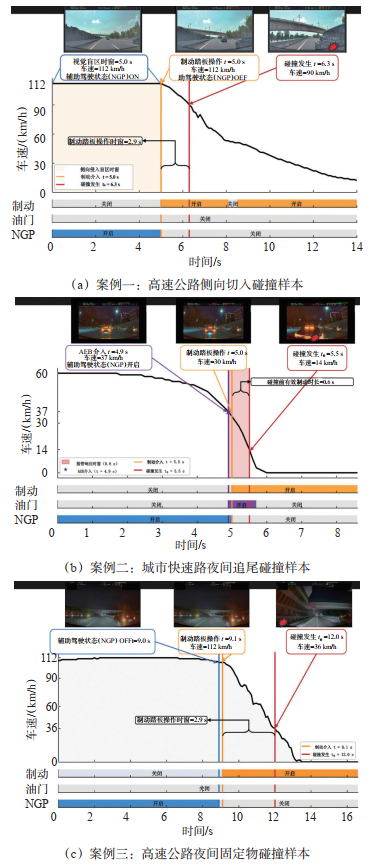
样本 字段 取值 案例一 事故类型/速度区间 侧面碰撞;80~150 km/h 道路类型/几何 高速公路;直线 光照/天气 光照良好;晴天 交通密度/标线 流量中等;车道线清晰 本车状态/位置 减速行驶;直行;3道中第1道,居中 对象类型/行为 SUV(黑色吉普);匀速;向左变道切入本车道 案例二 事故类型/速度区间 追尾碰撞;0~40 km/h 道路类型/几何 城市快速路;直线 光照/天气 夜间照明良好;晴天 交通密度/标线 交通拥堵;车道线清晰 本车状态/位置 减速行驶;直行;4道中第2道,居中 对象类型/行为 轿车;紧急制动;直行 案例三 事故类型/速度区间 碰撞固定物体;80~150 km/h 道路类型/几何 高速公路;直线 光照/天气 夜间照明昏暗;晴天 交通密度/标线 流量中等;车道线清晰 本车状态/位置 减速行驶;直行;3道中第1道,居中 对象类型/行为 交通安全设施(护栏);静止;无方向变化
下载: 导出CSV
-
[1] ALAMBEIGI H, MCDONALD A D, TANKASALA S R. Crash themes in automated vehicles: a topic modeling analysis of the California department of motor vehicles automated vehicle crash database[J]. Accident Analysis & Prevention, 2020, 144: 105595. [2] SONG Y, CHITTURI M V, NOYCE D A. Automated vehicle crash sequences: patterns and potential uses in safety testing[J]. Accident Analysis & Prevention, 2021, 153: 106017. [3] SONG Y, CHITTURI M V, NOYCE D A. Intersection two-vehicle crash scenario specification for automated vehicle safety evaluation using sequence analysis and Bayesian networks[J]. Accident Analysis & Prevention, 2022, 176: 106814. [4] GOODALL N J. Comparability of driving automation crash databases[J]. Journal of Safety Research, 2025, 92: 473-481. doi: 10.1016/j.jsr.2025.01.004 [5] PUTZE L, WESTHOFEN L, KOOPMANN T. On quantification for SOTIF validation of automated driving systems[C]. 2023 IEEE Intelligent Vehicles Symposium(Ⅳ), New York: IEEE, 2023. [6] BIRKEMEYER L, KING C, SCHAEFER Ⅰ. Is scenario generation ready for SOTIF? A systematic literature review[C]. IEEE International Conference on Intelligent Transportation Systems, Bilbao: IEEE, 2023. [7] ZHANG R, WANG B, ZHANG J, et al. When language and vision meet road safety: leveraging multimodal large language models for video-based traffic accident analysis[J]. Accident Analysis & Prevention, 2025, 219: 108077. [8] ABU TAMI M, ASHQAR H I, ELHENAWY M, et al. Using multimodal large language models(MLLMs)for automated detection of traffic safety-critical events[J]. Vehicles, 2024, 6 (3): 1571-1590. doi: 10.3390/vehicles6030074 [9] SMITH R. An overview of the Tesseract OCR engine[C]. The 9th International Conference on Document Analysis and Recognition, Curitiba: IEEE, 2007. [10] JOCHER G, CHAURASIA A, QIU J. Ultralytics YOLOv8[EB/OL]. (2023-01-10)[2026-06-06]. https://github.com/ultralytics/ultralytics .[11] DING S, ABDEL-ATY M, BARBOUR N, et al. Exploratory analysis of injury severity under different levels of driving automation using multi-source data[EB/OL]. (2023-03-31) [2026-06-06]. https://arxiv.org/abs/2303.17788 .[12] ABDEL-ATY M, DING S. A matched case-control analysis of autonomous vs human-driven vehicle accidents[J]. Nature Communications, 2024, 15: 4931. doi: 10.1038/s41467-024-48526-4 [13] 姜涵, 张健, 张海燕, 等. 基于强化学习的交叉口智能网联车多目标通行控制方法[J]. 交通信息与安全, 2024, 42 (1): 84-93. doi: 10.3963/j.jssn.1674-4861.2024.01.010JIANG H, ZHANG J, ZHANG H Y, et al. A multi-objective traffic control method for connected and automated vehicles at signalized intersections based on reinforcement learning[J]. Journal of Transport Information and Safety, 2024, 42(1): 84-93. (in Chinese) doi: 10.3963/j.jssn.1674-4861.2024.01.010 [14] ANTIN J F, LEE S, PEREZ M A, et al. Second strategic highway research program naturalistic driving study methods[J]. Safety Science, 2019, 119: 2-10. doi: 10.1016/j.ssci.2019.01.016 [15] PENG Y, YU W, WANG X, et al. AEB effectiveness research methods based on reconstruction results of truth vehicle-to-two-wheeler accidents in China[J]. Proceedings of the Institution of Mechanical Engineers, Part D: Journal of Automobile Engineering, 2021, 235(7): 2029-2039. doi: 10.1177/0954407020976741 [16] ZHOU W, WANG X, PENG Y, et al. An investigation of ADAS testing scenarios based on vehicle-to-powered two-wheeler accidents occurring in a county-level district in China[J]. Traffic Injury Prevention, 2021, 22(8): 593-598. doi: 10.1080/15389588.2021.1975687 [17] ZHENG O, ABDEL-ATY M, WANG Z, et al. AVOID: autonomous vehicle operation incident dataset across the globe[EB/OL]. (2023-03-22)[2026-06-06]. https://arxiv.org/abs/2303.12889 .[18] LEE S, ARVIN R, KHATTAK A J. Advancing investigation of automated vehicle crashes using text analytics of crash narratives and Bayesian analysis[J]. Accident Analysis & Prevention, 2023, 181: 106932. [19] BECK J, ARVIN R, LEE S, et al. Automated vehicle data pipeline for accident reconstruction: new insights from LiDAR, camera, and radar data[J]. Accident Analysis & Prevention, 2023, 195: 107409. [20] GOODALL N J. Potential crash rate benchmarks for automated vehicles[J]. Transportation Research Record, 2021, 2675(10): 31-40. doi: 10.1177/03611981211009878 [21] GOODALL N J. Comparison of automated vehicle struck-fr om-behind crash rates with national rates using naturalistic data[J]. Accident Analysis & Prevention, 2021, 154: 106056. [22] BOGGS A M, WALI B, KHATTAK A J. Exploratory analysis of automated vehicle crashes in California: a text analytics & hierarchical Bayesian heterogeneity-based approach[J]. Accident Analysis & Prevention, 2020, 135: 105354. [23] KHATTAK Z H, FONTAINE M D, SMITH B L. Exploratory investigation of disengagements and crashes in autonomous vehicles under mixed traffic: an endogenous switching regime framework[J]. IEEE Transactions on Intelligent Transportation Systems, 2021, 22(12): 7485-7495. doi: 10.1109/TITS.2020.3003527 [24] LIU Q, WANG X, WU X, et al. Crash comparison of autonomous and conventional vehicles using pre-crash scenario typology[J]. Accident Analysis & Prevention, 2021, 159: 106281. [25] KUTELA B, DAS S, DADASHOVA B. Mining patterns of autonomous vehicle crashes involving vulnerable road users to understand the associated factors[J]. Accident Analysis & Prevention, 2022, 165: 106473. -

 点击查看大图
计量
- 文章访问数: 9
- HTML全文浏览量: 4
- PDF下载量: 0
- 被引次数: 0