



Identification Method for Gritical Rail Transit Station Considering the Resilience of Composite Public Transportation Network
-
摘要: 现有轨道交通关键站点识别研究多基于单层轨道网络,难以反映轨道交通与常规公交之间的换乘耦合关系;且多采用站点或连边完全移除模拟失效,未考虑公交绕行、接驳调整对网络关键站点识别的影响。为提高对复合公共交通网络实际运行特征的刻画能力,研究了考虑复合公共交通网络韧性的轨道交通关键站点识别方法。基于L-空间模型构建轨道交通、常规公交及其换乘组成的加权复合公共交通网络,以800 m为换乘距离阈值建立层间连边;综合考虑线路条数、发车间隔、运行时耗和额定载客量等运营指标构建连边权重;在网络平均效率变化值、乘客平均出行时间变化值的基础上,引入轨道交通与常规公交的层间耦合关系指标平均层间度变化值,形成韧性评价指标体系;在失效模拟中,调整常规公交层和换乘层的边权,以表征绕行、接驳和换乘效率下降后的剩余运输能力,并采用TOPSIS法识别关键站点。以无锡市复合公共交通网络为例,结果表明:三阳广场站最重要,其失效后网络韧性性能下降至0.673 6;重要度排名前40站点中,77.5%的关键站点分布于1号线与3号线;网络中7个换乘站中有5个位于前25,8个起终点站中有6个位于前40。与忽略层间耦合影响的识别结果相比,该方法能够突出具有公交接驳支撑与跨层转换功能的站点,如塘铁桥站具有23条层间连边,在考虑层间耦合时,其排名较单层网络分析有所前移。敏感性分析表明:站点可按层间耦合影响程度划分为低、中、高敏感度3类,进而可以进行针对性保护。
-
关键词:
- 公共交通网络韧性 /
- 复合公共交通网络 /
- 轨道交通关键站点识别方法 /
- TOPSIS法 /
- 层间耦合关系
Abstract: Existing studies on critical station identification in urban rail transit networks are mostly based on single-layer rail transit networks. Such networks can hardly reflect the transfer coupling relationship between urban rail transit and regular public transit. In addition, station or link failure is often simulated by complete removal, without considering the influence of bus detours and feeder adjustment on critical station identification. The ability to characterize the actual operating features of composite public transportation networks is enhanced. A critical station identification method for urban rail transit considering the resilience of composite public transportation networks is investigated. Based on the L-space model, a weighted composite public transportation network consisting of urban rail transit, regular public transit, and transfer links constructed. Inter-layer links are established with 800 m as the transfer distance threshold. Operational indicators, including the number of lines, headway, travel time, and rated capacity, are comprehensively considered to construct link weights. On the basis of network average efficiency change and passenger average travel time change, the average inter-layer degree change is introduced. This indicator reflects the coupling relationship between rail transit and regular public transit, and a resilience evaluation index system is formed. In failure simulation, link weights of the regular bus layer and transfer layer are adjusted to characterize the remaining transport capacity after detour, feeder, and transfer efficiency decline. The TOPSIS method is adopted to identify critical stations. The composite public transportation network of Wuxi is used as an example. Sanyang Square Station ranks first in importance, and its network resilience drops to 0.673 6 after failure. Among the top 40 stations, key stations are distributed on Lines 1 and 3. Five of the seven transfer stations rank among the top 25, and six of the eight terminal stations rank among the top 40. Compared with identification results ignoring inter-layer coupling, the proposed method can highlight stations with bus feeder support and cross-layer transfer functions. For example, Tangtieqiao Station has 23 inter-layer links, and its ranking shifts forward under inter-layer coupling conditions. Sensitivity analysis shows that stations can be divided into low, medium, and high sensitivity types according to the influence of inter-layer coupling, enabling targeted protection. -

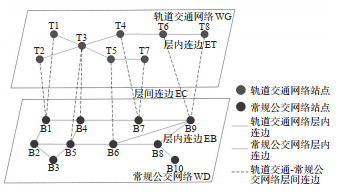
图 1 复合公共交通网络的L-空间模型示意图
Figure 1. Schematic diagram of the L-space model for the composite public transportation network

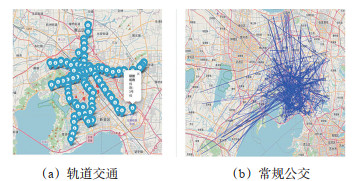
图 2 无锡市市区分层网络模型图(截至2024年末)
Figure 2. Hierarchical network model of the Wuxi urban area (as of the end of 2024)

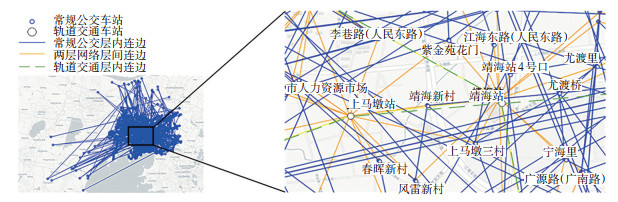
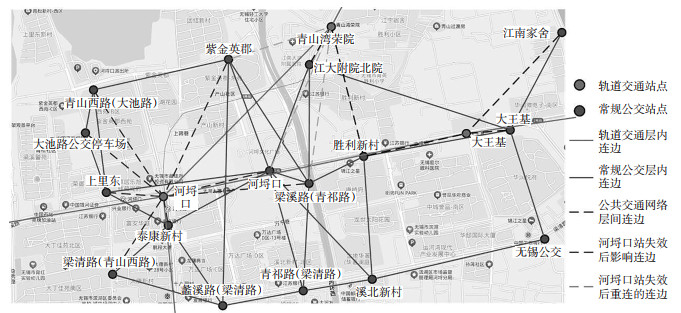
图 3 无锡市复合公共交通网络模型局部模型图
Figure 3. Partial view of composite public transportation network model in Wuxi

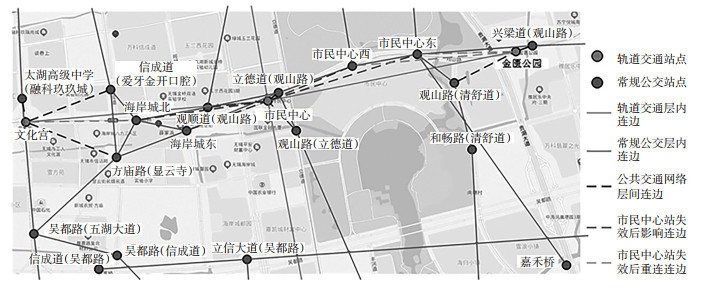
图 5 市民中心站周边复合公共交通网络图
Figure 5. Integrated public transport network around the Shimin center station

图 6 河埒口站周边复合公共交通网络图
Figure 6. Integrated public transport network around the Heliekou station

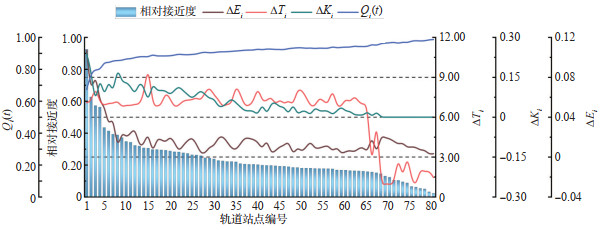
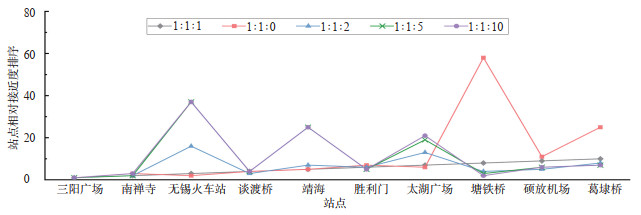
图 7 不同权重下站点相对接近度排序变化的折线图
Figure 7. Line chart of the ranking changes in site relative closeness under different weights

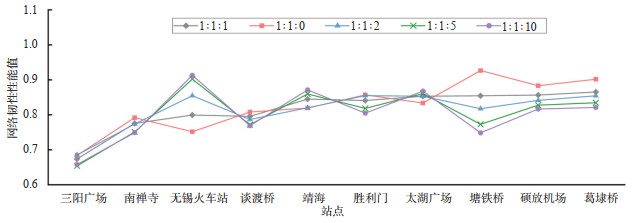
图 8 不同权重下网络韧性性能值随站点失效变化图
Figure 8. Graph of network resilience performance values against node failure under different weights
表 1 编号与实际站点名称对应表
Table 1. Table of correspondence between ID and station names
编号 实际站点名称 1-10 三阳广场、南禅寺、无锡火车站、谈渡桥、靖海、胜利门、太湖广场、塘铁桥、硕放机场、葛埭桥 11-20 南方泉、清名桥、长广溪、高浪东路、盛岸、叙丰、五爱广场、刘潭、广瑞、人民医院 21-30 周新苑、庄前、上马墩、无锡新区站、梅园开原寺、荣巷、扬名、龙山梢、旺庄路、黄山路 31-40 长江南路、博览中心、映月湖公园、华清大桥、云林、周泾巷、广石路、迎宾广场、苏庙、石门路 41-50 广益、青山湾荣院、小桃源、江南大学、体育中心、锡北运河、市民中心、文化宫、北栅口、吴桥 51-60 西园弄、丰润道、东林广场、新光路、夏家边、五湖大道、庄桥、吴都路、梁溪大桥、惠山古镇 61-70 民丰、钱桥、大剧院、天一、南湖家园、无锡东站、西漳、黄巷、堰桥、金匮公园 71-80 雪浪、查桥、东风、九里河公园、蠡湖大桥、大王基、柏庄、东亭、河埒口、太湖花园  下载: 导出CSV
表 2 相对接近度排名前40的轨道交通站点信息表
Table 2. Table of the top 40 rail transit stations ranked by relative closeness
序号 所属线路 站点名称 相对接近度 站点失效后的网络韧性性能 序号 所属线路 站点名称 相对接近度 站点失效后的网络韧性性能 1 1/2号线 三阳广场 0.924 7 0.673 6 21 4号线 周新苑 0.283 0 0.888 9 2 1号线 南禅寺 0.626 7 0.775 4 22 1号线 庄前 0.281 9 0.895 0 3 1/3号线 无锡火车站 0.572 4 0.799 2 23 2号线 上马墩 0.276 2 0.891 7 4 1号线 谈渡桥 0.562 7 0.795 5 24 3号线 无锡新区站 0.272 6 0.890 7 5 2/3号线 靖海 0.435 2 0.844 8 25 2号线 梅园开原寺* 0.264 2 0.893 3 6 1号线 胜利门 0.413 9 0.840 8 26 2号线 荣巷 0.262 8 0.895 1 7 1号线 太湖广场 0.393 5 0.853 0 27 1号线 扬名 0.258 5 0.903 9 8 1号线 塘铁桥 0.388 6 0.854 3 28 3号线 龙山梢 0.244 9 0.907 2 9 3号线 硕放机场* 0.372 1 0.856 3 29 3号线 旺庄路 0.243 4 0.903 0 10 1号线 葛埭桥 0.347 8 0.865 2 30 3号线 黄山路 0.237 9 0.904 8 11 1号线 南方泉* 0.342 8 0.866 2 31 3号线 长江南路 0.228 2 0.908 7 12 1号线 清名桥 0.322 9 0.873 5 32 4号线 博览中心* 0.225 9 0.909 9 13 1号线 长广溪 0.318 7 0.878 6 33 2号线 映月湖公园 0.222 1 0.909 9 14 3号线 高浪东路 0.307 7 0.879 6 34 1号线 华清大桥 0.221 7 0.912 5 15 3/4号线 盛岸 0.305 7 0.877 0 35 2号线 云林 0.220 2 0.914 4 16 3号线 叙丰 0.297 3 0.892 0 36 3号线 周泾巷 0.208 7 0.916 8 17 2号线 五爱广场 0.296 5 0.882 9 37 4号线 广石路 0.206 0 0.919 6 18 1/4号线 刘潭* 0.294 5 0.883 7 38 2号线 迎宾广场 0.204 2 0.920 2 19 3号线 广瑞 0.292 5 0.883 4 39 3号线 苏庙* 0.204 0 0.920 3 20 1号线 人民医院 0.287 8 0.884 5 40 3号线 石门路 0.202 9 0.926 6 注:标注*的站点为对应线路的起终点站。
下载: 导出CSV
表 3 换乘站的韧性指标与重要度表
Table 3. Table of resilience metrics and importance of transfer stations
站点名称 所属线路 层间连边数 站点失效后网络平均效率变化值(变化率/%) 站点失效后乘客出行时间变化值(变化率/%) 站点失效后平均层间度变化值(变化率/%) 站点失效后的网络韧性性能 相对接近度 三阳广场 1/2号线 26 0.106 9(23.01) 7.091 1(0.05) 0.237 8(2.25) 0.673 6 0.924 7 无锡火车站 1/3号线 13 0.086 2(18.54) 8.302 2(0.06) 0.037 8(0.36) 0.799 2 0.572 4 靖海 2/3号线 15 0.052 5(11.30) 6.882 1(0.05) 0.068 5(0.65) 0.844 8 0.435 2 盛岸 3/4号线 14 0.025 5(5.48) 10.117 7(0.07) 0.053 1(0.50) 0.877 0 0.305 7 刘潭 1/4号线 4 0.017 5(3.76) 6.927 7(0.05) 0.100 7(-0.95) 0.883 7 0.294 5 市民中心 1/4号线 10 0.016 0(3.45) 7.268 2(0.05) 0.008 4(-0.08) 0.930 1 0.189 4 河埒口 2/4号线 15 0.002 8(0.61) 1.968 0(0.01) 0.000 0(0.00) 0.984 6 0.032 2 平均值 10 0.016 5(3.55) 6.298 6(0.04) 0.053 7(0.51) 0.912 2 0.234 2 注:括号内为该站点对应指标相较于初始水平(E0 = 0.464 6,T0 = 14 720.771 1,K0 = 10.545 5)的变化率
下载: 导出CSV
表 4 起终点站的韧性指标与重要度表
Table 4. Table of resilience metrics and importance of origin-destination stations
站点名称 层间连边数 站点失效后网络平均效率变化值(变化率/%) 站点失效后乘客出行时间变化值(变化率/%) 站点失效后平均层间度变化值(变化率/%) 站点失效后的网络韧性性能 相对接近度 硕放机场 2 0.025 7(-5.53) 6.767 9(0.05) 0.131 5(-1.25) 0.856 3 0.372 1 南方泉 3 0.023 9(-5.14) 6.876 1(0.05) 0.116 1(-1.10) 0.866 2 0.342 8 刘潭 4 0.017 5(3.76) 6.927 7(0.05) 0.100 7(-0.95) 0.883 7 0.294 5 梅园开原寺 6 0.019 7(-4.25) 7.308 4(0.05) 0.069 9(-0.66) 0.893 3 0.264 2 博览中心 8 0.020 9(-4.51) 6.755 6(0.05) 0.039 2(-0.37) 0.909 9 0.225 9 苏庙 9 0.017 7(-3.80) 7.190 2(0.05) 0.023 8(-0.23) 0.920 3 0.204 0 无锡东站 11 0.023 0(-4.96) 1.320 4(0.01) 0.000 0(0.00) 0.956 4 0.156 3 堰桥 7 0.019 4(-4.18) 1.014 2(0.01) 0.000 0(0.00) 0.963 8 0.130 4 平均值 10 0.016 5(3.55) 6.298 6(0.04) 0.053 7(0.51) 0.912 2 0.234 2 注:括号内为该站点对应指标相较于初始水平(E0 = 0.464 6,T0 = 14 720.771 1,K0 = 10.545 5)的变化率
下载: 导出CSV
-
[1] 张韫博, 周雪梅, 王沛钰, 等. 公交协同优化的时空Transformer-STGNN混合强化学习方法[J]. 交通信息与安全, 2026, 44(1): 1-12. doi: 10.3963/j.jssn.1674-4861.2026.01.009ZHANG Y B, ZHOU X M, WANG P Y, et al. A spatio-temporal transformer-STGNN hybrid reinforcement learning method for bus cooperative optimization[J]. Journal of Transport Information and Safety, 2026, 44(1): 1-12. (in Chinese) doi: 10.3963/j.jssn.1674-4861.2026.01.009 [2] 甄云竹, 胡军红, 杨茗舒, 等. 城市复合公共交通网络韧性评估及恢复策略研究综述[J]. 城市交通, 2025, 23: 25-39.ZHEN Y Z, HU J H, YANG M S, et al. A review of resilience assessment and recovery strategies for urban multimodal public transportation networks[J]. Urban Transport of China, 2025, 23: 25-39. (in Chinese) [3] 黄勇, 冯高乾, 葛国钦. 重庆市城市轨道交通与公共汽车换乘距离适宜性研究[J]. 城市交通, 2023, 21(3): 46, 54+10.HUANG Y, FENG G Q, GE G Q. Suitability of transfer distance between urban rail transit stations and bus stops in Chongqing[J]. Urban Transport of China, 2023, 21(3): 46, 54+10. (in Chinese) [4] CHEN J Q, LIU X W, ZHU S C, et al. Resilience assessment of an integrated bus-rail network considering dynamic congestion propagation process under traffic congestion events[J]. Reliability Engineering & System Safety, 2026, 266: 111721. [5] PU H, LI Y, MA C. Topology analysis of Lanzhou public transport network based on double-layer complex network theory[J]. Physica A: Statistical Mechanics and its Applications, 2022, 592: 126694. doi: 10.1016/j.physa.2021.126694 [6] 潘恒彦, 张文会, 胡宝雨, 等. 城市公交-地铁加权复合网络构建及鲁棒性分析[J]. 吉林大学学报(工学版), 2022, 52 (11): 2582-2591.PAN H Y, ZHANG W H, HU B Y, et al. Construction and robustness analysis of urban weighted subway-bus composite network[J]. Journal of Jilin University(Engineering and Technology Edition), 2022, 52(11): 2582-2591. (in Chinese) [7] XU C, XU X G. A two-stage resilience promotion approach for urban rail transit networks based on topology enhancement and recovery optimization[J]. Physica A: Statistical Mechanics and its Applications, 2024, 635: 129496. doi: 10.1016/j.physa.2024.129496 [8] LIU W, HUANG X Q, LIANG B J. Resilience assessment of urban connected infrastructure networks[J]. Scientific Reports, 2025, 15(1): 19770. doi: 10.1038/s41598-025-03730-0 [9] ZHANG L, CHEN T T, LIU Z S, et al. Analysis of multi-modal public transportation system performance under metro disruptions: a dynamic resilience assessment framework[J]. Transportation Research PartA: Policy and Practice, 2024, 183: 104077. doi: 10.1016/j.tra.2024.104077 [10] PROMSUWAN P, NAKAYAMA S, YAMAGUCHI H, et al. Comparison between algebraic connectivity-based and global efficiency-based vulnerability for railway topology analysis: a case study of Kyushu, Japan[J]. Asian Transport Studies, 2022(8): 100074. [11] 胡馨月, 彭其渊, 陈锦渠, 等. 考虑公交换乘的地铁常态化限流站点识别方法研究[J]. 铁道运输与经济, 2024, 46 (6): 169-180.HU X Y, PENG Q Y, CHEN J Q, et al. Identification method of metro stations with regularized passenger flow control considering bus transfers[J]. Railway Transport and Economy, 2024, 46(6): 169-180. (in Chinese) [12] 李林波, 孙思薇, 刘思瑶. 基于动态用户均衡的多模式公共交通鲁棒性评价[J]. 同济大学学报(自然科学版), 2026, 54 (5): 675-685.LI LB, SUN SW, LIU SY. Robustness assessment ofmultimodal public transport systems based on dynamic user equilibrium[J]. Journal of Tongji University(Natural Science), 2026, 54 (5): 675-685. (in Chinese) [13] 赖元文, 张诗棋, 葛玉晨, 等. 乘客多路径决策下的城市公交复合网络韧性评估[J]. 湖南大学学报(自然科学版), 2026, 53: 185-195.LAI Y W, ZHANG S Q, GE Y C, et al. Resilience evaluation of urban public transport composite networks under passengers' multi-path decision-making[J]. Journal of Hunan University(Natural Sciences), 2026, 53: 185-195. (in Chinese) [14] 周雨阳, 张梦瑶, 李长锦, 等. 地面公交运营效率与服务质量评价综述[J]. 交通运输工程与信息学报, 2024, 22: 1-20.ZHOU Y Y, ZHANG M Y, LI C J, et al. Bus operation efficiency and service quality: a review[J]. Journal of Transportation Engineering and Information, 2024, 22: 1-20. (in Chinese) [15] 马书红, 杨磊, 陈西芳. 风险扩散下城市群多模式交通网络的韧性演化[J]. 华南理工大学学报(自然科学版), 2023, 51: 42-51.MA S H, YANG L, CHEN X F. Resilience evolution of multi-mode transportation network in urban agglomeration based on risk diffusion[J]. Journal of South China University of Technology(Natural Science Edition), 2023, 51: 42-51. (in Chinese) [16] HU J H, ZHEN Y Z, ZANG R, et al. Fault recovery strategy for urban rail transit considering train operation intersections[J]. Applied Sciences, 2026, 16(12): 6020. doi: 10.3390/app16126020 [17] ZHANG M M, YANG Z K, LU Y, et al. Evaluation of core competitiveness of new energy industry and analysis of obstacle factors taking Shandong province as an example[J]. Sustainability, 2024, 16(4): 1423. doi: 10.3390/su16041423 [18] ZHAO X Y, ZHANG Y H, ZHAI Q Y, et al. A multi-attribute decision-making approach for critical node identification in complex networks[J]. Entropy, 2024, 26(12): 1075. doi: 10.3390/e26121075 [19] XU P C, LU Q C, FENG T, et al. Resilience analysis of metro stations integrating infrastructures and passengers[J]. Reliability Engineering & System Safety, 2024, 252: 110467. [20] ZHU C L, WU J P, LIU M Y, et al. Cyber-physical resilience modelling and assessment of urban roadway system interrupted by rainfall[J]. Reliability Engineering & System Safety, 2020, 204: 107095. [21] HU J H, ZANG R, ZHEN Y Z, et al. Identification method of critical stations in urban rail transit networks considering turnback intervals[J]. Sustainability, 2026, 18(10): 5032. doi: 10.3390/su18105032 [22] 郑乐, 高良鹏, 陈学武, 等. 地铁-公交加权复合网络关键站点识别及鲁棒性研究[J]. 交通运输系统工程与信息, 2023, 23: 120-129.ZHENG L, GAO L P, CHEN X W, et al. Critical stations identification and robustness analysis of weighted metro-bus composite network[J]. Journal of Transportation Systems Engineering and Information Technology, 2023, 23: 120-129. (in Chinese) [23] HU J H, YANG M S, ZHEN Y Z, et al. Node importance evaluation of urban rail transit based on signaling system failure: a case study of the Nanjing Metro[J]. Applied Sciences, 2024, 14(20): 9600. doi: 10.3390/app14209600 [24] LIU Z, YU B, ZHANG L, et al. Resilience enhancement of multi-modal public transportation system via electric bus network redesign[J]. Transportation Research Part E: Logistics and Transportation Review, 2025, 193: 103810. doi: 10.1016/j.tre.2024.103810 [25] 程刚, 郭磊善. 基于GIS的公交换乘网络构建及可达性分析[J]. 江苏大学学报(自然科学版), 2024, 45(2): 191-197.CHENG G, GUO L S. Bus transfer network construction and accessibility analysis based on GIS[J]. Journal of Jiangsu University(Natural Science Edition), 2024, 45(2): 191-197. (in Chinese) [26] 钟志鹏, 施雯, 谷敬豪, 等. 融合客流特征的深圳地铁网络关键节点识别与鲁棒性评估[J]. 自然资源信息化, 2026 (2): 105-115.ZHONG Z P, SHI W, GU J H, et al. Critical node identification and robustness assessment of Shenzhen Metro network integrating passenger flow characteristics[J]. Natural Resources Informatization, 2026(2): 105-115. (in Chinese) [27] MURTAGH E M, MAIR J L, AGUIAR E, et al. Outdoor walking speeds of apparently healthy adults: a systematic review and meta-analysis[J]. Sports Medicine, 2021, 51(1): 125-141. doi: 10.1007/s40279-020-01351-3 -

 点击查看大图
计量
- 文章访问数: 17
- HTML全文浏览量: 8
- PDF下载量: 0
- 被引次数: 0