



A Decision-Making Method for Rudder-Engine Coordinated Maneuvering of Ships in Canyon-Sharp Bends within Backwater Zones
-
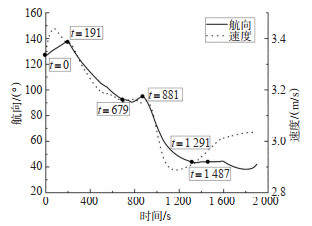
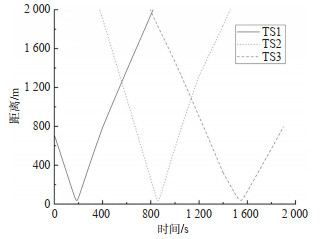
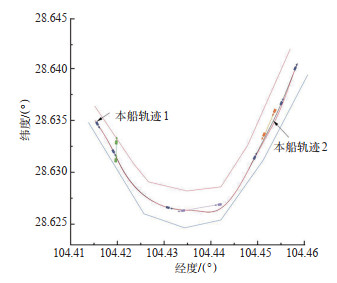
摘要: 回水区峡谷型急弯河段因地形-水文耦合效应导致的航道狭窄、流态紊乱、横流强劲,以及“扫弯水”显著等复杂航行环境,传统船舶避碰方法易失效且未充分考虑受限水域两岸物理约束。针对相关问题,研究了融合水流扰动补偿、边界约束避碰决策和最优轨迹跟踪的车舵协调智能操纵方法。构建三自由度船舶运动模型,基于MIKE21 FM平台对典型洪水期与枯水期工况下的三维流场进行精细化模拟,系统揭示了回水区流速、流向空间异质性对船舶漂移与偏转的扰动机制。针对内河受限水域特点,研究了引入航道边界约束的改进非线性速度障碍法。通过将航道边界离散化并映射为动态虚拟障碍物,将绝对速度障碍区与边界约束区进行并集处理,有效避免了船舶在避让过程中的冲岸及搁浅风险。为应对回水区强横流导致的舵效降低问题,结合船舶主机车钟的离散特性与舵机物理约束,建立了车舵协调操纵决策数学模型,将速度域的避让指令精准映射为抵御复杂水流的“车-舵”组合动作集。在航线跟踪方面,设计了1种曲率自适应的改进视线(LOS)法,实时补偿航道曲率变化引起的跟踪滞后;以航向偏差与舵机能耗为优化目标,推导最优PID控制律。建立融合时效性与经济性的综合评价函数优选决策方案。以向家坝库区典型急弯河段为对象开展仿真实验,船舶全程未越出航道安全区域,与岸线最小距离为32 m;最大横向偏差不超过30 m,平均横向偏差约为18 m;转向完成后25 s内回归常规偏差范围,全航程最大航向偏差为6.5°。多船会遇中,本船在不同时间分别对3艘目标船实施避让并完成复航,与目标船TS1、TS2和TS3的最小距离分别为35、40、36 m,均满足安全通过要求。研究结果表明:本文方法能够在强横流与狭窄航道条件下兼顾避碰安全、航道边界约束和航线恢复需求,提高船舶在回水区峡谷型急弯河段中的航向稳定性与轨迹跟踪精度。
-
关键词:
- 航行安全 /
- 回水区峡谷型急弯河段 /
- 车舵协调操纵方法 /
- 非线性速度障碍
Abstract: In canyon-shaped sharp-bend reaches within backwater zones, terrain-hydrology coupling produces narrow channels, disordered flow patterns, strong cross-currents, and pronounced sweeping currents. Traditional collision-avoidance methods are prone to failure and seldom account for the physical constraints imposed by both banks. An intelligent rudder-engine coordinated maneuvering method integrating flow-disturbance compensation, boundary-constrained collision-avoidance decision-making, and trajectory tracking is proposed. A three-degree-of-freedom ship motion model is established, and high-resolution three-dimensional flow fields are simulated under typical flood- and dry-season conditions on the MIKE21 FM platform. The spatial heterogeneity of flow velocity and direction, together with its disturbance to ship drift and heading deviation, is systematically revealed. An improved nonlinear velocity obstacle method incorporating channel boundary constraints is developed for restricted inland waterways. Channel boundaries are discretized into dynamic virtual obstacles. The velocity obstacle region is combined with the boundary-constrained region through set union, thereby reducing bank collision and grounding risks during evasive maneuvers. A coordinated maneuvering decision model combines discrete telegraph settings with steering-gear constraints and maps velocity-domain avoidance commands into engine-rudder actions. A curvature-adaptive improved line-of-sight (LOS) method compensates the tracking lag caused by channel curvature variation. An optimal proportional-integral-derivative (PID) control law is derived with heading deviation and rudder energy consumption as optimization objectives. A comprehensive evaluation function integrating timeliness and economy selects the optimal decision scheme. Simulation experiments are conducted in a typical sharp-bend reach of the Xiangjiaba Reservoir area. The ship remains within the navigational safety area, with a minimum distance of 32 m from the shoreline. The maximum cross-track error does not exceed 30 m, and the mean cross-track error is approximately 18 m. After the turning maneuver, the ship returns to the normal deviation range within 25 s, and the maximum heading deviation over the voyage reaches 6.5°. In multi-ship encounters, the own ship avoids three target ships (TS1, TS2, TS3) at different times and returns to the planned route. The minimum distances to TS1, TS2, and TS3 are 35 m, 40 m, and 36 m, respectively, all meeting safe-passage requirements. The proposed method balances collision-avoidance safety, channel boundary constraints, and route recovery under strong cross-current and narrow-channel conditions. The heading stability and trajectory-tracking accuracy of such ships are improved. -

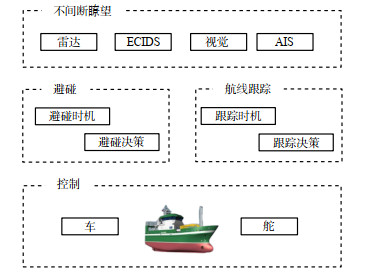
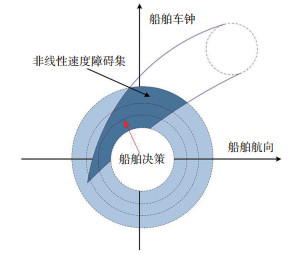
图 3 船舶车舵协调操纵决策框架
Figure 3. Decision-making framework for coordinated operation of ship rudder and telegraph

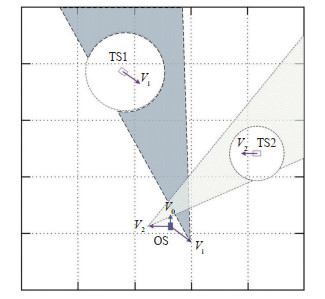
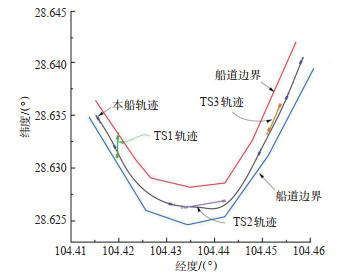
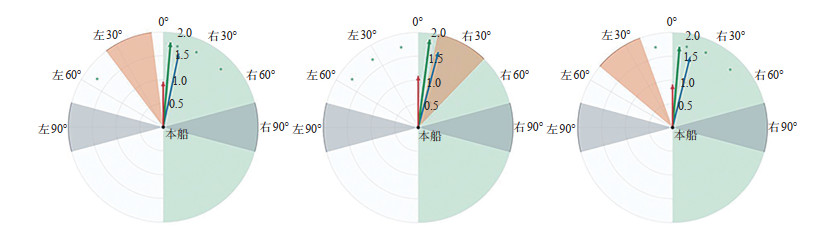
图 10 典型会遇瞬时速度障碍区
Figure 10. Typical instantaneous velocity-obstacle regions at key encounter moments
表 1 本船参数
Table 1. The initial parameters of own ships
参数 数值 参数 数值 船长/m 105.3 排水量/t 97 000 型宽/m 19.23 舵叶面积AR / m2 13.50 吃水/m 6.2 舵高HR /m 5.60 方形系数CB 0.871 5 展弦比λ 2.4 菱形系数CP 0.873 9 桨距DP /m 4.1 正投影面积/ m2 290 螺距P /m 3.5 侧投影面积/ m2 1563 桨叶数Z 4  下载: 导出CSV
表 2 目标船初始参数
Table 2. The initial parameters of target ships
船舶 经度/(°E) 纬度/(°W) 航向/(°) 航速/(n mile/h) 目标船1 104.419 7 28.631 01 003 2.5 目标船2 104.442 0 28.626 91 265 3.2 目标船3 104.451 4 28.633 56 040 4.5
下载: 导出CSV
表 3 船舶计划航线
Table 3. The Planned Route of Ship
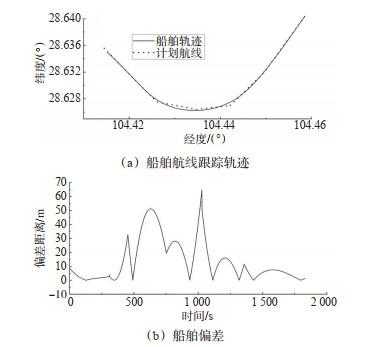
编号 经度(/ °E) 纬度(/ °W) 目标点1 104.414 49 28.635 59 目标点2 104.422 65 28.629 85 目标点3 104.426 16 28.627 53 目标点4 104.434 63 28.626 42 目标点5 104.442 15 28.627 00 目标点6 104.449 55 28.631 90 目标点7 104.458 84 28.640 63
下载: 导出CSV
-
[1] 吴漫, 童思陈, 孙开, 等. 内河航道船舶追越操纵运动数值模拟[J]. 船海工程, 2025, 54(3): 148-154.WU M, TONG S C, SUN K, et al. Numerical simulation of ship overtaking maneuvering motion in inland waterway[J]. Ship & Ocean Engineering, 2025, 54(3): 148-154. (in Chinese) [2] 张笛, 万程鹏, 艾云飞, 等. 船舶航行安全主动控制技术研究及展望[J]. 中国航海, 2025, 48(2): 1-9.ZHANG D, WAN C P, AI Y F, et al. Current research and prospects for the use of active controltechnologies to improve the safety of ship navigation[J]. Navigation of China, 2025, 48 (2): 1-9. (in Chinese) [3] 范爱龙, 严新平, 李忠, 等. 我国航运业绿色低碳发展的需求、路径与展望[J]. 船海工程, 2024, 53(4): 1-5, 12.FAN A L, YAN X P, LI Z, et al. Demand, pathway, and prospects of green and low-carbon development in China' s shipping industry[J]. Ship & Ocean Engineering, 2024, 53(4): 1-5, 12. (in Chinese) [4] HE Y, LIU X, ZHANG K, et al. Dynamic adaptive intelligent navigation decision making method for multi-object situation in open water[J]. Ocean Engineering, 2022, 253: 111238. doi: 10.1016/j.oceaneng.2022.111238 [5] CUI Z, GUAN W, ZHANG X. Gated transformer-based proximal policy optimization for multiple marine autonomous surface ships collision avoidance decision-making strategy[J]. Engineering Applications of Artificial Intelligence, 2025, 156: 111242. doi: 10.1016/j.engappai.2025.111242 [6] 赵兴亚, 贺益雄, 黄立文, 等. 复杂环境下船舶慢速域自主航行决策方法[J]. 华中科技大学学报(自然科学版), 2024, 52 (3): 113-120.ZHAO X Y, HE Y X, HUANG L W, et al. Autonomous navigation decision-making method for ships in slow-speed domain under complex environment[J]. Journal of Huazhong University of Science and Technology(Natural Science Edition), 2024, 52(3): 113-120. (in Chinese) [7] 关巍, 罗文哲, 崔哲闻. 基于深度强化学习的无人驾驶船舶避碰行为决策方法[J]. 大连海事大学学报, 2024, 50(1): 11-19.GUAN W, LUO W Z, CUI Z W. Collision avoidance behavior decision-making of unmanned ship based on deep reinforcement learning[J]. Journal of Dalian Maritime University, 2024, 50(1): 11-19. (in Chinese) [8] XU L P, HUANG L, ZHAO X, et al. Navigational decision-making method for wide inland waterways with traffic separation scheme navigation system[J]. Brodogradnja, 2025, 76(2): 1-23. [9] ZHANG L, CHEN P, LI M, et al. A data-driven approach for ship-bridge collision candidate detection in bridge waterway[J]. Ocean Engineering, 2022, 266: 113137. doi: 10.1016/j.oceaneng.2022.113137 [10] ZHANG B, XU Z, ZHANG J, et al. A warning framework for avoiding vessel-bridge and vessel-vessel collisions based on generative adversarial and dual-task networks[J]. Computer-Aided Civil and Infrastructure Engineering, 2022, 37(5): 629-649. doi: 10.1111/mice.12757 [11] ZHANG J, LIU J, HIRDARIS S, et al. An interpretable knowledge-based decision support method for ship collision avoidance using AIS data[J]. Reliability Engineering & System Safety, 2023, 230: 108919. [12] ZHU Z, WU P, LIU Y, et al. A novel route-plan-guided artificial potential field method for ship collision avoidance: modeling, integration and test[J]. Ocean Engineering, 2023, 288: 116088. doi: 10.1016/j.oceaneng.2023.116088 [13] 贺益雄, 柴露通, 王兵, 等. 特殊规则约束下感潮河段船舶自主航行方法[J]. 交通信息与安全, 2025, 43(4): 86-97. doi: 10.3963/j.jssn.1674-4861.2025.04.009HE Y X, CHAI L T, WANG B, et al. Autonomous navigation method for ships in tidal river sections under special rule constraints[J]. Journal of Transport Information and Safety, 2025, 43(4): 86-97. (in Chinese) doi: 10.3963/j.jssn.1674-4861.2025.04.009 [14] HU Y C, WANG M Y, LIU Y. Ship collision avoidance based on the vulnerability assessment for small vessels in bad weather[J]. IEEE Access, 2023, 11: 39968-39977. doi: 10.1109/ACCESS.2023.3268123 [15] 黄立文, 纪孟阳, 刘进来, 等. 长江弯曲航道船舶航迹控制方法研究[J]. 武汉理工大学学报(交通科学与工程版), 2024, 48(5): 991-998.HUANG L W, JI M Y, LIU J L, et al. Study on ship track control method in the yangtze river curved channel[J]. Journal of Wuhan University of Technology(Transportation Science & Engineering), 2024, 48(5): 991-998. (in Chinese) [16] 范中洲, 严啸, 李锦晓. 连续弯曲航道的船舶碰撞风险评估方法研究[J]. 安全与环境学报, 2023, 23(10): 3429-3437.FAN Z Z, YAN X, LI J X. Study on collision risk assessment method of ship in continuous curved channel[J]. Journal of Safety and Environment. 2023, 23(10): 3429-3437. (in Chinese). [17] ZHANG K, HUANG L, HE Y, et al. A real-time multi-ship collision avoidance decision-making system for autonomous ships considering ship motion uncertainty[J]. Ocean Engineering, 2023, 278: 114205. doi: 10.1016/j.oceaneng.2023.114205 [18] ZHAO X, HUANG L, ZHANG K, et al. Dynamic adaptive decision-making method for autonomous navigation of ships in coastal waters[J]. IEEE Transactions on Intelligent Transportation Systems, 2024, 25(11): 17917-17930. doi: 10.1109/TITS.2024.3419046 [19] 张大朋, 严谨, 赵博文, 等. 基于大涡模拟的大型水面舰船复杂风场数值模拟[J]. 船舶工程, 2023, 45(6): 52-60, 67.ZHANG D P, YAN J, ZHAO B W, et al. Numerical simulation on wind field of large surface warship based on large eddy simulation[J]. Ship Engineering, 2023, 45(6): 52-60, 67. (in Chinese). [20] 杨晓霞. 弯曲航道水流对船舶通航安全的影响[D]. 郑州: 华北水利水电大学, 2022.YANG X X. Influence of water flow in curved channel on navigation safety of ships[D]. Zhengzhou: North China University of Water Resources and Electric Power, 2022. (in Chinese). [21] 韩成浩, 马吉林, 刘佳仑, 等. 基于虚拟仿真测试平台的船舶智能航行系统设计及应用[J]. 中国航海, 2023, 46(1): 148-154.HAN C H, MA J L, LIU J L, et al. Virtual test platform in design and application of intelligent navigation system[J]. Navigation of China, 2023, 46(1): 148-154. (in Chinese) [22] LIU J, HUANG L, YU D, et al. The control method for ship tracking when navigating through narrow and curved sections[J]. Applied Ocean Research, 2024, 145: 103943. doi: 10.1016/j.apor.2024.103943 -

 点击查看大图
计量
- 文章访问数: 10
- HTML全文浏览量: 11
- PDF下载量: 0
- 被引次数: 0