



Research Progress on Corner cases of Autonomous Driving
-
摘要: 当前自动驾驶数据采集存在覆盖范围有限、多样性不足的问题,尤其难以覆盖对系统安全运行至关重要但罕见的Cornercases。针对这一问题,从定义、内在特征、分类方法、描述方法和生成方法5个关键角度进行综述。通过剖析不同研究中对Cornercases的定义与选择标准,从不同任务的角度总结其定义,并与安全关键场景、边缘场景、极端场景、危险场景等相近术语进行对比,明确Cornercases本质是邻近训练数据分布或系统运行经验边界的长尾异常场景,从数据认知、统计概率和行驶安全层面分析其特点,归纳Cornercases在不确定性、罕见性和高风险性3个方面的特点。面向不同的自动驾驶任务需求,从目标检测复杂度、传感器模态和数据融合水平、对象语义属性、风险产生机制、成因、安全风险评估6个维度归纳Cornercases分类方法,讨论各类方法在适用情况、层次划分和任务指向上的差异。为解决场景可理解、可执行的需求,梳理基于结构化表示与特定编程语言的场景描述方法,涵盖PEGASUS分层框架、OpenSCENARIO、Scenic、本体方法等,实现Cornercases由概念转向具体场景的形式化描述。按照生成机理,系统归纳了基于仿真平台、三维场景重建、生成模型、优化搜索和混合生成5类Cornercases生成方法,并对比不同方法的适用情景、优劣和进展情况。从技术与规则2个层面分析了Cornercases带来的挑战,并结合现有技术、标准和法规等总结应对方法及其局限,展望未来研究方向。研究表明:现有Cornercases相关研究仍存在术语界定不统一、生成数据质量评价标准不统一和覆盖率评价缺失等问题。未来,Cornercases研究将转向丰富语义约束、多模态融合和闭环反馈共同驱动的高价值场景生成,以支撑自动驾驶系统训练、测试和安全验证。
-
关键词:
- 自动驾驶安全 /
- Cornercases /
- 自动驾驶场景描述 /
- 自动驾驶数据生成 /
- 自动驾驶测试
Abstract: Autonomous driving data collection currently suffers from limited coverage and insufficient diversity and can hardly capture the rare but safety-critical Corner cases. To address this problem, a comprehensive review of Corner cases is provided from five key perspectives: definition, intrinsic characteristics, classification, description, and generation. Existing definitions and selection criteria are first analyzed, and the definitions adopted in different driving tasks are summarized. Corner cases are compared with similar terms such as safety-critical, edge, extreme, and hazardous scenarios. It is clarified that Corner cases are long-tail anomalies near the boundaries of training data distributions or system operational experience. Viewed from data cognition, statistical probability, and driving safety, Corner cases exhibit uncertainty, rarity, and high risk. According to the requirements of various autonomous driving tasks, Corner cases are categorized along six dimensions. These dimensions cover object detection complexity, sensor modalities and data fusion levels, object semantic attributes, risk generation mechanisms, causes, and safety risk assessment. Differences among these classification methods in applicability, hierarchical division, and task orientation are discussed. To support understandable and executable scenarios, description methods based on structured representations and domain-specific languages are reviewed, including the PEGASUS framework, OpenSCENARIO, Scenic, and ontology approaches. These methods formalize the transition of Corner cases from abstract concepts to concrete scenarios. Based on their underlying mechanisms, generation methods are grouped into five categories: simulation platforms, 3D scene reconstruction, generative models, optimization search, and hybrid approaches. Their applicable scenarios, advantages, disadvantages, and current progress are compared. The technical and regulatory challenges posed by Corner cases are then analyzed. Existing technologies, standards, and regulations are summarized together with the limitations of current countermeasures. The review shows that current research still suffers from inconsistent terminology, non-unified standards for evaluating generation quality, and a lack of coverage assessment. Future work is expected to focus on high-value scenario generation jointly driven by rich semantic constraints, multimodal fusion, and closed-loop feedback. Such scenarios can support the training, testing, and safety verification of autonomous driving systems. -

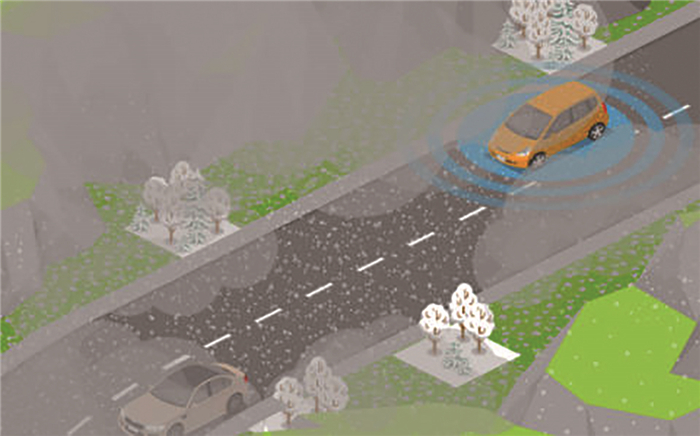
图 3 数据融合技术交通应用于恶劣天气示意图
Figure 3. Case of data fusion technology application under adverse weather conditions
表 1 Corner cases相关的术语及定义统计表
Table 1. Terms and definitions related to Corner cases
术语 定义 参考文献 Corner cases 相关的位置存在自动驾驶系统不可预测的相关对象/类 [8-12] 与任务相关的,导致模型产生高度不确定性的情况 [13-15] 现实世界中发生概率低,现有模型难以准确泛化、存在复杂交互或高安全风险的场景 [10, 16] 安全关键场景/ Safety-Critical Scenario 具有极高概率导致碰撞的高风险交通情境 [3, 5, 6, 21, 22] 具有罕见性与极端性的场景 [5, 17, 23] 边缘场景/Edge scenes/ Boundary scenes 处于运行域内的,逼近系统处理能力边界的场景 [1, 15, 24] 极端场景/Extreme scenes 接近数据边界或超出了常规训练数据的范围的场景 [15, 25] 危险场景 多维度危险因素相互作用,对道路交通安全构成威胁的驾驶场景 [26-27]  下载: 导出CSV
表 3 Corner cases描述方法总结表
Table 3. Methods of Corner cases description
Corner cases描述方法 具体内容 优点 不足 基于结构化表示 PEGASUS 道路层、交通基础设施、临时操作层、对象层、环境层、数字信息六层模型 层次清晰,覆盖物理层与功能层 只是框架,不可直接执行 OpenSCENARIO XML 表现为层次结构,包括文件头、参数声明、目录位置、道路网络、实体、故事板、目录 互操作性强、擅于描述动态场景 静态场景需结合OpenDRIVE 本体方法 通过定义类、属性、关系、规则、实例描述与推理车辆行为 语义丰富、可推理、易于集成 复杂度高、计算成本大 基于特定编程语 Scenic 场景定义包括场景本身以及动态对象随时间变化的行为及其概率分布 高效自动生成、灵活性强 随机性高、难以描述复杂场景 OpenSCENARIO DSL 通过结构化模块、量化参数和声明式约束描述动态行为 人类可读、抽象能力强、行业标准 泛化能力较差
下载: 导出CSV
表 4 Corner cases生成方法总结表
Table 4. Methods of Corner cases generation
Corner cases生成方法 方法介绍 生成方式 具体类别 参考文献 基于仿真平台的方法 基于规则引导,由物理引擎模拟与图形渲染的场景实例化 通过设定道路环境、行为规则、传感器参数和车辆动力学参数等,接入仿真平台构建测试场景 全流程仿真平台 [38-39] 传感器仿真平台 [40-41] 车辆动力学仿真平台 [42-43] 基于三维场景重建的方法 基于真实数据的可编辑三维场景重构与渲染 从多源真实数据中获取环境的三维场景表示,依据设定的视角、轨迹、光照等条件编辑或新视角渲染,构建对应场景 隐式建模 [44-47] 显式建模 [48-51] 生成对抗模型 [52-55] 基于生成模型的方法 基于数据分布学习的样本合成 学习并模拟数据集的潜在概率分布,在文本、布局等条件约束下生成新样本 变分自编码器模型 [56-57] 扩散模型 [58-61] 自回归模型 [62-64] 基于优化生成的方法 基于目标函数与反馈的条件场景生成 将场景生成转化为目标驱动的优化问题,通过目标函数与规则约束,在场景参数空间或行为策略空间中迭代求解,生成诱发系统失效或安全边界的场景 基于采样优化的算法 [19, 65-66] 基于强化学习的算法 [18, 67-69] 混合生成方法 多模态数据、多技术协同的场景生成框架 综合利用世界模型的时序预测与闭环交互能力、语言模型的语义理解能力,多模态数据的互补,提升Corner cases生成的真实性、多样性、可控性等 基于世界模型的技术协同 [20, 64, 70-73] 基于几何与多模态融合 [74-75]
下载: 导出CSV
-
[1] 杜德慧, 叶振, 郑成行, 等. 面向自动驾驶系统的场景建模及边缘关键场景生成[J]. 软件学报, 2025, 36(8): 3512-3530.DU D H, YE Z, ZHENG C X, et al. Scenario modeling and edge-critical scenario generation for autonomous driving system[J]. Journal of Software, 2025, 36(8): 3512-3530. (in Chinese) [2] 孙乐乐, 黄松, 郑长友, 等. GCE3S: 基于进化搜索的自动驾驶安全关键场景生成方法[J]. 计算机科学, 2025, 52(10): 1-13.SUN L L, HUANG S, ZHENG C Y, et al. GCE3S: a method for generating safety-critical scenarios in autonomous driving based on evolutionary search[J]. Computer Science, 2025, 52 (10): 1-13. (in Chinese) [3] ZHANG J, XU C, LI B. ChatScene: knowledge-enabled safety-critical scenario generation for autonomous vehicles[C]. 2024 IEEE/CVF Conference on Computer Vision and Pattern Recognition(CVPR), Seattle, USA: IEEE, 2024. [4] 刘江帆, 张天缘, 钟芳梽, 等. 面向自动驾驶的安全评测数据生成技术综述[J]. 中国图象图形学报, 2025, 30(11): 3413-3437.LIU J F, ZHANG T Y, ZHONG F Z, et al. A survey of safety evaluation data generation techniques for autonomous driving[J]. Journal of Image and Graphics, 2025, 30(11): 3413-3437. (in Chinese) [5] DING W, XU C, ARIEF M, et al. A survey on safety-critical driving scenario generation: a methodological perspective[J]. IEEE Transactions on Intelligent Transportation Systems, 2023, 24(7): 6971-6988. doi: 10.1109/TITS.2023.3259322 [6] 王淳浩, 闭家铭, 阮利, 等. 自动驾驶安全关键场景生成技术综述[J]. 信息与控制, 2024, 53(1): 17-32, 46.WANG C H, BI J M, RUAN L, et al. Survey on automatic driving safety-critical scenario generation technology[J]. Information and Control, 2024, 53(1): 17-32, 46. (in Chinese) [7] BOGDOLL D, BREITENSTEIN J, HEIDECKER F, et al. Description of Corner cases in automated driving: goals and challenges[C]. 2021 IEEE/CVF International Conference on Computer Vision Workshops(ICCVW), Montreal, Canada: IEEE, 2021. [8] BOLTE J A, BAR A, LIPINSKI D, et al. Towards corner case detection for autonomous driving[C]. 2019 IEEE Intelligent Vehicles Symposium(Ⅳ), Paris, France: IEEE, 2019. [9] BREITENSTEIN J, TERMÖHLEN J A, LIPINSKI D, et al. Systematization of Corner cases for visual perception in automated driving[C]. 2020 IEEE Intelligent Vehicles Symposium (Ⅳ), Las Vegas, USA: IEEE, 2020. [10] LI K, CHEN K, WANG H, et al. CODA: a real-world road Corner case dataset for object detection in autonomous driving[C]. 2022 European Conference on Computer Vision(ECCV), Tel Aviv, Israel: Springer, 2022. [11] CHEN R, SHAO W, ZHANG B, et al. JiSAM: alleviate labeling burden and Corner case problems in autonomous driving via minimal real-world data[C]. 2025 IEEE/CVF Conference on Computer Vision and Pattern Recognition (CVPR), Nashville, USA: IEEE, 2025. [12] HEIDECKER F, BREITENSTEIN J, ROSCH K, et al. An application-driven conceptualization of Corner cases for perception in highly automated driving[C]. 2021 IEEE Intelligent Vehicles Symposium(Ⅳ), Nagoya, Japan: IEEE, 2021. [13] ZHOU J, BEYERER J. Corner cases in data-driven automated driving: definitions, properties and solutions[C]. 2023 IEEE Intelligent Vehicles Symposium(Ⅳ), Anchorage, USA: IEEE, 2023. [14] PFEIL J, WIELAND J, MICHALKE T, et al. On why the system makes the Corner case: AI-based holistic anomaly detection for autonomous driving[C]. 2022 IEEE Intelligent Vehicles Symposium(Ⅳ), Aachen, Germany: IEEE, 2022. [15] HEIDECKER F, BIESHAAR M, SICK B. Corner cases in machine learning processes[J]. AI Perspectives & Advances, 2024, 6(1): 1. [16] LU Q, MA M, WANG Z, et al. Realistic Corner case generation for autonomous vehicles with multimodal large language model[J]. Tsinghua Science and Technology, 2026, 31 (3): 1440-1459. doi: 10.26599/TST.2025.9010178 [17] LIU H X, FENG S. Curse of rarity for autonomous vehicles[J]. Nature Communications, 2024, 15(1): 4808. doi: 10.1038/s41467-024-49194-0 [18] DING W, CHEN B, ZHAO D. Learning to collide: an adaptive safety-critical scenarios generating method[C]. 2020 IEEE/RSJ International Conference on Intelligent Robots and Systems(IROS), Las Vegas, USA: IEEE, 2020. [19] TIAN H, JIANG Y, WU G, et al. MOSAT: finding safety violations of autonomous driving systems using multi-objective genetic algorithm[C]. 30th ACM Joint European Software Engineering Conference and Symposium on the Foundations of Software Engineering, Singapore: ACM, 2022. [20] ZHAO G, WANG X, ZHU Z, et al. DriveDreamer-2: LLM-enhanced world models for diverse driving video generation[C]. 39th AAAI Conference on Artificial Intelligence, Philadelphia, USA: AAAI Press, 2025. [21] 吴思宇, 于文浩, 邢星宇, 等. 基于关键场景的预期功能安全双闭环测试验证方法[J]. 汽车工程, 2023, 45(9): 1583-1607.WU S Y, YU W H, XING X Y, et al. Methodology of critical scenarios based dual loop testing and verification for safety of the intended functionality[J]. Automotive Engineering, 2023, 45 (9): 1583-1607. (in Chinese) [22] YANG Y, LU X, ZHANG Z, et al. AuthSim: Toward authentic and effective safety-critical scenario generation for autonomous driving tests[J]. IEEE Transactions on Intelligent Transportation Systems, 2025, 26(10): 16128-16143. doi: 10.1109/TITS.2025.3586608 [23] WU W, HOU X, GAN M, et al. ZPD-guided adversarial learning for safety-critical autonomous driving[J]. Expert Systems with Applications, 2026, 313: 131547. doi: 10.1016/j.eswa.2026.131547 [24] 李江坤, 邓伟文, 任秉韬, 等. 基于场景动力学和强化学习的自动驾驶边缘测试场景生成方法[J]. 汽车工程, 2022, 44 (7): 976-986.LI J K, DENG W W, REN B T, et al. Automatic driving edge scene generation method based on scene dynamics and reinforcement learning[J]. Automotive Engineering, 2022, 44 (7): 976-986. (in Chinese) [25] WANG Y, WU Q, SHI X, et al. SAGA: generating extreme scenarios for autonomous driving via adversarial perturbations[J]. IEEE Transactions on Intelligent Transportation Systems, 2026, 27(3): 3505-3519. doi: 10.1109/TITS.2025.3640578 [26] 陈启蒙, 吴艳, 王丽芳, 等. 危险驾驶场景要素分析[J]. 中国汽车, 2023(7): 31-38.CHEN Q M, WU Y, WANG L F, et al. Analysis of hazardous driving scenario elements[J]. China Auto, 2023(7): 31-38. (in Chinese) [27] 魏鹏, 袁梦. 基于自然驾驶数据的跟车危险场景构建[J]. 中国汽车, 2023(7): 39-44.WEI P, YUAN M. Construction of car following critical scenarios based on natural driving data[J]. China Auto, 2023 (7): 39-44. (in Chinese) [28] SCHICKTANZ C, GIMM K. Detection and analysis of corner case scenarios at a signalized urban intersection[J]. Accident Analysis & Prevention, 2025, 210: 107838. [29] International Organization for Standardization. Road vehicles-safety of the intended functionality: ISO 21448: 2022[S]. Geneva: International Organization for Standardization, 2022. [30] 熊璐, 吴建峰, 邢星宇, 等. 自动驾驶汽车行驶风险评估方法综述[J]. 汽车工程学报, 2024, 14(5): 745-759.XIONG L, WU J F, XING X Y, et al. A survey of driving risk assessment for autonomous vehicles[J]. Chinese Journal of Automotive Engineering, 2024, 14(5): 745-759. (in Chinese) [31] WEBER H, BOCK J, KLIMKE J, et al. A framework for definition of logical scenarios for safety assurance of automated driving[J]. Traffic Injury Prevention, 2019, 20: S65-S70. doi: 10.1080/15389588.2019.1630827 [32] LIN Y, RATZEL M, ALTHOFF M. Automatic traffic scenario conversion from OpenSCENARIO to CommonRoad[C]. 2023 IEEE 26th International Conference on Intelligent Transportation Systems(ITSC), Bilbao, Spain: IEEE, 2023. [33] ARMAND A, FILLIAT D, IBAÑEZ-GUZMAN J. Ontology-based context awareness for driving assistance systems[C]. 2014 IEEE Intelligent Vehicles Symposium Proceedings, Dearborn, USA: IEEE, 2014. [34] 马明月, 苗泽霖, 王韦清, 等. 基于通行规则模型的自动驾驶仿真场景构建研究[J]. 汽车工程, 2025, 47(8): 1437-1447, 1458.MA M Y, MIAO Z L, WANG W Q, et al. Research on construction of autonomous driving simulation scenario based on the traffic rule model[J]. Automotive Engineering, 2025, 47 (8): 1437-1447, 1458. (in Chinese) [35] VISWANADHA K, INDAHENG F, WONG J, et al. Addressing the IEEE AV test challenge with scenic and verifAI[C]. 2021 IEEE International Conference on Artificial Intelligence Testing(AITest), Oxford, U K: IEEE, 2021. [36] INDAHENG F, KIM E, VISWANADHA K, et al. A scenario-based platform for testing autonomous vehicle behavior prediction models in simulation[EB/OL]. (2021-11-14)[2025-12-10]. https://arxiv.org/abs/2110.14870 .[37] BASLAN N, KERSCHL A, SCHMIDT J, et al. Safety and reliability: validation for automated driving functions through scenario-based testing[C]. 2025 IEEE Intelligent Vehicles Symposium(Ⅳ), Cluj-Napoca, Romania: IEEE, 2025. [38] GOYAL S, GRIGGIO A, TONETTA S. System-level simulation-based verification of autonomous driving systems with the VIVAS framework and CARLA simulator[J]. Science of Computer Programming, 2025, 242: 103253. doi: 10.1016/j.scico.2024.103253 [39] IQBAL M, HAN J C, ZHOU Z Q, et al. Metamorphic testing of advanced driver-assistance system(ADAS)simulation platforms: lane keeping assist system(LKAS)case studies[J]. Information and Software Technology, 2023, 155: 107104. doi: 10.1016/j.infsof.2022.107104 [40] JANSEN W, VERREYCKEN E, SCHENCK A, et al. COSYS-AIRSIM: a real-time simulation framework expanded for complex industrial applications[C]. 2023 Annual Modeling and Simulation Conference(ANNSIM), Hamilton, Canada: IEEE, 2023. [41] KAUFMANN D, KLAMPFL L, KLÜCK F, et al. Critical and challenging scenario generation based on automatic action behavior sequence optimization: 2021 IEEE autonomous driving AI test challenge group 108[C]. 2021 IEEE International Conference on Artificial Intelligence Testing (AITest), Oxford, U K: IEEE, 2021. [42] NAN J, GE Z, YE X, et al. Model predictive control for autonomous vehicle path tracking through optimized kinematics[J]. Results in Engineering, 2024, 24: 103123. doi: 10.1016/j.rineng.2024.103123 [43] SUN Y, VELENIS E, KRISHNAKUMAR A. Evaluation of an intuitive 4WD drift assist control concept in a driving simulator[J]. Vehicle System Dynamics, 2025: 1-22. [44] MI Z, XU D. Switch-NeRF: learning scene decomposition with mixture of experts for large-scale neural radiance fields[C]. 2023 International Conference on Learning Representations(ICLR), Kigali, Rwanda: ICLR, 2023. [45] YANG J, IVANOVIC B, LITANY O, et al. EmerNeRF: emergent spatial-temporal scene decomposition via self-supervision[C]. 2024 International Conference on Learning Representations, Vienna, Austria, 2024. [46] WU Z, LIU T, LUO L, et al. MARS: an instance-aware, modular and realistic simulator for autonomous driving[C]. 2023 Third CAAI International Conference on Artificial Intelligence(CICAI), Fuzhou, China: Springer, 2024. [47] LIU J, CHENG H, WANG S, et al. NeRF dynamic scene reconstruction based on motion, semantic information and inpainting[J]. Neurocomputing, 2025, 630: 129653. doi: 10.1016/j.neucom.2025.129653 [48] ZHOU X, LIN Z, SHAN X, et al. DrivingGaussian: composite Gaussian splatting for surrounding dynamic autonomous driving scenes[C]. 2024 IEEE/CVF Conference on Computer Vision and Pattern Recognition(CVPR), Seattle, USA: IEEE, 2024. [49] KHAN M, FAZLALI H, SHARMA D, et al. AutoSplat: constrained Gaussian splatting for autonomous driving scene reconstruction[C]. 2025 IEEE International Conference on Robotics and Automation(ICRA), Atlanta, USA: IEEE, 2025. [50] YAN T, WU D, HAN W, et al. DrivingSphere: building a high-fidelity 4D world for closed-loop simulation[C]. 2025 IEEE/CVF Conference on Computer Vision and Pattern Recognition(CVPR), Nashville, USA: IEEE, 2025. [51] ZHOU J, FAN L, HUANG L, et al. FlexDrive: toward trajectory flexibility in driving scene gaussian splatting reconstruction and rendering[C]. 2025 IEEE/CVF Conference on Computer Vision and Pattern Recognition(CVPR), Nashville, USA: IEEE, 2025. [52] LIU M Y, BREUEL T, KAUTZ J. Unsupervised image-to-image translation networks[C]. 31st International Conference on Neural Information Processing Systems, Red Hook, USA: Curran Associates Inc., 2017. [53] ZHANG M, ZHANG Y, ZHANG L, et al. Deeproad: Gan-based metamorphic testing and input validation framework for autonomous driving systems[C]. 2018 33rd IEEE/ ACM International Conference on Automated Software Engineering(ASE), Montpellier, France: IEEE, 2018. [54] ZHOU R, HUANG H, ZHANG G, et al. Crash-based safety testing of autonomous vehicles: insights from generating safety-critical scenarios based on in-depth crash data[J]. IEEE Transactions on Intelligent Transportation Systems, 2025, 26 (10): 15616-15630. doi: 10.1109/TITS.2025.3591012 [55] YOON J, JARRETT D, VANDERSCHAAR M. Time-series generative adversarial networks[C]. 33rd International Conference on Neural Information Processing Systems, Red Hook, USA: Curran Associates Inc., 2019. [56] WANG Y, ZHANG W, ZHANG D, et al. Research on key scene trajectory generation method based on BLA-VAE[C]. 2024 27th International Conference on Computer Supported Cooperative Work in Design(CSCWD), Tianjin, China: IEEE, 2024. [57] DING W, LIN H, LI B, et al. Semantically adversarial scene generation with explicit knowledge guidance[J]. IEEE Transactions on Intelligent Transportation Systems, 2025, 26(2): 1510-1521. doi: 10.1109/TITS.2024.3510515 [58] ZHONG Z, REMPE D, XU D, et al. Guided conditional diffusion for controllable traffic simulation[C]. 2023 IEEE International Conference on Robotics and Automation (ICRA), London, U K: IEEE, 2023. [59] ZHOU Y, SIMON M, PENG Z, et al. SimGen: simulator-conditioned driving scene generation[C]. 38th International Conference on Neural Information Processing Systems, Red Hook, USA: Curran Associates Inc., 2024. [60] WANG Z, ZENG Y, MA L, et al. DrivePTS: a progressive learning framework with textual and structural enhancement for driving scene generation[C]. 2026 IEEE/CVF Conference on Computer Vision and Pattern Recognition (CVPR), Denver, USA: IEEE, 2026. [61] YU Z, WANG H, YANG J, et al. SGD: street view synthesis with Gaussian splatting and diffusion prior[C]. 2025 IEEE/ CVF Winter Conference on Applications of Computer Vision (WACV), Tucson, USA: IEEE, 2025. [62] MEI J, HU T, YANG X, et al. Dreamforge: motion-aware autoregressive video generation for multi-view driving scenes[EB/OL]. (2025-05-29)[2025-12-10]. https://arxiv.org/abs/2409.04003 .[63] WU Y, ZHANG H, LIN T, et al. Generating multimodal driving scenes via next-scene prediction[C]. 2025 IEEE/CVF Conference on Computer Vision and Pattern Recognition (CVPR), Nashville, USA: IEEE, 2025. [64] YANG X, WEN L, WEI T, et al. Drivearena: a closed-loop generative simulation platform for autonomous driving[C]. 2025 IEEE/CVF International Conference on Computer Vision(ICCV), Honolulu, USA: IEEE, 2025. [65] QIAN C, XU J, XING X, et al. Test case sampling optimization for safety validation of automated driving systems[J]. Nature Communications, 2026, 17. [66] BIAGIOLA M, TONELLA P. Boundary state generation for testing and improvement of autonomous driving systems[J]. IEEE Transactions on Software Engineering, 2024, 50(8): 2040-2053. doi: 10.1109/TSE.2024.3420816 [67] PRIISALU M, PADURARU C, SMICHISESCU C. Varied realistic autonomous vehicle collision scenario generation[C]. 22nd Scandinavian Conference, Sirkka, Finland: Springer, 2023. [68] FENG S, SUN H, YAN X, et al. Dense reinforcement learning for safety validation of autonomous vehicles[J]. Nature, 2023, 615(7953): 620-627. doi: 10.1038/s41586-023-05732-2 [69] CAO Y, IVANOVIC B, XIAO C, et al. Reinforcement learning with human feedback for realistic traffic simulation[C]. 2024 IEEE International Conference on Robotics and Automation(ICRA), Yokohama, Japan: IEEE, 2024. [70] HU X, YIN W, JIA M, et al. DrivingWorld: constructing world model for autonomous driving via video GPT[EB/OL]. (2024-12-30)[2025-12-10]. https://arxiv.org/abs/2412.19505 .[71] LIAO H, WANG B, YANG J, et al. Addressing Corner cases in autonomous driving: a world model-based approach with mixture of experts and LLMs[J]. Transportation Research Part C: Emerging Technologies, 2026, 183: 105456. doi: 10.1016/j.trc.2025.105456 [72] GUAN Y, LIAO H, WANG C, et al. World Model-based end-to-end scene generation for accident anticipation in autonomous driving[J]. Communications Engineering, 2025, 4 (1): 144. doi: 10.1038/s44172-025-00474-7 [73] GAO Z, MU Y, CHEN C, et al. Enhance sample efficiency and robustness of end-to-end urban autonomous driving via semantic masked World Model[J]. IEEE Transactions on Intelligent Transportation Systems, 2024, 25(10): 13067-13079. doi: 10.1109/TITS.2024.3400227 [74] LI X, ZHANG Y, YE X. DrivingDiffusion: Layout-guided multi-view driving scene video generation with latent diffusion model[C]. European Conference on Computer Vision, Milan, Italy: Springer, 2024. [75] GAO R, CHEN K, LI Z, et al. MagicDrive3D: controllable 3D generation for any-view rendering in street scenes[C]. 2026 IEEE/CVF Conference on Computer Vision and Pattern Recognition(CVPR), Denver, USA: IEEE, 2026. [76] JIANG S, HUANG Z, QIAN K, et al. A survey on vision-language-action models for autonomous driving[C]. IEEE/CVF International Conference on Computer Vision, Nashville, USA: IEEE, 2025. [77] ZHANG J, YANG K, WANG Y, et al. ERMVP: communication-efficient and collaboration-robust multi-vehicle perception in challenging environments[C]. 2024 IEEE/CVF Conference on Computer Vision and Pattern Recognition(CVPR), Seattle, USA: IEEE, 2024. [78] CHEN J, ZHONG W, GAO B, et al. Risk occupancy: a new and efficient paradigm through Vehicle-Road-Cloud collaboration[EB/OL].(2024-08-17)[2025-12-10]. https://arxiv.org/abs/2408.07367 .[79] GAO B, LIU J, ZOU H, et al. Vehicle-Road-Cloud collaborative perception framework and key technologies: a review[J]. IEEE Transactions on Intelligent Transportation Systems, 2024, 25 (12): 19295-19318. doi: 10.1109/TITS.2024.3459799 [80] LIN H, LIU Y, WANG L, et al. Big data-driven advancements and future directions in vehicle perception technologies: from autonomous driving to modular buses[J]. IEEE Transactions on Big Data, 2025, 11(3): 1-20. -

 点击查看大图
计量
- 文章访问数: 12
- HTML全文浏览量: 7
- PDF下载量: 0
- 被引次数: 0